Notting Hill's housing stock — what you're working with
Notting Hill occupies the W11 postcode and parts of W10, W2, and W8, within the Royal Borough of Kensington and Chelsea. The dominant residential form is the mid-Victorian stucco-fronted terrace — the wide, cream-rendered houses that line the streets of the Ladbroke estate, running from Ladbroke Grove south to Holland Park Avenue. These are substantial properties: typically four or five storeys including a raised ground floor and basement, with full-height sash windows on the upper floors and wide reception rooms that set the interior at an imposing scale. The window proportions here are among the most generous in London, and the deep plastered reveals create an ideal seat depth for a plantation shutter frame.
The streets around Portobello Road — Colville Terrace, Ledbury Road, Westbourne Park Road, and the crescents and squares that form the Pembridge conservation area — contain a different but equally well-preserved Victorian palette. The painted terraces here are narrower than the Ladbroke estate's grandest villas but share the same architectural vocabulary: multi-pane sash windows, projecting bay fronts at ground and first floor, and the period detailing that plantation shutters were historically used to frame. Our Notting Hill shutters guide covers the borough context in overview; this article goes deeper into how each specific property type determines the correct specification.
The conservation areas of RBKC that cover Notting Hill — the Ladbroke, Pembridge, and Norland conservation areas collectively protect the vast majority of the W11 residential stock — mean that the external appearance of these properties is tightly controlled. Internal shutters are unaffected by this: they sit within window reveals, are not visible from outside, and carry no planning implications. The practical concerns at survey stage are the condition of the reveals — accumulated paint layers in sash boxes, settled frames in 150-year-old masonry, and occasional arched or shaped fanlights above the main sash opening — all of which are measured precisely and accounted for in the fixed written quote.
Why period architecture demands shutters
Notting Hill's Victorian terraces and stucco villas were originally fitted with internal folding shutters as standard — most of the properties on the Ladbroke estate had solid-panel or louvred shutters built into the window reveals when they were constructed between the 1840s and 1870s. Many properties still have the original shutter boxes recessed into the reveals; where those shutters have been removed over the decades, modern plantation shutters restore the architectural intent without affecting the fabric of the building.
The proportional logic of these windows rewards a plantation shutter specifically. Tall sash openings with deep reveals create an interior depth between glass and wall that a roller blind or curtain rod cannot span cleanly; a plantation shutter frame fills that depth and makes the window look finished rather than dressed. The period detailing of these rooms — original cornicing, ceiling roses, picture rails, and joinery painted in period-appropriate whites and off-whites — is complemented by a shutter in a matching or closely related finish. For the broader case for shutters in Victorian and Edwardian properties, see our guide to shutters for Victorian homes.
Notting Hill properties also have a specific street-level privacy challenge. The raised-ground-floor arrangement of most Ladbroke estate houses places the principal reception room windows 1.2–1.5 m above street level, which reduces overlooking but does not eliminate it. On busier streets — Ladbroke Grove itself, Portobello Road, Westbourne Park Road — the combination of foot traffic and the elevated window format means that full privacy requires a covering that can be adjusted in fine increments rather than simply opened or closed. Louvred shutters, where a 15-degree tilt change produces a significant difference in sight-line management, handle this precisely in ways that curtains cannot.
The shutter styles that suit Notting Hill properties
Five configurations cover the large majority of Notting Hill installations. The right choice depends on the floor, the window type, and whether light control or privacy is the primary requirement.
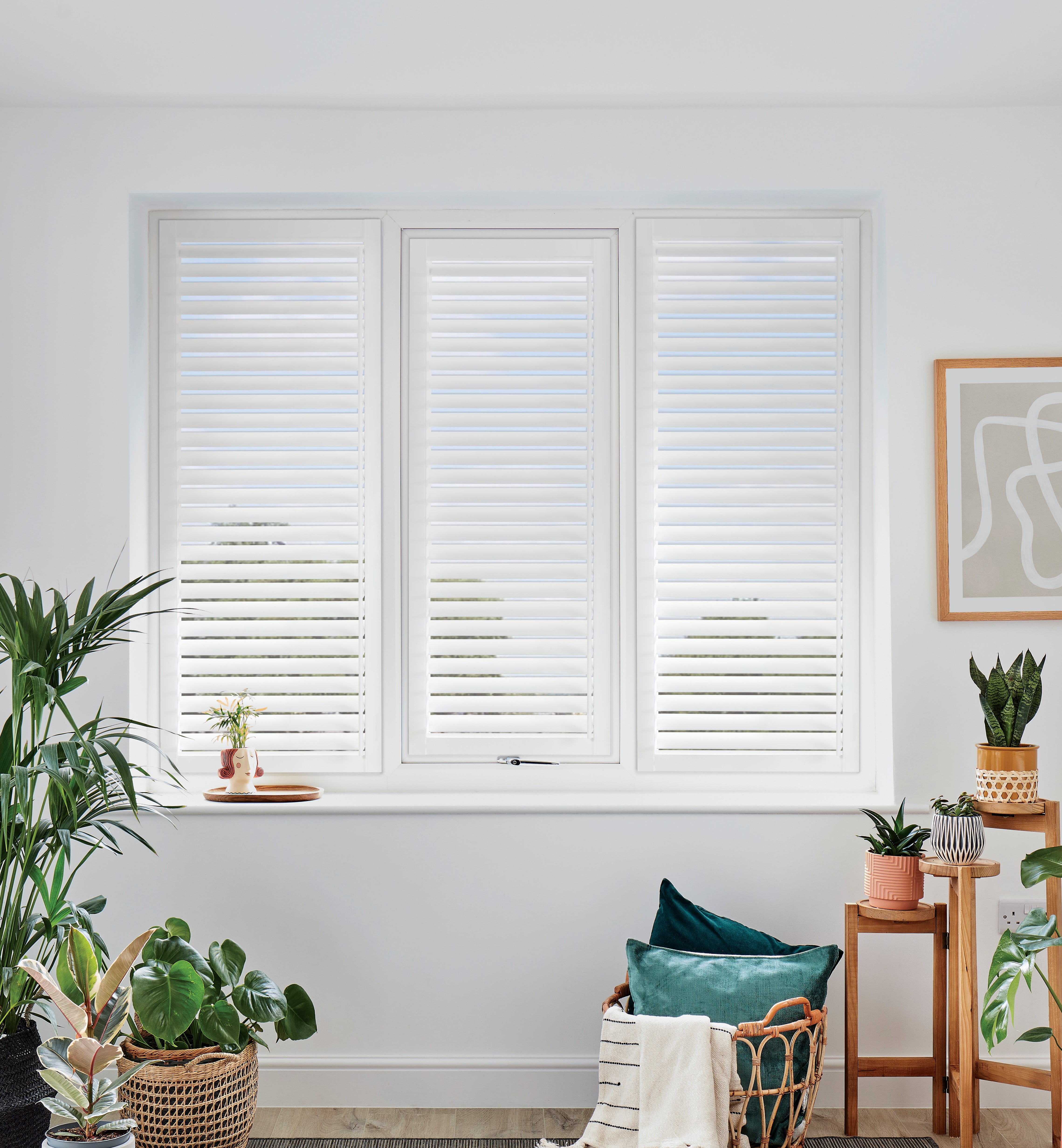
- Full height — the default for Victorian reception rooms, hallways, and master bedrooms throughout W11. A single continuous panel per side runs from the window board to the top of the reveal, with an optional mid-rail for independent louvre tilt above and below. The tall sash windows on the Ladbroke estate terraces and the grander stucco villas of Pembridge are the ideal format for this configuration — a shutter that fills the reveal from floor to head reads as architecturally integral rather than installed. See full-height shutters.
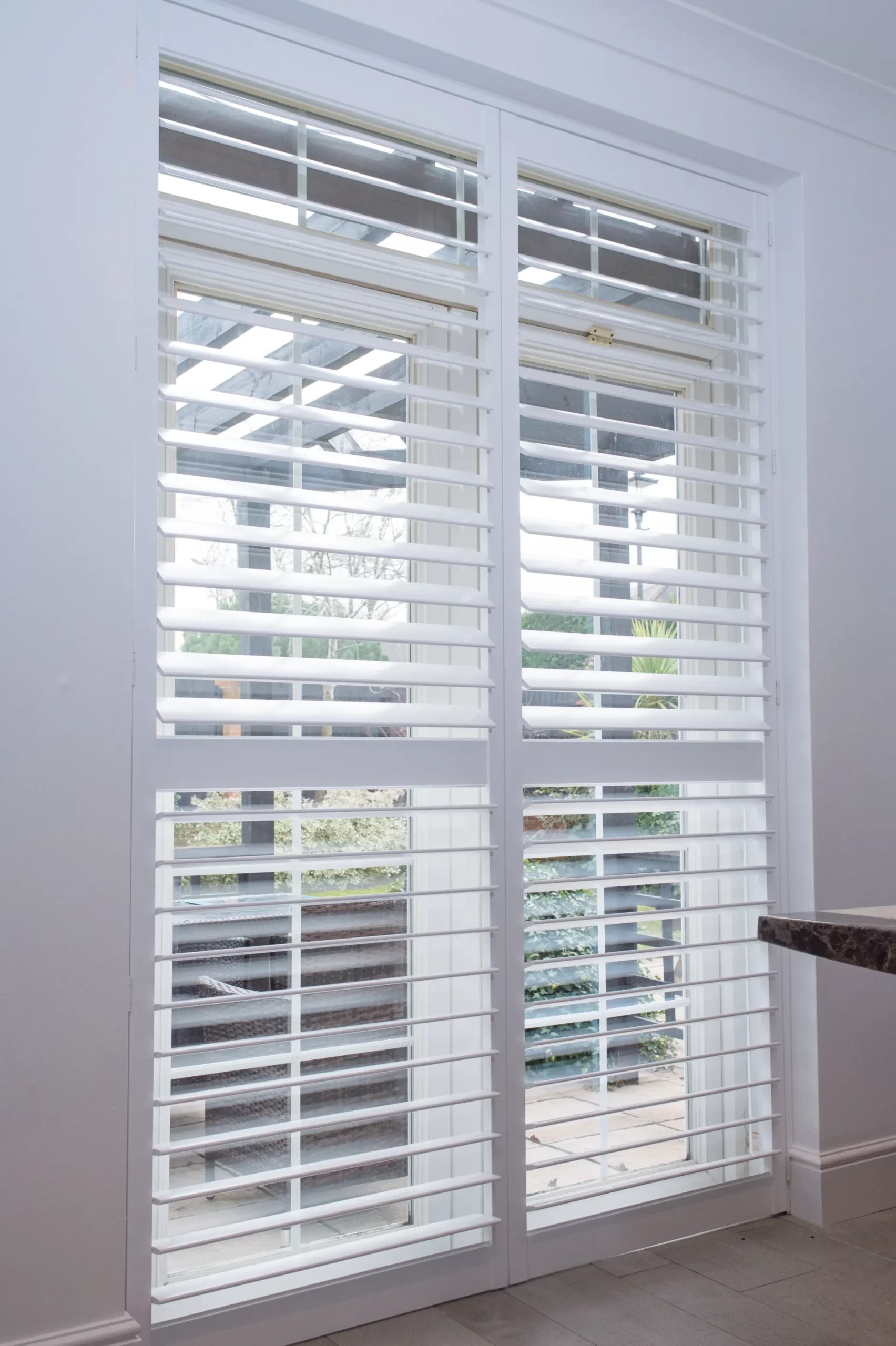
- Tier-on-tier — the right choice for first-floor Notting Hill bedrooms facing directly onto a residential street, and for ground-floor conversion flat rooms where the window sits close to pavement level. Upper and lower panels operate independently: close the lower half for eye-level privacy while the upper half admits daylight from above. For how this style pairs with sash windows, see our sash window shutters guide and tier-on-tier shutters.
- Café style — covers the lower half of the window only, leaving the upper sash open. Works well on the narrower Portobello-area terraces where ground-floor rooms sit very close to the pavement and the priority is eye-level privacy without losing the light from the upper portion of the window. See café style shutters.
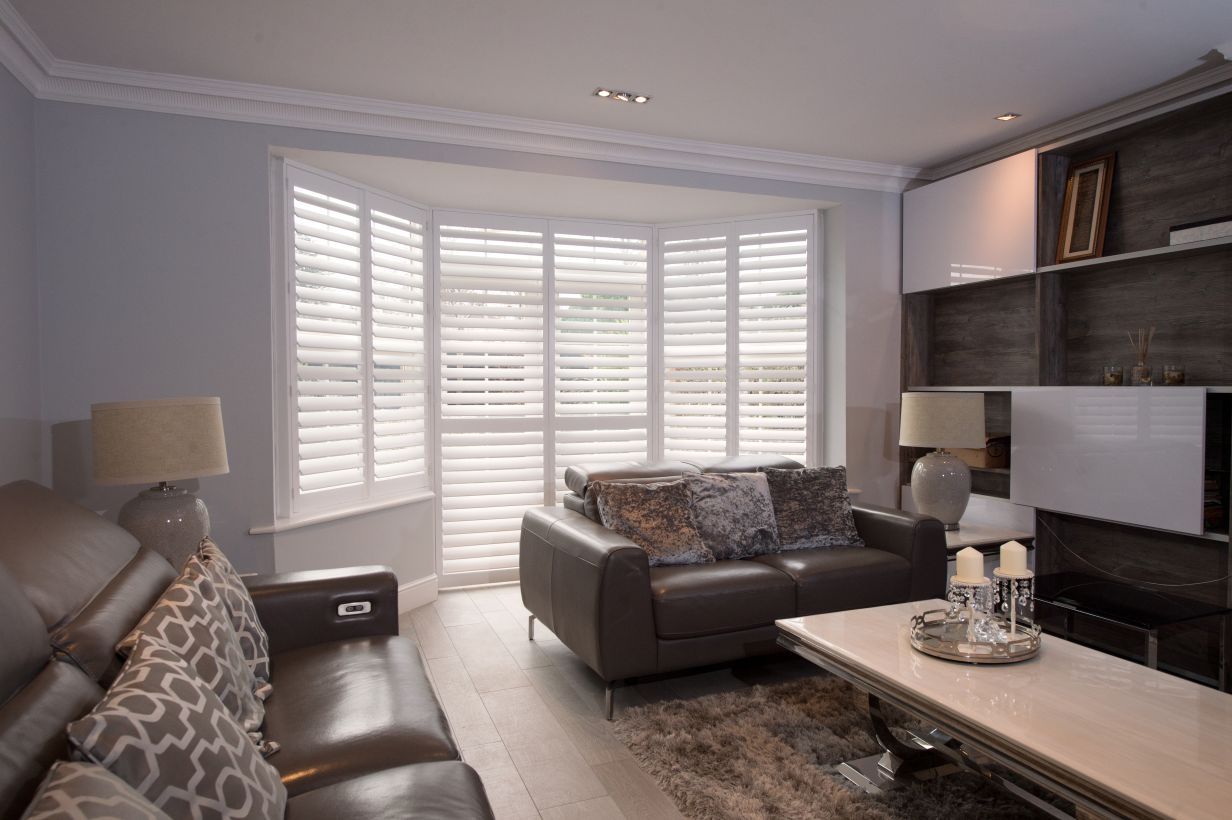
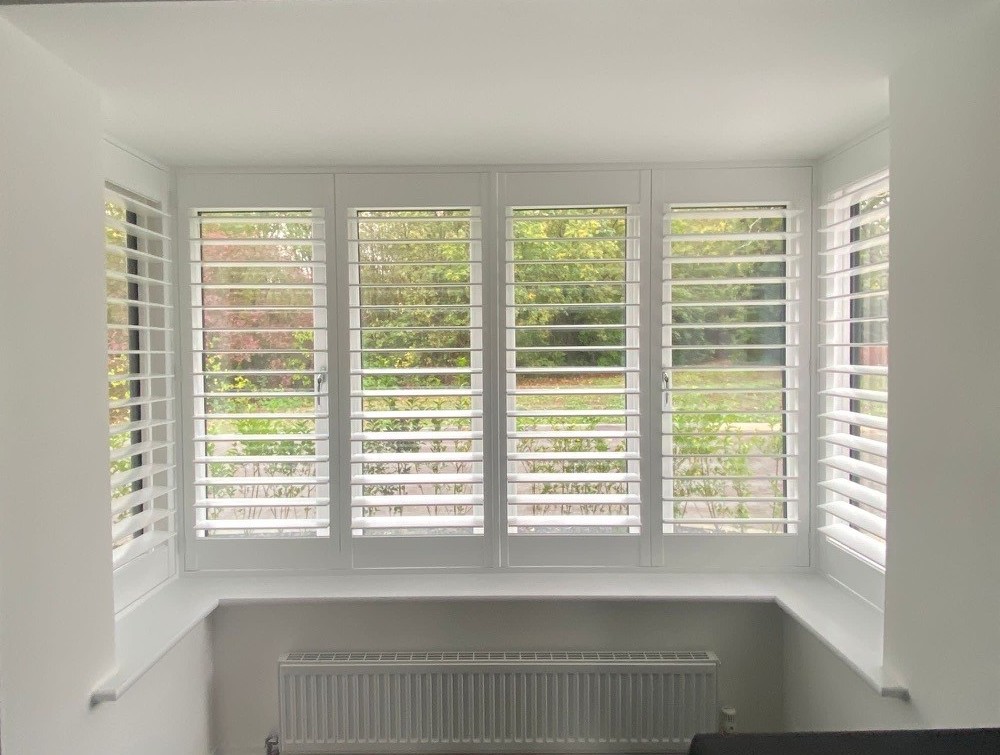
- Bay window shutters — a significant specification for the Victorian and Edwardian terraces with projecting bay fronts throughout W11. Mitred frames at each bay angle produce an architecturally integrated finish. The three-section bays on the Pembridge and Colville area terraces are the typical format. See bay window shutters.
- Shaped shutters — for the arched fanlights and round-head windows found above main sash openings on the grander Ladbroke estate villas and the mid-Victorian stock around Pembridge Square. A shaped panel is templated on-site and built to the exact contour of the opening. See our guide to shaped shutters for arched windows.
Material choices for Notting Hill period properties
Three materials cover the vast majority of Notting Hill installations. The choice depends on the room's purpose, its moisture exposure, and the interior character of the property.
Painted hardwood (Endura) is the primary specification for period reception rooms, hallways, and master bedrooms across W11. Endura hardwood shutters accept a factory paint match to existing skirting boards, architraves, and window surrounds — essential in a Ladbroke estate reception room where the joinery, cornicing, and original fireplaces set a material standard that composite cannot match. Hardwood carries a weight and solidity that reads as architectural in these rooms; the painted finish, colour-matched on-site at survey, makes the shutters appear as though they were always there. For a detailed look at where hardwood is the correct specification, see our Endura hardwood shutters guide.
Composite (Mimeo) is the practical default for Notting Hill kitchens, bathrooms, basement flats, and any room where moisture and steam are everyday conditions. Mimeo composite shutters are fully waterproof, wipe clean with a damp cloth, and run 25–35% less per square metre than hardwood — important when a conversion flat in W11 has five or six windows to cover and cost efficiency is a real constraint. Composite is the unambiguous specification for basement-level rooms where cold walls generate condensation, and for the kitchen extensions that increasingly characterise the larger Ladbroke estate houses.
For how composite and hardwood compare across different scenarios, see our Mimeo composite shutters guide. Aluminium (Dura) is the specification for wide tracked installations — rear kitchen extensions with bi-fold or sliding glazing, and any opening spanning more than 2.5 m that hinged panels cannot cross cleanly. The tracked system runs along a top rail, covering the opening without visible hardware or structural modification.
Realistic 2026 pricing for shutters in Notting Hill
Shutter prices are set by window dimensions and material choice, not by postcode. A Victorian sash window in W11 costs the same to shutter as the equivalent in Fulham or Islington. What adds cost in Notting Hill is complexity: the deep sash-box reveals on the Ladbroke estate stock, bay angles on projecting bay fronts, shaped or arched fanlights above main sash openings, and the wide rear-extension glazing increasingly common in the larger houses.
All figures below are supply-and-fit, covering survey, manufacture, frames, hardware, delivery, and installation.
- Standard flat sash window, composite: from £380 per m² supply and fit
- Standard flat sash window, painted hardwood: from £550 per m² supply and fit
- Typical single sash (approx. 0.9 m × 1.4 m), composite: from £480 total supply and fit
- Bay window (three panes, mitred frame), composite: from £1,250 total supply and fit
- Bay window (three panes, mitred frame), hardwood: from £1,650–£2,200 total supply and fit
- Shaped or arched fanlight above main sash: from £580 per m² supply and fit
- Wide rear-extension opening, tracked aluminium: from £450 per m² supply and fit
- Tier-on-tier configuration: approximately 10–15% above full-height pricing for the same window
Conservation areas in RBKC — what applies to Notting Hill
The Ladbroke, Pembridge, and Norland conservation areas together cover the majority of Notting Hill's residential streets. The Royal Borough of Kensington and Chelsea is one of the most active conservation authorities in London, and homeowners in these areas need planning permission for most external alterations to their properties. The practical position for shutter installations is clear and consistent: internal plantation shutters do not require planning permission anywhere in the Royal Borough. They sit within window reveals, are not visible from the street, and are classified as internal furnishings rather than structural alterations.
For Grade II listed properties — present across the Ladbroke estate, Pembridge Square, and the grander Victorian streets of W11 — internal shutters are almost always acceptable. Fixings typically go into existing wooden window boards or reveal linings rather than original masonry or plasterwork. In practice, approval is not required and not sought for a standard plantation shutter installation in a listed Notting Hill property; where the listed building consent question arises, our surveyors can advise on the precise fixing detail and material choices that align with RBKC's conservation guidance. For a comparable conservation area context, see our Islington terraces shutters guide, covering Georgian and Victorian stock under similarly active conservation oversight.
At survey stage across Notting Hill's older stock, accumulated paint layers in sash boxes — sometimes 20 or 30 coats built up over 150 years — can reduce the usable depth of the reveal. Our surveyors measure every opening with a digital level and account for the as-found condition in the fixed written quote. Out-of-square reveals, settled frames, and the variation that 19th-century construction produces are all standard survey conditions in W11, and none of them presents a problem for a properly measured bespoke shutter.
Getting started — the Notting Hill service
Shutters Factory covers all Notting Hill postcodes — W11, W10, and adjacent W2, W8, and W9 areas — with free home surveys and no call-out charge. Our Notting Hill shutters service page sets out the full coverage area, the typical window scenarios across the W11 stock, and what to expect from the survey visit. Browse the full product range at Shutters Factory products before your survey if you want to arrive with a material preference in mind — hardwood for a period Ladbroke estate reception room, composite for a basement kitchen or first-floor bathroom, aluminium for a wide rear-extension opening.
To see finished installations across different room types and period property styles, explore the shutters gallery. To get a fixed, all-in quote for your Notting Hill property, book a free home survey — we confirm pricing in writing within 48 hours of the visit with no obligation to proceed.