Croydon's housing stock — what you're working with
Croydon covers the CR0, CR2, and CR7 postcodes in the London Borough of Croydon, roughly 10–12 miles south of central London. The residential stock divides into several distinct bands that present different shutter specifications. The streets of Thornton Heath (CR7) and South Norwood are dominated by late-Victorian terraces built in the 1880s and 1890s: two-storey terraced rows with standard sash windows, bay fronts at ground and first floor, and the consistent proportions that make plantation shutters look architecturally correct rather than retrofitted. Our Croydon shutters service page sets out the full coverage area and the range of window scenarios we encounter regularly across the borough.
South Croydon (CR2) and the streets running towards Sanderstead and Purley contain a heavier concentration of Edwardian and interwar semi-detached houses: wider plots, larger windows, and the generous proportions of early 20th-century suburban housing. Many retain original sash windows in good condition, though some have been replaced with uPVC casements — a change that does not affect shutter compatibility, as frames can be fitted into any reveal type. The avenue streets around South Croydon station — Haling Park Road, Welcomes Road, and the roads running south towards the Purley boundary — represent some of the most consistent Edwardian housing stock in south London. For how period homes across London benefit from shutters, see our guide to shutters for Victorian and Edwardian homes.
The third residential category is the townhouse and conversion stock that has grown significantly as part of Croydon's ongoing regeneration. The area around East Croydon station, along George Street and the Dingwall Road corridor, has seen a substantial volume of former commercial and office buildings converted to residential use — producing apartment layouts with non-standard window formats: horizontal glazing bands, floor-to-ceiling glass on upper floors, and wide openings that reflect the building's commercial origins. Purpose-built townhouse developments on the eastern and southern edges of CR0 add a further layer of modern architecture with large-format glazed openings and sliding patio doors at rear-ground level. The adjacent south London context in Wimbledon addresses comparable housing variety — see our Wimbledon period and modern homes shutters guide for reference.
What makes townhouses and conversions different
Townhouses present a shutter specification challenge that single-floor flats and standard terraces do not: the requirement spans multiple floors and multiple room functions simultaneously. A typical Croydon townhouse might have a ground-floor open-plan kitchen and dining room opening to a rear terrace, a mid-level living room facing the street, and bedrooms on the upper two floors — each with different priorities. The rear-ground opening calls for tracked aluminium shutters across wide sliding or bi-fold glazing; the street-facing living room needs tier-on-tier for ground-level privacy; the bedrooms need full-height with reliable louvre closure for sleep. A single material specification rarely covers a whole townhouse optimally, and specifying room by room at survey stage is the standard approach for multi-floor properties.
Conversions in Croydon's town centre present a different set of challenges. Former office buildings converted to residential use often retain a commercial window grid — a horizontal band of glazing spanning the full width of a room, subdivided into narrow fixed and opening lights. These formats are incompatible with a standard hinged shutter panel but work well with a tracked shutter that travels across the full glazing width, or with a café-style installation on the lower portion for street-level privacy. Noise from the East Croydon tram routes, the A232, and the approach roads towards the M25 is also a consistent consideration for conversion apartments facing busy road frontages: a well-fitted shutter frame with a sealed reveal provides meaningful mid-frequency attenuation compared with an unshuttered window. For how tracked shutters handle wide and non-standard glazing formats, see our tracked shutters and bi-fold doors guide.
Shutter styles for Croydon townhouses and conversions
Five configurations cover the large majority of Croydon installations. The right choice depends on the property type, the floor level, and the primary requirement — privacy, blackout, or light control.
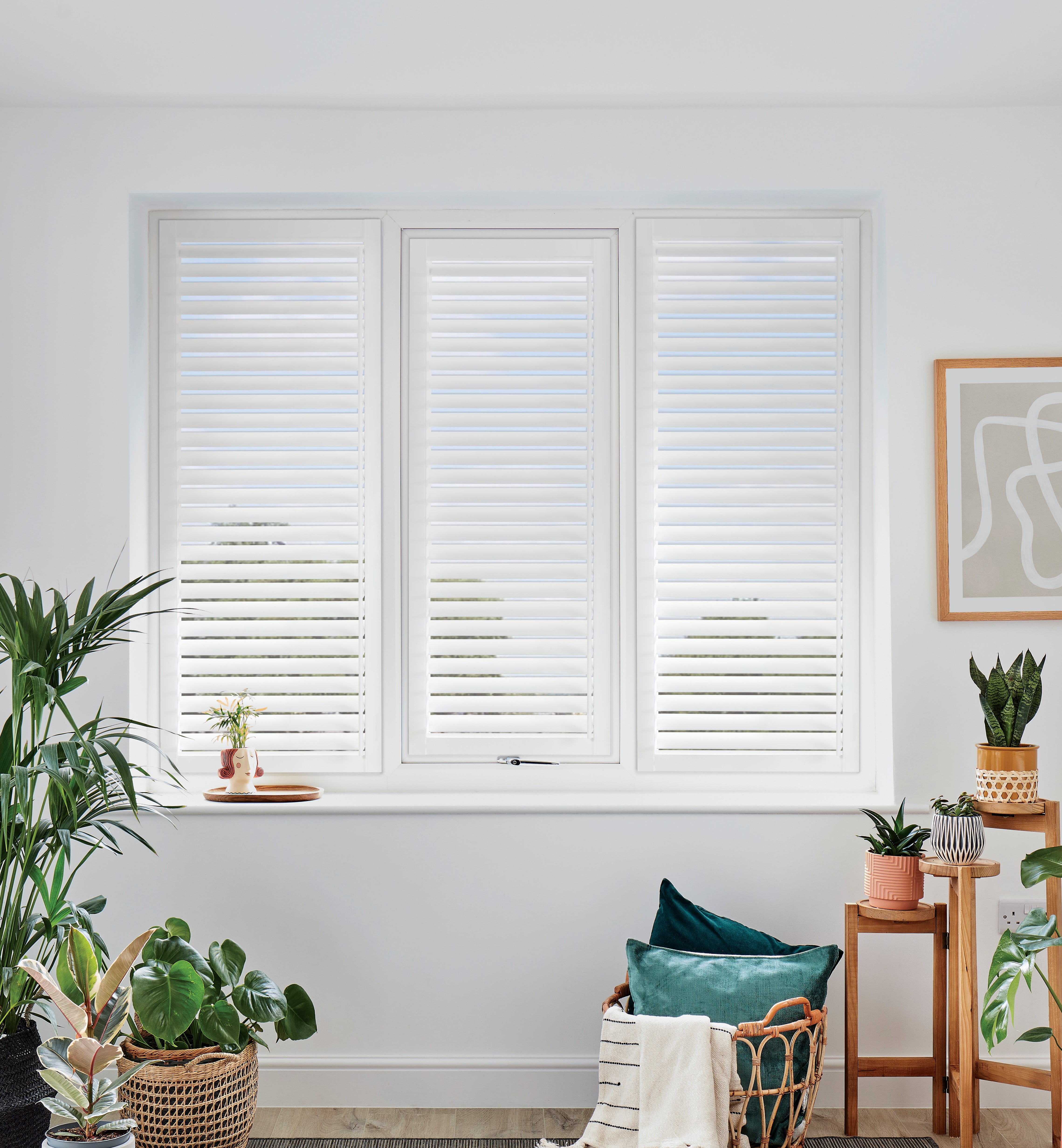
- Full height — the standard specification for period reception rooms, hallways, and bedrooms in Victorian and Edwardian CR2 and CR7 properties. A single continuous panel runs from window board to head of reveal, with a mid-rail option for independent upper and lower louvre control. See full-height shutters.
- Tier-on-tier — the right choice for ground-floor rooms in South Norwood and Thornton Heath terraces where eye-level privacy from the street is the priority. Upper and lower panels operate independently: close the lower half for privacy while the upper half continues to admit daylight. Works equally well in Edwardian semis with front gardens on South Croydon roads. See tier-on-tier shutters.
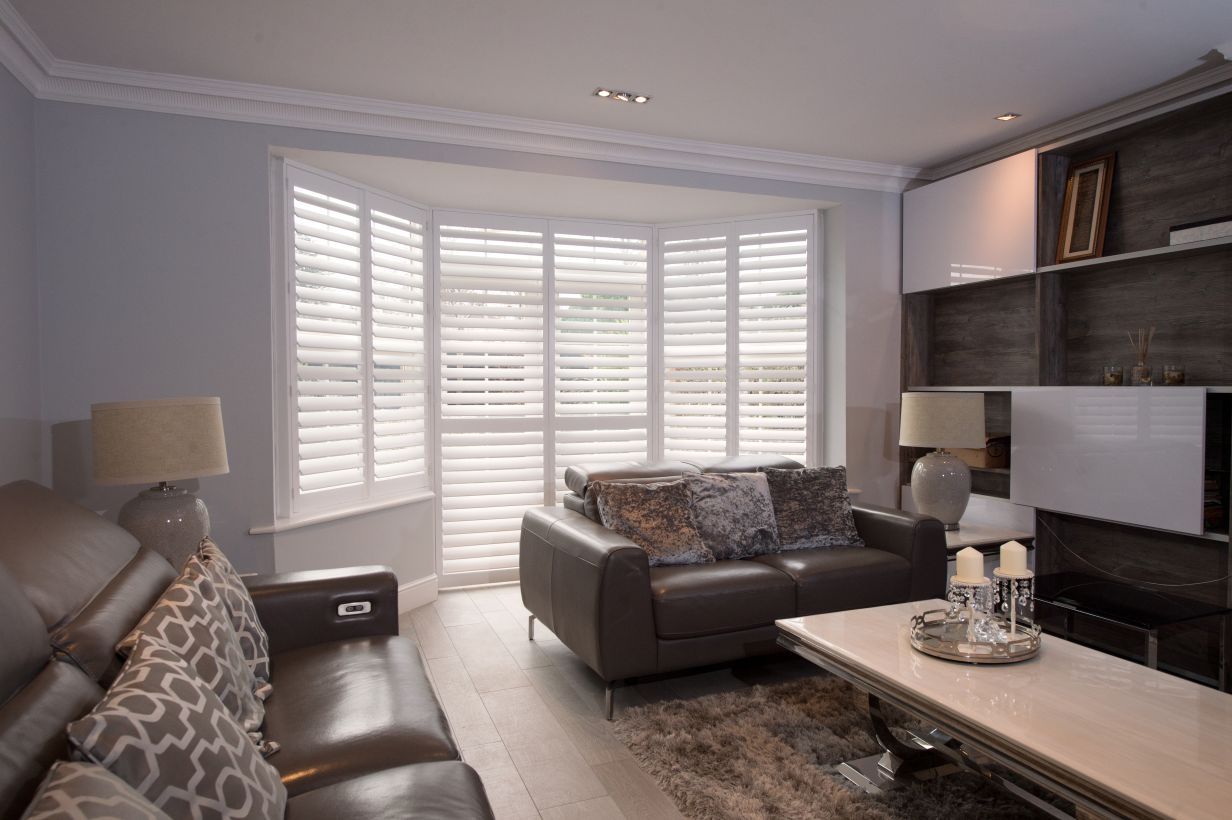
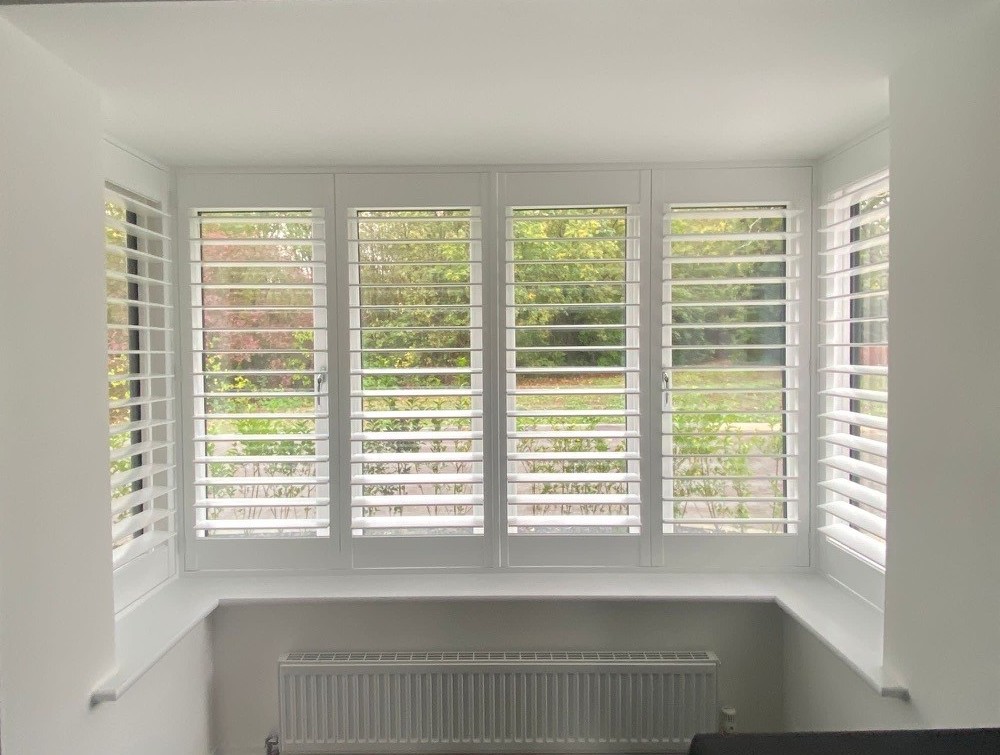
- Bay window shutters — essential for the projecting bay fronts common on Victorian CR7 terraces and Edwardian CR2 semis. Mitred frames at each bay angle produce a continuous, architecturally integrated result. The three-section bay is the most common Croydon format. See bay window shutters.
- Café style — covers the lower half of the window only, leaving the upper sash open for daylight and ventilation. Works well in Victorian kitchen and dining rooms where the window sits close to pavement level, providing effective street-level privacy without reducing upper-floor light. See café style shutters.
- Tracked shutters — the correct solution for conversion apartments and townhouse rear extensions with wide bi-fold or sliding glazing. Panels travel horizontally on a top-mounted head rail, covering any opening span that hinged panels cannot reach. See our tracked shutters guide for the full specification detail.
Material choices for Croydon properties
Three materials cover the full range of Croydon properties. The right choice is determined by room function, window format, and the architectural character of the property — not by price alone.
Painted hardwood (Endura) is the primary specification for period reception rooms, hallways, and master bedrooms in the Victorian and Edwardian stock of CR2 and CR7. Endura hardwood shutters accept a factory paint match to existing skirting boards, architraves, and original joinery — essential in a South Croydon Edwardian semi where the period character of the interior is the baseline that window treatments need to respect. The weight and solidity of a hardwood panel reads as architecturally correct in these rooms in a way that composite cannot replicate. For the detailed case for hardwood in period interiors, see our Endura hardwood range guide.
Composite (Mimeo) is the practical default for kitchens, bathrooms, children's bedrooms, and any room across a Croydon townhouse where wipe-clean durability is a daily requirement. Mimeo composite shutters are fully waterproof, wipe clean with a damp cloth, and run 25–35% less per square metre than hardwood — an important consideration when fitting shutters across all floors of a townhouse simultaneously. For a detailed comparison of where composite outperforms hardwood, see our Mimeo composite shutters guide. Aluminium (Dura) is the specification for wide tracked installations in conversion apartments and townhouse rear extensions. The Dura aluminium shutter covers any opening span on a top-mounted head rail without structural modification, and is the only material that reliably handles the full-width glazing of a commercial-to-residential conversion.
Realistic 2026 pricing for Croydon
Shutter prices are set by window dimensions and material choice, not by postcode. A Victorian sash window in CR7 costs the same to shutter as the equivalent in Wimbledon or Wandsworth. What adds cost in Croydon is complexity: bay angles on Victorian bay fronts, wide tracked openings in conversion apartments, and non-standard reveal depths in commercial-to-residential conversions requiring bespoke frame solutions. For a comprehensive national breakdown of shutter pricing, see our UK shutter prices guide for 2026.
All figures below are supply-and-fit, covering survey, manufacture, frames, hardware, delivery, and installation.
- Standard flat sash window, composite: from £380 per m² supply and fit
- Standard flat sash window, painted hardwood: from £550 per m² supply and fit
- Typical single sash (approx. 0.9 m × 1.4 m), composite: from £480 total supply and fit
- Bay window (three panes, mitred frame), composite: from £1,250 total supply and fit
- Bay window (three panes, mitred frame), hardwood: from £1,650–£2,200 total supply and fit
- Wide tracked conversion opening, aluminium: from £450 per m² supply and fit
- Tier-on-tier configuration: approximately 10–15% above full-height pricing for the same window
Conservation areas and listed buildings in Croydon
The London Borough of Croydon administers a number of conservation areas across the borough. The Old Town conservation area protects the historic core around Croydon Minster, Church Street, and the medieval street pattern to the south of the High Street — an area containing some of the oldest surviving buildings in the borough, including several Grade II listed structures. The South Norwood conservation area covers the Victorian commercial and residential development around South Norwood Hill and Portland Road. Addington Village, to the south-east of the borough, is a further designated conservation area protecting a rural character distinct from the urban parts of CR0.
For plantation shutters, the practical position across all Croydon conservation areas is consistent with London-wide planning practice: internal shutters do not require planning permission anywhere in the London Borough of Croydon. They sit within window reveals, are not visible from the street as an external alteration, and are classified as internal furnishings rather than works affecting the external appearance of a listed building or conservation area. For Grade II listed properties within the Old Town conservation area or elsewhere in the borough, internal shutters are almost always accepted without objection, with fixings going into window boards and reveal linings rather than original masonry or historic plasterwork.
At survey stage in Croydon's period stock, common complications include accumulated paint layers reducing reveal depth in Victorian sash boxes, structural movement in the older CR7 terraces affecting frame squareness, and non-standard reveal depths in commercial-to-residential conversions. Our surveyors measure every opening precisely under as-found conditions, and all findings are accounted for in the fixed written quote. For the equivalent south London conservation area context nearby, see our Wimbledon period homes shutters guide; for Croydon-specific shutter history and installation patterns, see our Croydon south London shutters guide.
Getting started — the Croydon service
Shutters Factory covers all Croydon postcodes — CR0, CR2, CR7, and the adjacent SE25, SE19, and SM areas — with free home surveys and no call-out charge. Our Croydon shutters service page sets out the full coverage area and what to expect from the survey visit. Browse the full product range at Shutters Factory products before your survey if you want to arrive with a material preference in mind.
To see finished installations across different Croydon property types and room styles, explore the shutters gallery. To get a fixed, all-in written quote for your Croydon townhouse or conversion, book a free home survey — we confirm pricing within 48 hours of the visit, with no obligation to proceed.