What each style is and how it works
Note: we also have an established in-depth comparison of these two styles — read Tier-on-Tier vs Full Height Shutters: Which Is Right for You? for the full decision framework.
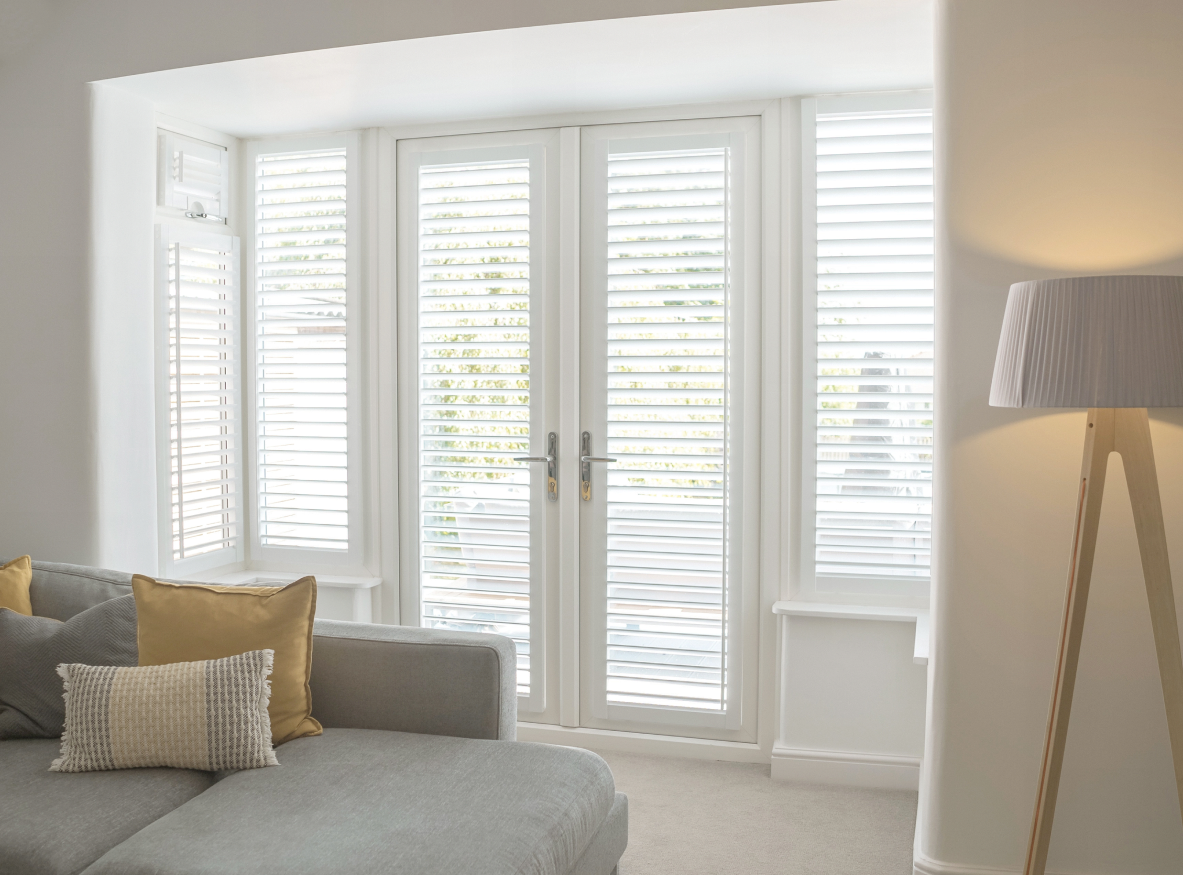
Full-height shutters span the entire window opening from top rail to bottom rail as a single set of hinged panels. The louvres run continuously the full height of each panel, operated by a single tilt rod. Adjusting the louvre angle changes the whole panel uniformly; folding the panels back opens the entire window at once. This simplicity is both the style's greatest strength and its only real constraint: the top louvres and bottom louvres on the same panel always move together.
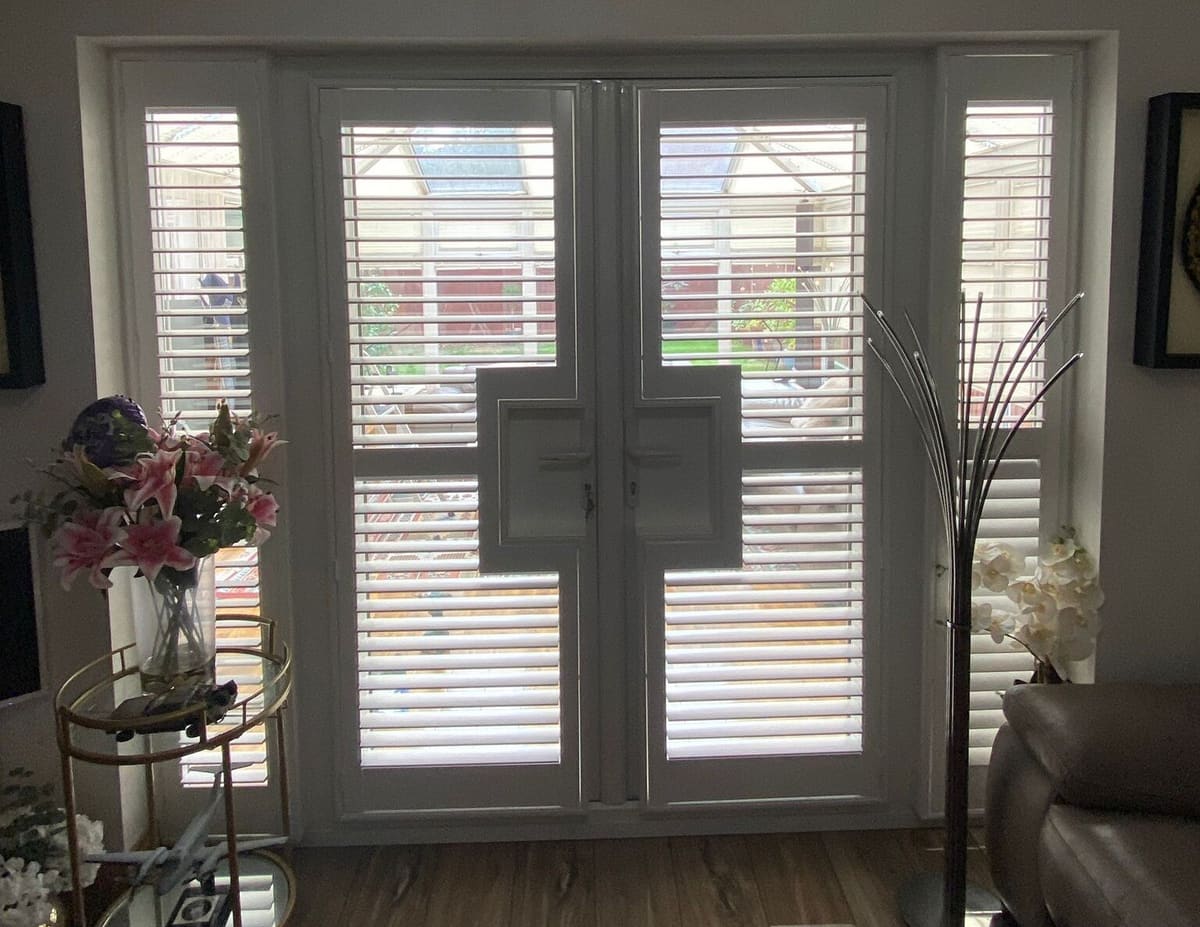
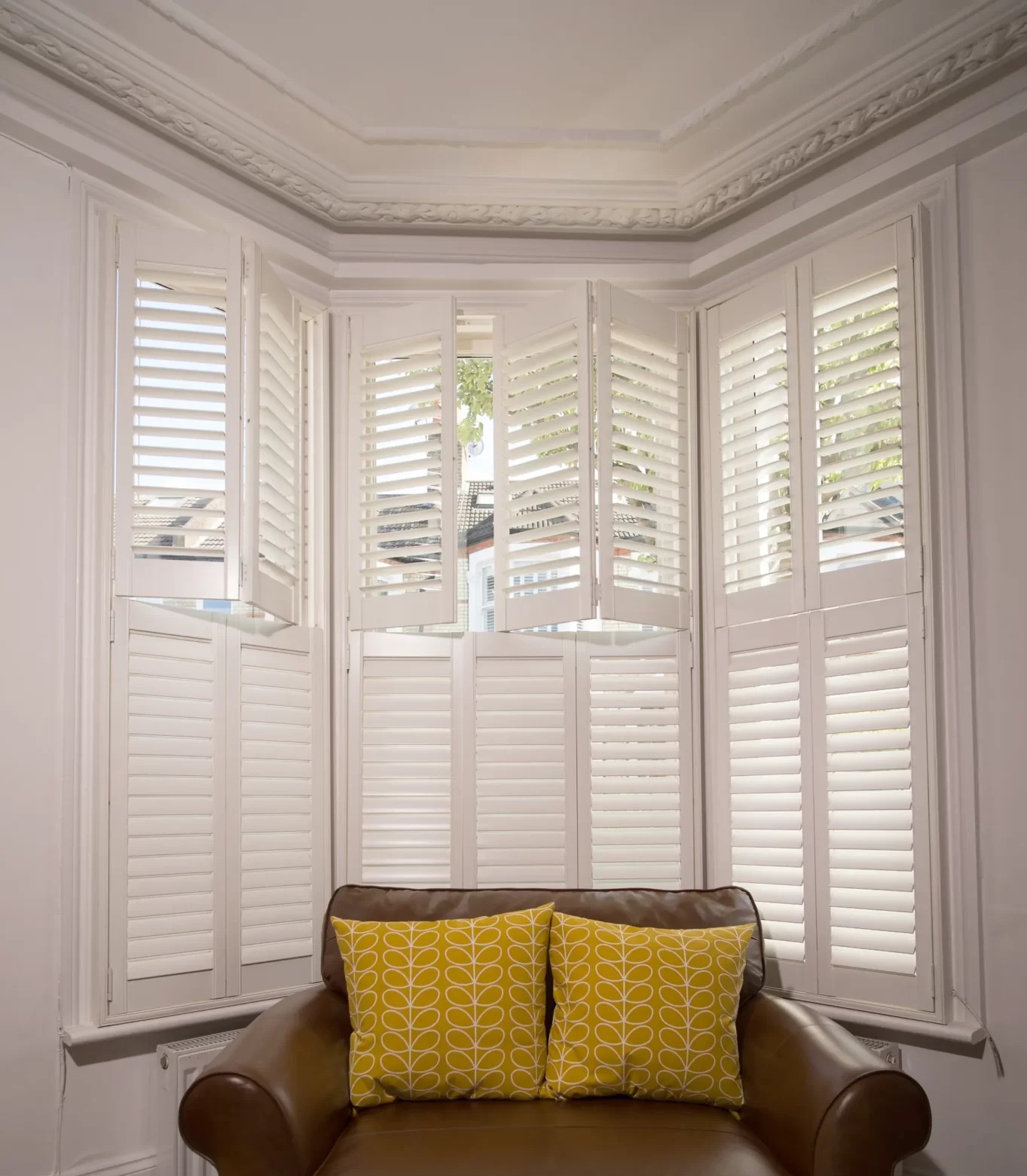
Tier-on-tier shutters divide the window into two independent sections — an upper tier and a lower tier — each with its own set of panels and its own tilt rod. The split typically falls at or near the midpoint of the window, though the exact position is specified to suit the window and the room. The upper and lower sections operate completely independently: the lower panels can be closed for ground-floor privacy while the upper panels are angled open to admit daylight, or both tiers can be set to different louvre angles to direct diffused light toward the ceiling. This independence is the defining advantage of the tier-on-tier format.
Full-height shutters: clean simplicity for most windows
For the majority of UK domestic windows — standard casements, picture windows, modern tilt-and-turn openings, and flat contemporary windows of any proportion — full-height shutters are the right default and the most popular style. Our article on why full-height shutters are the most popular style covers the reasons in detail, but the core one is visual: with no horizontal rail dividing the window, the panels present an uninterrupted vertical surface that reads as part of the architecture rather than applied on top of it.
For rooms used for a single activity — living rooms, dining rooms, home offices — the simplicity of a single-tier louvre system matches daily use precisely. When you want the room fully lit, fold the panels back. When you want privacy with diffused light, tilt the louvres. There is no need to manage two independent sections. Mimeo composite shutters in the full-height format are the most commonly specified configuration across UK homes — waterproof, low-maintenance, and available from around £350 per m² supply and fit.
Tier-on-tier shutters: the case for independent control
Where tier-on-tier genuinely outperforms full-height is in tall windows that face a street or pavement at ground level, where privacy pressure is high and the window is tall enough to benefit from dividing into two functional zones. The classic UK example is the Victorian sash window: tall, double-hung, typically 1,200mm to 1,800mm high, set in a terrace where the pavement is just a metre or two from the glazing.
With the lower tier closed and the upper tier open, you have full privacy at eye level and full daylight from above simultaneously — a combination that full-height shutters cannot match without either darkening the room entirely or sacrificing privacy. Our detailed guide to tier-on-tier shutters for sash windows explores the configuration options in depth, including louvre size choice and split-rail positioning. The sash window shutters guide also covers which styles work best with the UK's most common period window type.
The Victorian sash window: why tier-on-tier is often the right answer
London's Victorian and Edwardian housing stock has hundreds of thousands of tall sash windows, and these are the single most common context in which tier-on-tier shutters are specified. The reason goes beyond privacy: the window already divides into two halves. A traditional sash window has an upper sash and a lower sash that slide vertically. This geometry maps directly onto the upper and lower tiers of a tier-on-tier shutter, with the horizontal split rail falling at approximately the meeting rail of the sashes. The result is a shutter that looks designed for the window — because architecturally, the split corresponds to the window's existing structure.
Full-height shutters on a tall narrow sash can look panel-heavy if the window is under 800mm wide. A single pair of panels from sill to head on a 750mm-wide, 1,600mm-tall window creates proportions that some homeowners find less comfortable than the balanced two-tier format. Where a mid-rail is added to a full-height specification for structural support on taller panels, the aesthetic and functional gap between full-height-with-mid-rail and tier-on-tier narrows considerably. Our guide to shutters for Victorian homes covers how the choice plays out across different window proportions in period properties. Tier-on-tier shutters in white-painted hardwood — matched to the window frame and surrounding woodwork — are the most period-appropriate specification for a traditional sash in a conservation setting.
When full-height wins: modern homes, bay windows, and private aspects
Full-height shutters are the stronger choice in several common scenarios. Modern casement and tilt-and-turn windows — the standard in new builds and post-1990s properties — rarely have the street-level privacy profile that justifies tier-on-tier. A casement set 900mm above floor level in a living room has no ground-level sightline problem; full-height shutters are simpler, slightly less expensive, and visually cleaner.
Bay window shutters in Victorian and Edwardian homes also generally read best in full-height format. Each panel folds neatly into the bay reveal without the visual interruption of a mid-panel split rail, and the continuous louvre line across all three or five lights gives the bay a strong, unified character. For bedroom windows facing a garden or rear aspect, first-floor windows, and any window where street privacy is not a concern, full-height is almost always the simpler and more cost-effective answer. Consider pairing full-height shutters with 64mm louvres for most standard windows — our louvre size guide explains why 64mm is the most versatile specification for light control and aesthetics.
Price and lead times: what to expect for both styles
For supply and fit in the UK, full-height shutters start from around £350 per m² for Mimeo composite shutters, rising to £500–£620 per m² for Endura hardwood shutters. Tier-on-tier shutters carry a modest premium — typically 8–15% above full-height on the same product — due to the additional split-rail frame components, the doubled panel-hinging hardware, and the independent tilt-rod mechanism on each section. On a typical double sash window of approximately 0.9m², that premium translates to roughly £45–£80 more than the equivalent full-height specification. For a window where tier-on-tier genuinely improves daily use, that difference is usually straightforward to justify.
Lead times are the same regardless of style: 4–6 weeks for composite shutters and 6–8 weeks for hardwood ranges. Both styles are manufactured to exact millimetre dimensions confirmed at the home survey, and both include professional installation with all hardware, fixings, and a final quality check on the day.
Making your decision: seeing both styles in your space
The quickest way to decide between the two styles is to assess the window in context. Ask two questions: is the window tall enough that the lower and upper halves serve genuinely different functions? And is there a street-level sightline that makes independent lower-panel privacy worthwhile? If both answers are yes — typically a ground-floor or raised-ground-floor sash window in a period terrace — tier-on-tier is likely the right specification. If either answer is no, full-height almost certainly delivers a cleaner and more cost-effective result.
Browse finished examples of both styles in the shutters gallery, including installations in Victorian sash windows, modern casements, and bay windows, to calibrate your eye before the survey visit. When you book a free home survey, the surveyor will assess every window, bring physical samples of both styles, and give you a direct price comparison so you can see the difference before committing to either.