Manufacturer versus reseller: a practical distinction
Most window covering companies in the UK do not make their own products. A typical reseller selects from a catalogue of imported shutters — usually produced in large-volume factories in Southeast Asia — applies a brand, and coordinates installation. The quality of the product is determined entirely by whoever runs the origin factory; the reseller can inspect, reject, or accept what arrives, but cannot influence how it was made, the tolerances maintained on the production line, or the moisture content of the timber when it was processed.
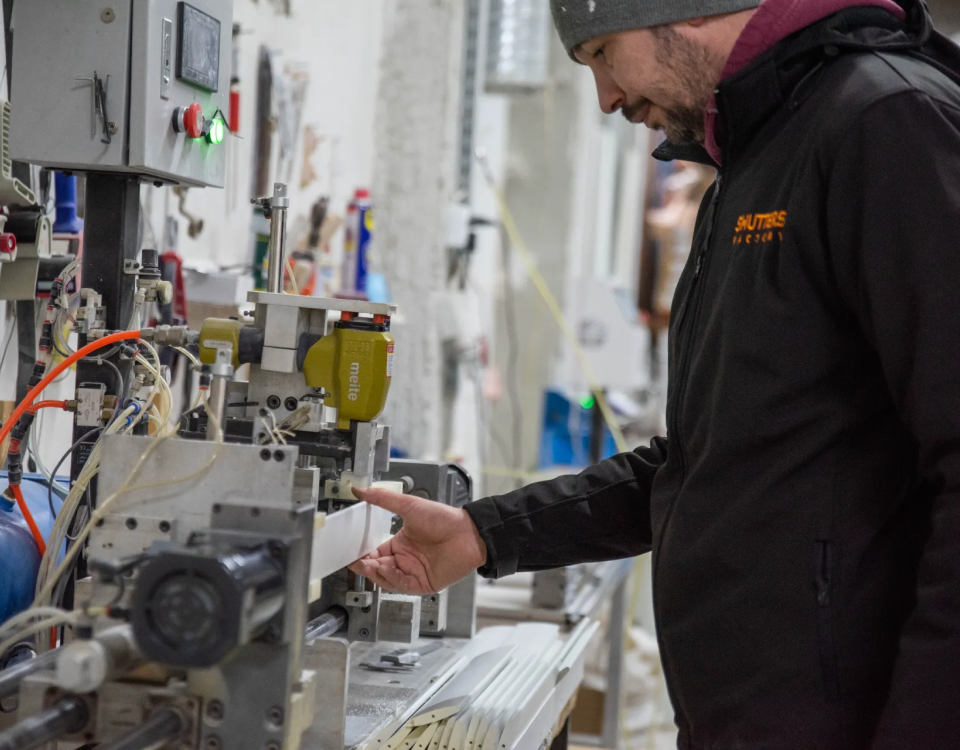
At Shutters Factory, the model is structurally different. We operate our own manufacturing facility, where every shutter panel is produced to specification — timber is selected and prepared in-house, profiles are cut and assembled under quality supervision, and the finished product is checked against specification before it leaves the factory. This is not a semantic marketing claim; the practical consequences affect every stage of the customer experience, from the initial consultation through to the decade-long performance of the installed shutter in your home.
Why louvre tolerances matter — and how we control them
A plantation shutter is a mechanically precise product. The louvres — the horizontal slats that rotate to control light and privacy — are typically 47mm, 64mm, or 89mm wide, and they pivot on a rod or pin mechanism set into the stile. For a louvre to open and close smoothly without racking, binding, or sagging after years of regular use, the tolerances across that mechanism need to be consistent: pin diameter, bore hole, stile wall thickness, and panel width must align within fractions of a millimetre across the full height of the panel.
When shutters are produced at volume in a factory the reseller does not control, those tolerances are set by whoever runs that production line on any given week. When they are produced in a facility our team supervises directly, the tolerances are ours to set and enforce. The practical outcome is visible in the quality of our Mimeo composite shutters — the louvre action is consistent across the full size range from a 450mm bathroom window panel to an 1,800mm-wide living room bay — and in the Endura hardwood range, where panel width and louvre alignment are checked against specification before each order leaves the factory floor.
Material selection and the timber supply chain
One of the less visible advantages of manufacturing in-house is control over the raw material supply chain. For a hardwood shutter to perform reliably over years — to resist cupping, hold a painted or stained finish consistently, and remain dimensionally stable in a centrally heated UK home — the timber used in production needs to arrive with an appropriate and consistent moisture content. Wood that is over-dried will absorb moisture from a warm interior and expand; wood that is under-dried will shrink as the room dries it further. Either condition causes louvres to bind, panels to cup, and joints to crack over time.
For a reseller accepting an imported product, the moisture content of the timber is whatever the origin factory processed it to. For a manufacturer with direct oversight of the production process, moisture content is a variable that can be checked and managed at source. This is why products across our range — from lightweight Strato paulownia shutters to Dura powder-coated aluminium shutters — carry consistent physical properties within each material category: we know what went into them because we specified it from the beginning of the production process.
Lead times and the direct manufacturing model
The supply chain for an imported reseller typically runs: overseas factory — shipping container — UK port — customs clearance — warehouse — picking — delivery — installation. Delays compound at every stage, and critically, the reseller has no direct visibility of where in that chain a delay has occurred until it surfaces at the UK end. A customer waiting for shutters that have not yet left the origin port has no way of knowing this until it is too late to adjust expectations.
Our direct manufacturing model removes the longest and least controllable leg of that chain. Production is supervised by people in the same organisation as the installation team, which means delays in the production schedule are visible, communicable, and manageable rather than reported retroactively when a container is overdue. This translates to lead time commitments we can make with confidence: four to six weeks from confirmed order to installation for composite shutters, and six to eight weeks for hardwood — timelines that reflect a production schedule we have direct sight of. Our analysis of what plantation shutters are worth and how the process is structured covers the survey-to-fitting timeline from the customer's perspective.
Accountability after installation: the long-term case
The accountability question becomes clearest in the post-installation period, and it is the area where the difference between a manufacturer and a reseller is most consequential. If a louvre cracks two years after fitting, a reseller's only route is back to the importing company — which may no longer stock that component, may have changed the product line, or may have ceased trading altogether. A manufacturer with direct control of production can address the issue directly: the specification of the original product is on file, the component is producible from the same tooling, and a replacement can be made to match the original.
A plantation shutter installed in a UK home is expected to perform for fifteen to twenty years or more. Over that period, the provenance of the product matters as much as its initial quality. Our manufacturing and quality assurance process is detailed on our factory page, along with how long-term servicing works. The relationship established at your free home survey — with the same team responsible from measuring to installation — extends for the life of the product, not just until the fitting day.
Bespoke shapes: where manufacturing control is most critical
The manufacturing advantage is most visible in non-standard work. Shaped shutters for arched window heads, angled bay fronts, circular openings, and rooflights require precise pattern-matching to the exact geometry of the opening. The template taken at the survey must translate accurately into the finished frame and panel — a process that is straightforward when the template is sent directly into the production process the same company controls, and considerably more error-prone when it needs to be communicated across a supply chain that crosses time zones and intermediary parties.
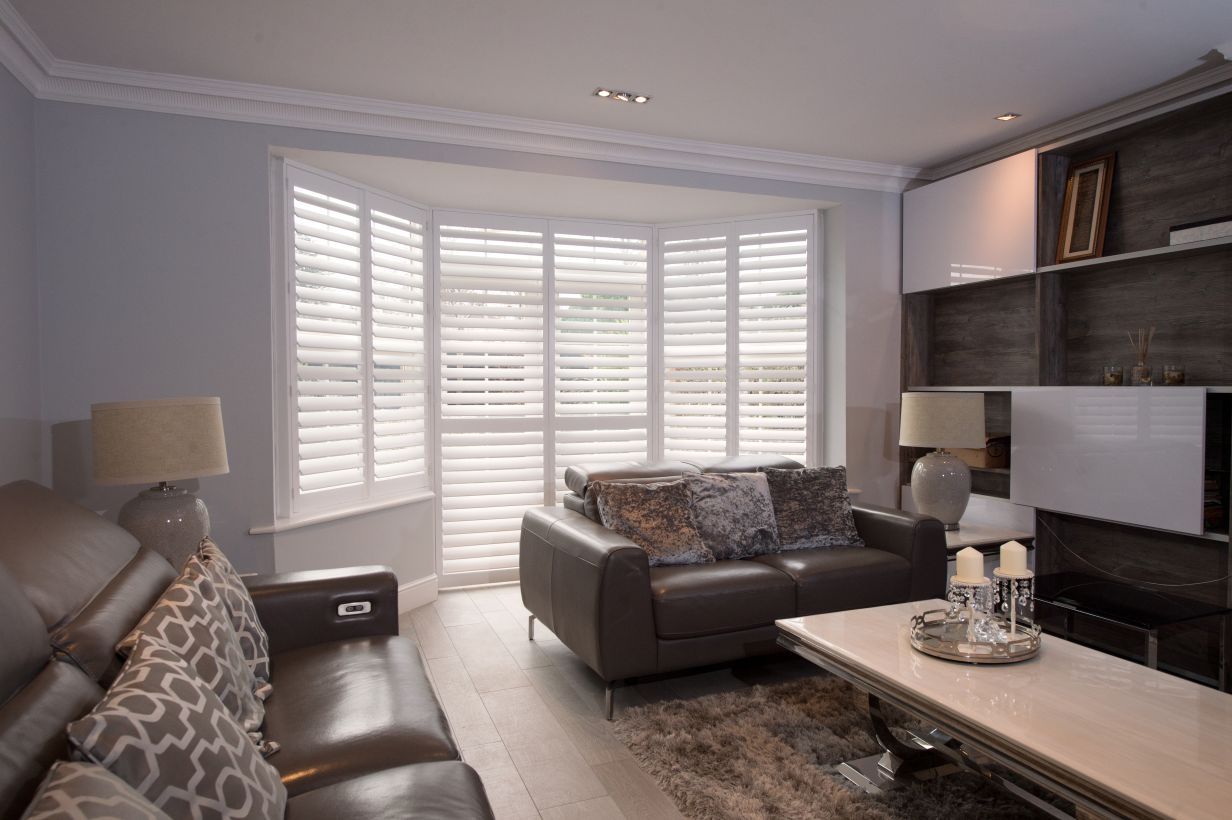
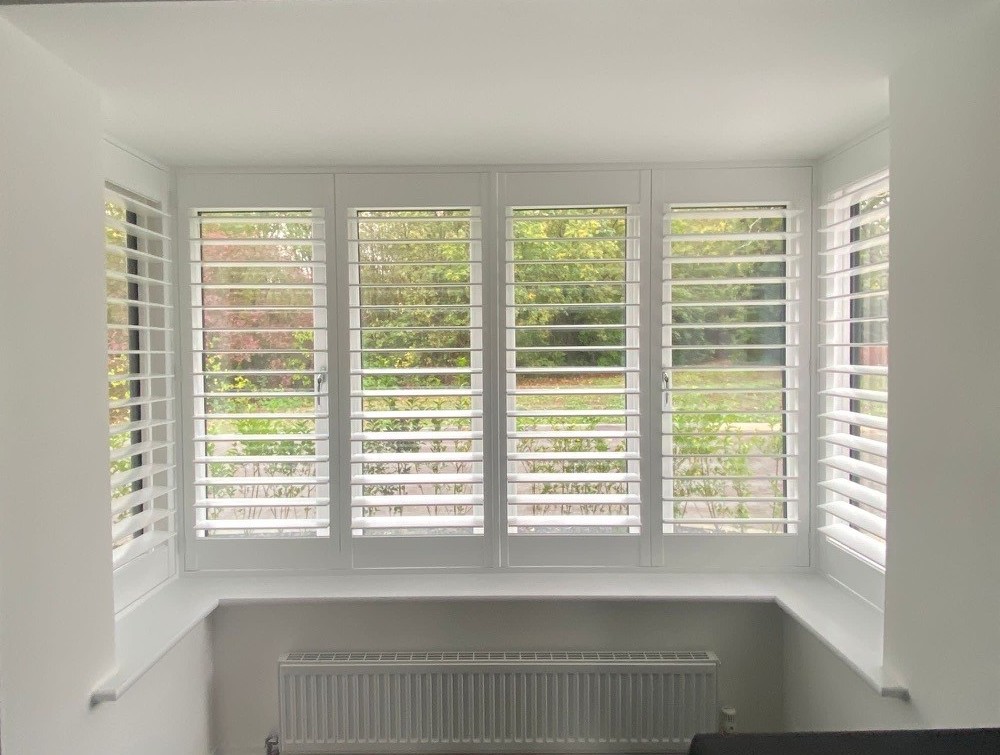
When our surveyor templates an unusual window — a fanlight over a Georgian front door, an obtuse-angled bay in a 1930s semi-detached, or a dormer window in a loft conversion — the dimensions go directly to our factory. There is no interpretation step at a third party, no translation loss, and no minimum order quantity constraint imposed by an importer. The same precision applies to bay-window shutter fabrication requiring corner joints built to the actual projection angle of the individual bay, and to the single-tier louvred panels spanning from sill to head that we fit in tall Victorian windows. Our earlier guide on shaped shutters for arched and angled windows covers the templating and production process for non-standard geometries in detail.
Questions to ask any shutter company before you order
When comparing shutter companies, whether a company manufactures its own product or resells an imported one is not always visible from a website. A few direct questions help establish the answer. Does the company operate a manufacturing facility it can describe and point to? Can it explain what quality checks are applied during production — not just at delivery? Can it provide lead times based on a production schedule it controls? Does it have a service model that can address an issue ten years after installation without referring to a third-party importer?
These questions separate supply chains you can have confidence in from those that depend on a factory you cannot inspect or hold accountable. Our article on what to look for in a UK shutter manufacturer covers the full checklist in detail. Finished shutter installations across every room type and window configuration we work with are collected in our gallery — a practical reference for what the product looks like when manufacturing quality and fitting precision are controlled by the same team. To discuss the right specification for your own windows, book a free home survey with our team. The surveyor brings material and colour samples, takes precise measurements, and leaves a confirmed written quotation with no obligation to proceed. Browse our full product range on the website before your survey appointment to identify the materials and styles that suit your home.