Kingston's housing stock — what you're working with
Kingston upon Thames covers the KT1, KT2, and KT6 postcodes within the Royal Borough of Kingston upon Thames, lying approximately 12 miles south-west of central London. The residential stock falls into three architecturally distinct bands, each presenting a different shutter specification. The first is the Georgian and early-Victorian townhouse and terrace stock concentrated nearest the river — the streets between the marketplace, Clarence Street, and the towpath around Charter Quay and the High Street. These properties, many of them three- or four-storey townhouses with tall, narrow sash windows, sit within Kingston's town centre conservation area and are frequently listed or locally designated. Our Kingston shutters service page covers KT1, KT2, and KT6 in full and sets out the range of window types and property ages we encounter regularly across the Royal Borough.
The second band is the Victorian terrace and semi-detached stock radiating north from the town centre into Norbiton (KT2) and the streets between Eden Street and Cambridge Road — late-Victorian rows of the 1870s through 1890s with standard sash windows, bay fronts on ground and first floors, and the consistent proportions that suit full-height or tier-on-tier shutters. The streets immediately around Kingston station, and the roads running east towards the New Malden boundary, are densely Victorian in character and represent the highest concentration of period terraced housing in the borough.
The third and architecturally most significant band is the Edwardian semi-detached stock of Surbiton (KT6), particularly the avenues running back from Brighton Road, Victoria Road, and the streets south of Surbiton station: substantial semi-detached houses built between 1900 and 1915 with wide bay-window fronts on both ground and first floors, generous reveals, and the kind of original joinery that makes a hardwood plantation shutter read as an architectural continuation of the room rather than a modern addition. For how similar Edwardian and Victorian stock across south-west London benefits from shutters, see our Richmond period homes shutters guide — Richmond borders Kingston directly to the north across the Thames.
Riverside homes: privacy, light, and the Thames towpath
The Thames runs along Kingston's western boundary for approximately two miles, and the towpath between Hampton Court and Richmond is one of the most heavily used recreational routes in south-west London. Properties fronting or side-facing the river — along the Barge Walk, Canbury Gardens, the water's edge at Hampton Wick, and the riverside sections of the town centre — face a very specific privacy challenge: the towpath puts cyclists, walkers, and river users within 5–10 metres of ground-floor windows, often at the same level as the window sill.
Louvred plantation shutters solve this directly. Unlike net curtains, which diffuse all light, or roller blinds, which require you to choose between full coverage and none, louvred shutters can be set to admit Thames-reflected light from above while angling the louvres to block sightlines from the path below. The effect is maintained even when louvres are partly opened for ventilation — a standard blind cannot replicate this. For riverside-facing reception rooms and ground-floor bedrooms in Kingston, the combination of light control and privacy management that shutters provide is practically unmatched by any other window treatment.
Upper-floor windows overlooking the river face the opposite priority: maximising the exceptional south and west-facing light that Thames-side properties receive in the afternoons. Full-height shutters on upper-floor rooms allow louvres to be opened fully for unobstructed views, then closed completely for evening privacy or sleep. The architectural benefit is that open shutters fold flat against the reveal wall, disappearing entirely when not needed — preserving the view as completely as if no window treatment were installed.
Shutter styles for Kingston upon Thames homes
Four configurations cover the large majority of Kingston period-home installations, with the right choice depending on the floor level, the window type, and whether the primary priority is privacy from the riverside, light control, or architectural character.
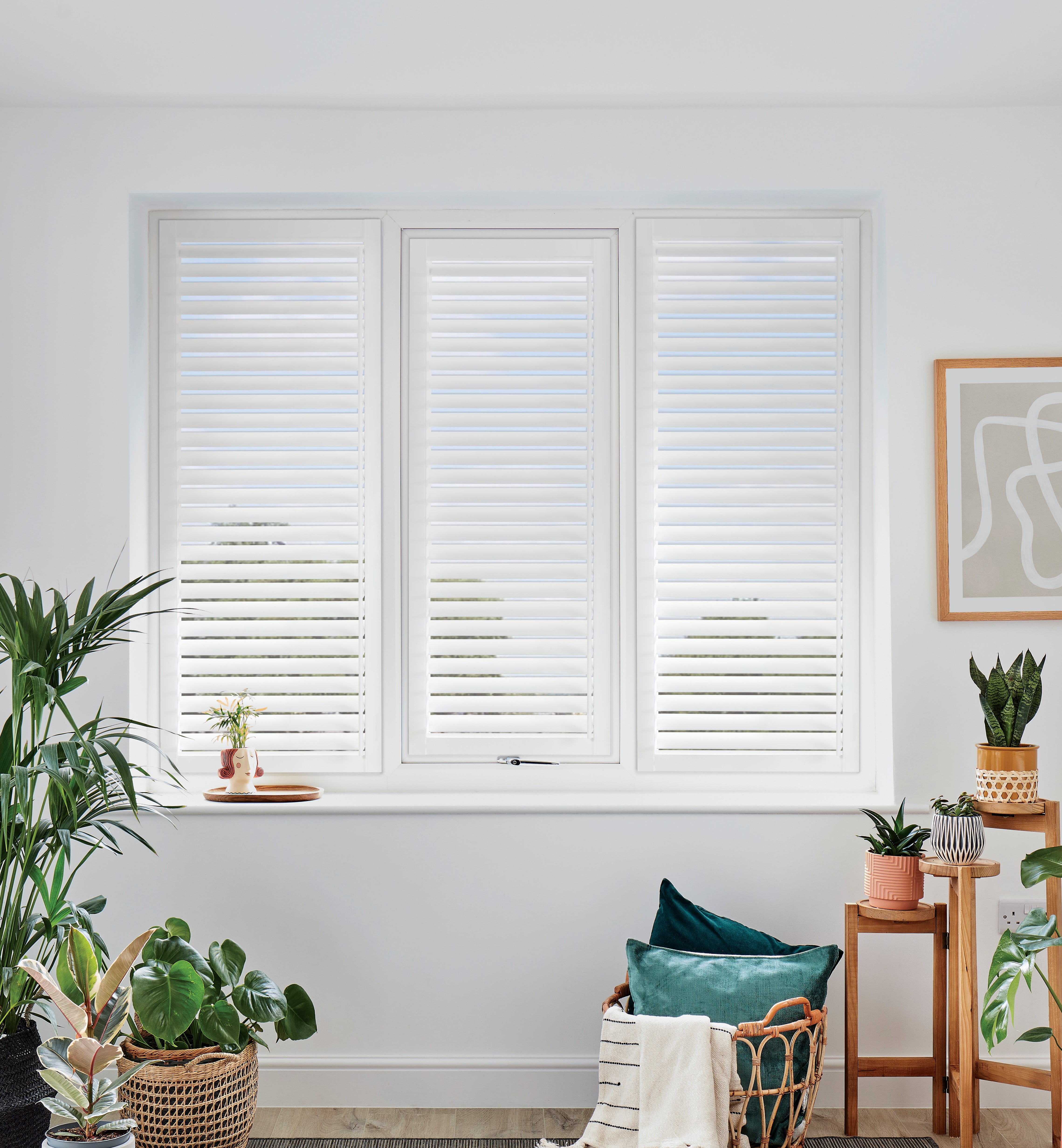
- Full height — the standard specification for period reception rooms and principal bedrooms across Kingston's Victorian and Edwardian stock. A single panel runs from window board to head of reveal, with a mid-rail option for independent upper and lower louvre control. See full-height shutters for the full style detail, and our in-depth full-height shutters guide for sizing and configuration advice.
- Tier-on-tier — the correct choice for ground-floor rooms in Victorian Norbiton terraces and riverside properties where both street- and path-level privacy is the primary requirement. Upper and lower panels operate independently: close the lower half to block sightlines from the towpath or pavement while the upper half continues to admit daylight. See tier-on-tier shutters.
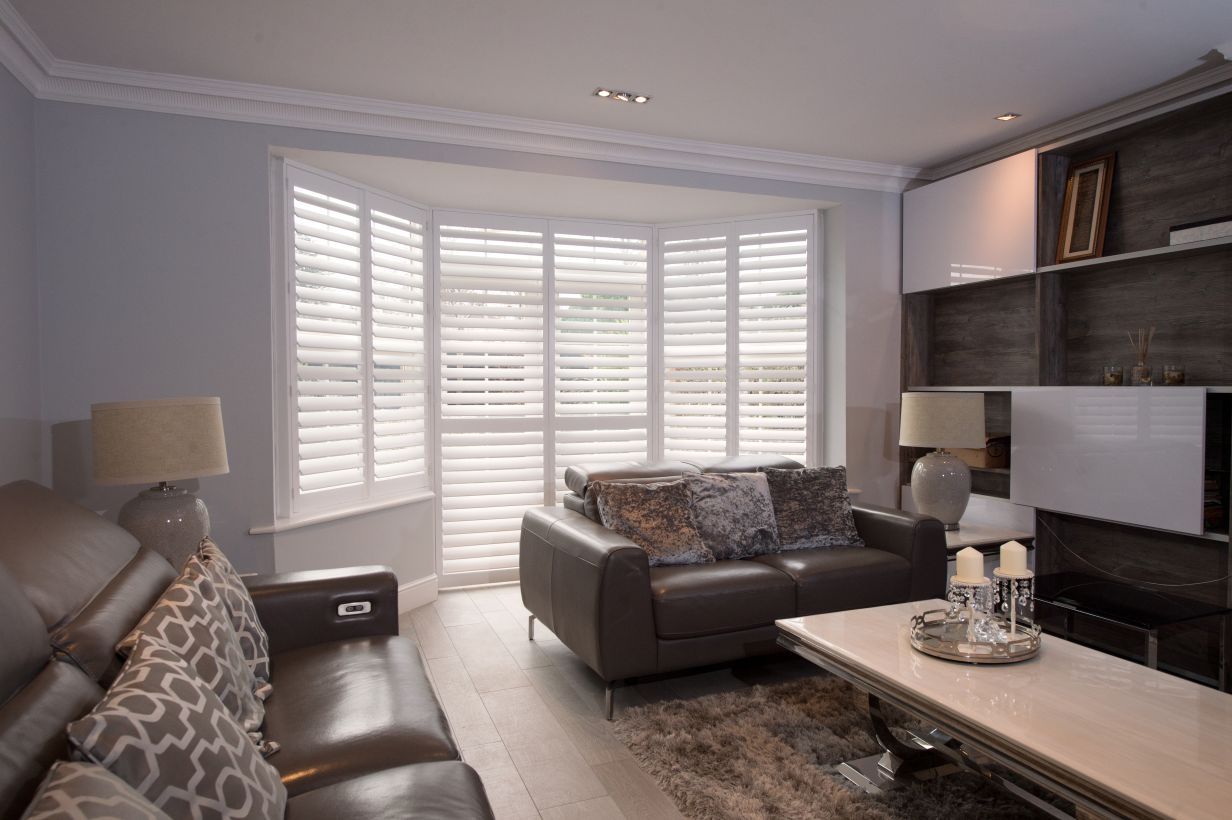
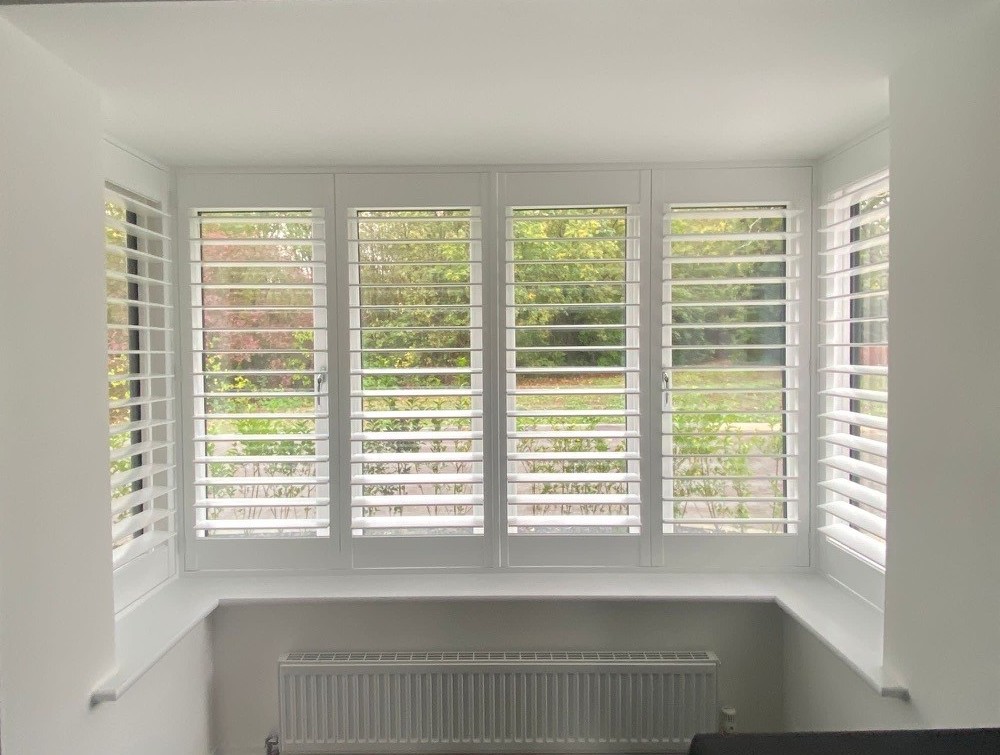
- Bay window shutters — essential for the projecting bay fronts of the Edwardian semis of Surbiton and Kingston Hill. Mitred frames at each bay angle produce a continuous, architecturally integrated result that blinds and curtains cannot match. See bay window shutters, and our detailed bay window shutters fitting guide for full specification detail including angle measurement and frame options.
- Café style — covers the lower half of the window only, leaving the upper sash open for daylight and river views. Particularly well suited to Georgian townhouses and ground-floor conversion flats near Kingston's riverside, where the upper portion of a tall window captures Thames light and views while the lower half faces directly onto a shared walkway or courtyard. See café style shutters.
Material choices for Kingston period properties
Two materials cover the large majority of Kingston period-home installations. The right choice depends on room function and the architectural character of the property — not on price alone.
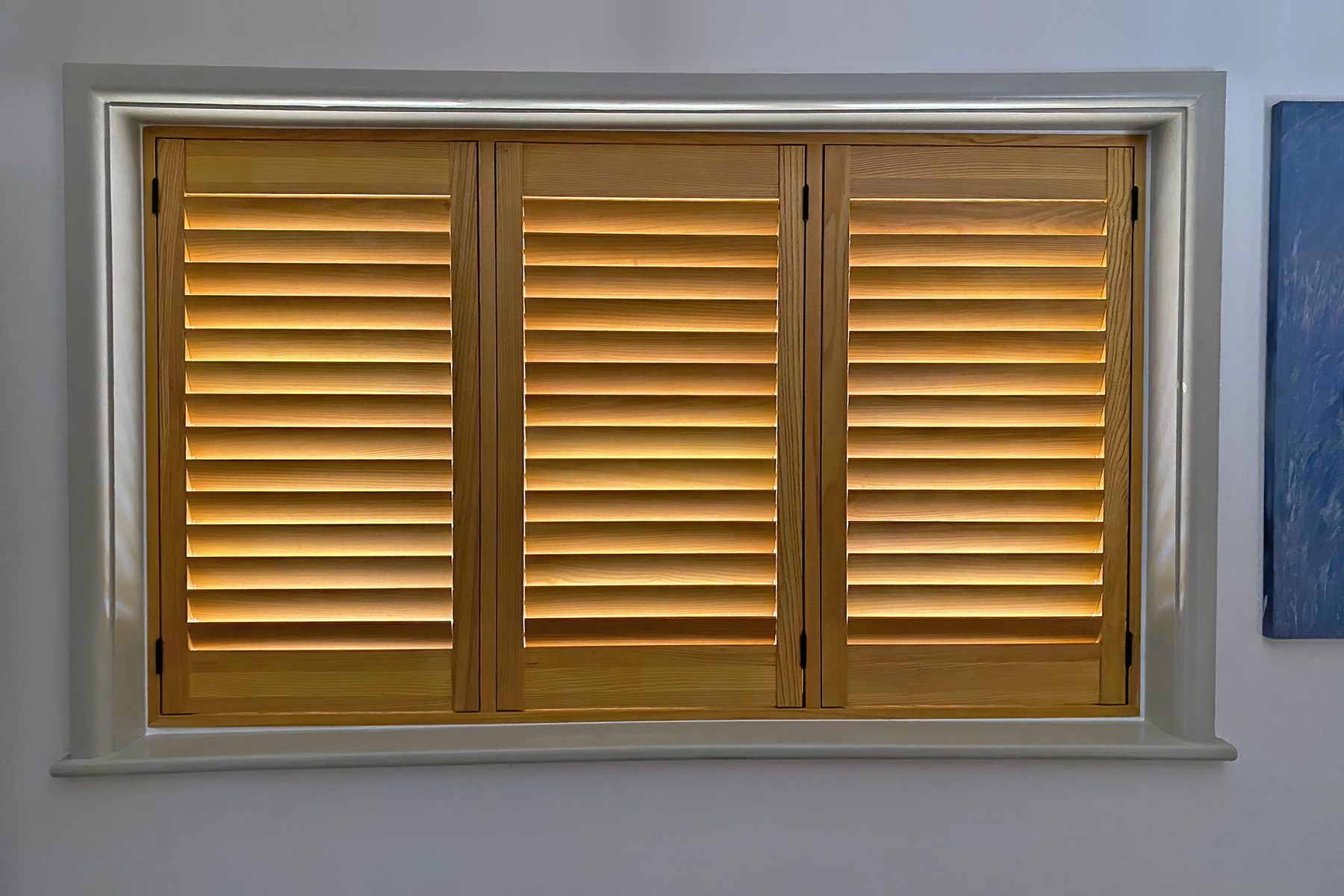
Painted hardwood (Endura) is the primary specification for period reception rooms, hallways, and master bedrooms in Kingston's Georgian, Victorian, and Edwardian stock. Endura hardwood shutters accept a factory paint match to the existing skirting boards, door architraves, and original joinery — a critical requirement in a Georgian townhouse near the riverside or a Surbiton Edwardian semi where the period character of the interior sets the design baseline. The weight, solidity, and finish depth of a hardwood panel reads as architecturally correct in these rooms in a way that composite cannot replicate.
Composite (Mimeo) is the practical default for kitchens, bathrooms, utility rooms, and any room in a Kingston home where wipe-clean durability is a daily requirement. Mimeo composite shutters are fully waterproof, wipe clean with a damp cloth, and run 25–35% less per square metre than hardwood — a meaningful difference when fitting shutters across all floors of a Surbiton Edwardian semi. Riverside properties in particular benefit from composite in rooms exposed to condensation from the Thames, especially ground-floor kitchens and rear extensions. For a broader overview of Kingston shutter installations and material choices, see our Kingston shutters expert guide.
Conservation areas and planning in the Royal Borough
The Royal Borough of Kingston upon Thames administers a significant number of conservation areas. Kingston Town Centre, Surbiton Town Centre, Ham and Petersham, Kingston Hill, Canbury, and the Coombe Estate are among the principal designated areas where the external character of buildings is subject to planning protection. The Ham and Petersham area is particularly significant: it sits within the Richmond Park setting and contains a high concentration of Grade II listed buildings, several at Grade II*, and falls under the setting-protection policies that govern development visible from the Grade I Richmond Park. The Coombe Estate conservation area contains some of the largest and most architecturally significant late-Victorian and Edwardian detached houses in the borough.
For plantation shutters, the planning position across all Kingston conservation areas follows the same principle that applies across London: internal shutters do not require planning permission. They are installed within the window reveal, are not visible from the street as an external alteration, and are classified as internal furnishings rather than works to the external fabric of a listed or conservation-area building. Grade II listed Georgian townhouses near Kingston's riverside can receive plantation shutters without a listed building consent application, provided fixings go into window boards and reveal linings rather than original historic fabric.
At survey stage, common complications in Kingston's period stock include accumulated paint layers reducing reveal depth in Victorian sash boxes, settled frames in older Georgian townhouses nearest the riverside, and non-standard window configurations in the larger Coombe Estate detached houses. Our surveyors measure every opening under as-found conditions, and all findings are accounted for in the fixed written quote before any order is placed.
Realistic 2026 pricing for Kingston upon Thames
Shutter prices are determined by window dimensions and material choice, not by postcode. A Victorian sash window in KT2 costs the same to shutter as the equivalent in Richmond or Wimbledon. What adds cost in Kingston is complexity: bay angles on Edwardian Surbiton fronts, tall narrow Georgian windows nearest the riverside with deep reveals, and multi-floor townhouses in the KT1 conservation zone. All figures below are supply-and-fit, covering survey, manufacture, frames, hardware, delivery, and installation.
- Standard flat sash window, composite: from £380 per m² supply and fit
- Standard flat sash window, painted hardwood: from £550 per m² supply and fit
- Typical single sash (approx. 0.9 m × 1.4 m), composite: from £480 total supply and fit
- Bay window (three panes, mitred frame), composite: from £1,250 total supply and fit
- Bay window (three panes, mitred frame), hardwood: from £1,650–£2,200 total supply and fit
- Tier-on-tier configuration: approximately 10–15% above full-height pricing for the same window
- Tall Georgian sash (approx. 0.6 m × 1.8 m or taller): priced by area at the standard m² rate, minimum order may apply
Getting started — the Kingston service
Shutters Factory covers all Kingston upon Thames postcodes — KT1, KT2, and KT6 — including the riverside zones of Hampton Wick, Canbury, and the town centre, as well as Surbiton, Norbiton, and Kingston Hill, with free home surveys and no call-out charge. Visit our Kingston shutters service page to see the full coverage area and what to expect from the survey visit.
Browse the full product range at Shutters Factory products, or see finished installations across different room styles and window types in the shutters gallery. To get a fixed, all-in written quote for your Kingston home, book a free home survey — we confirm pricing within 48 hours of the visit, with no obligation to proceed.