What makes Docklands and Canary Wharf apartments different
The residential architecture of Docklands and Canary Wharf spans three decades of development — from the converted Victorian warehouse lofts of Wapping and Limehouse to the glass-and-steel tower blocks of Wood Wharf, South Quay, and the Canary Wharf estate itself. What these properties share is a commitment to maximising light and views, which translates into significantly more glazing per apartment than you will find in a typical period terrace or suburban semi. Ground-floor and podium-level apartments often have floor-to-ceiling windows across an entire living wall; upper-floor units have panoramic views that their owners want to enjoy without surrendering privacy once the lights come on after dark.
The Docklands catchment for shutter installations also includes the older dock warehouse conversions at St Katharine Docks, Tobacco Dock, and Limehouse Basin — properties with exposed brickwork, high ceilings, and original steel-framed windows in non-standard shapes. These call for a different specification from the contemporary glass towers: full-height shutters within individual steel casements, sometimes in café-style format to preserve warehouse character while managing the light that floods through large industrial windows. For an overview of the wider area's shutter installations and the most common specifications, our Docklands east London guide covers the full range of properties and products in detail.
Tracked shutters for bi-fold and sliding door openings
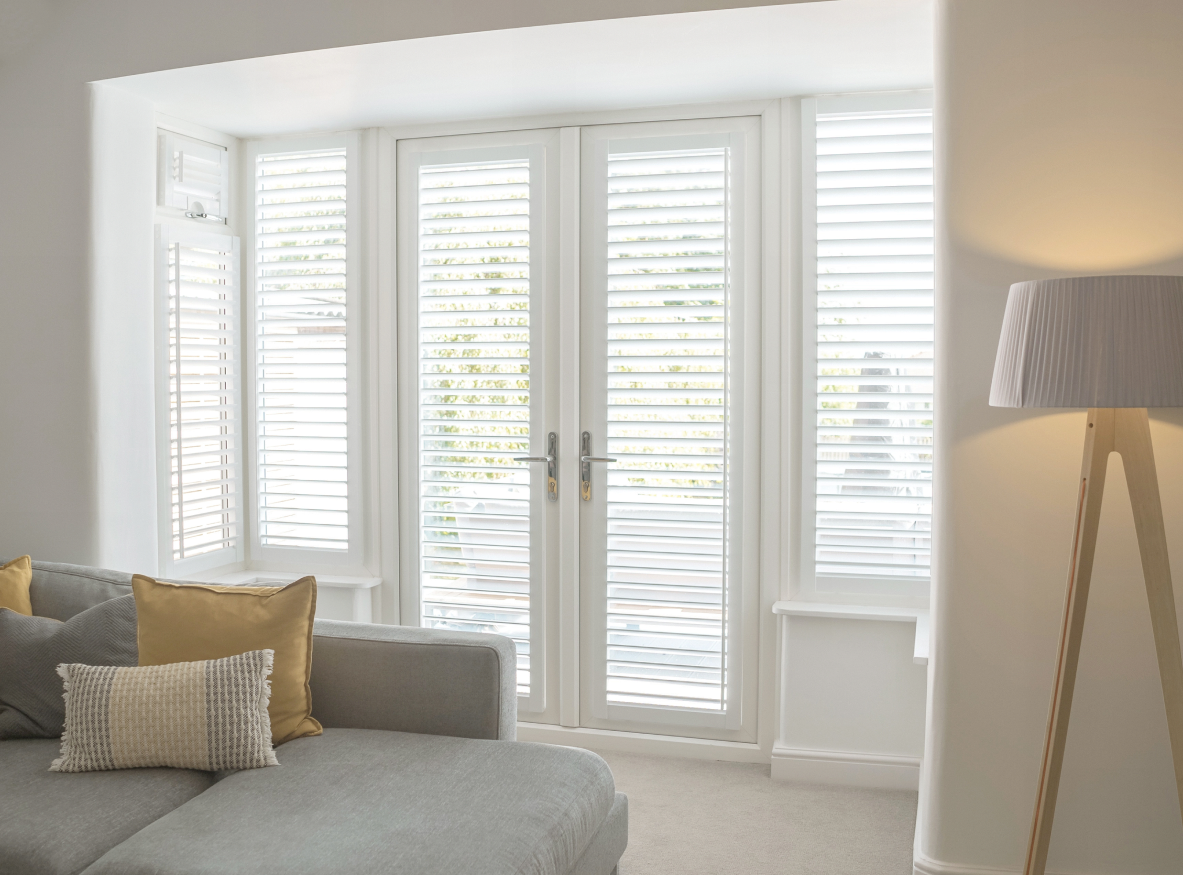
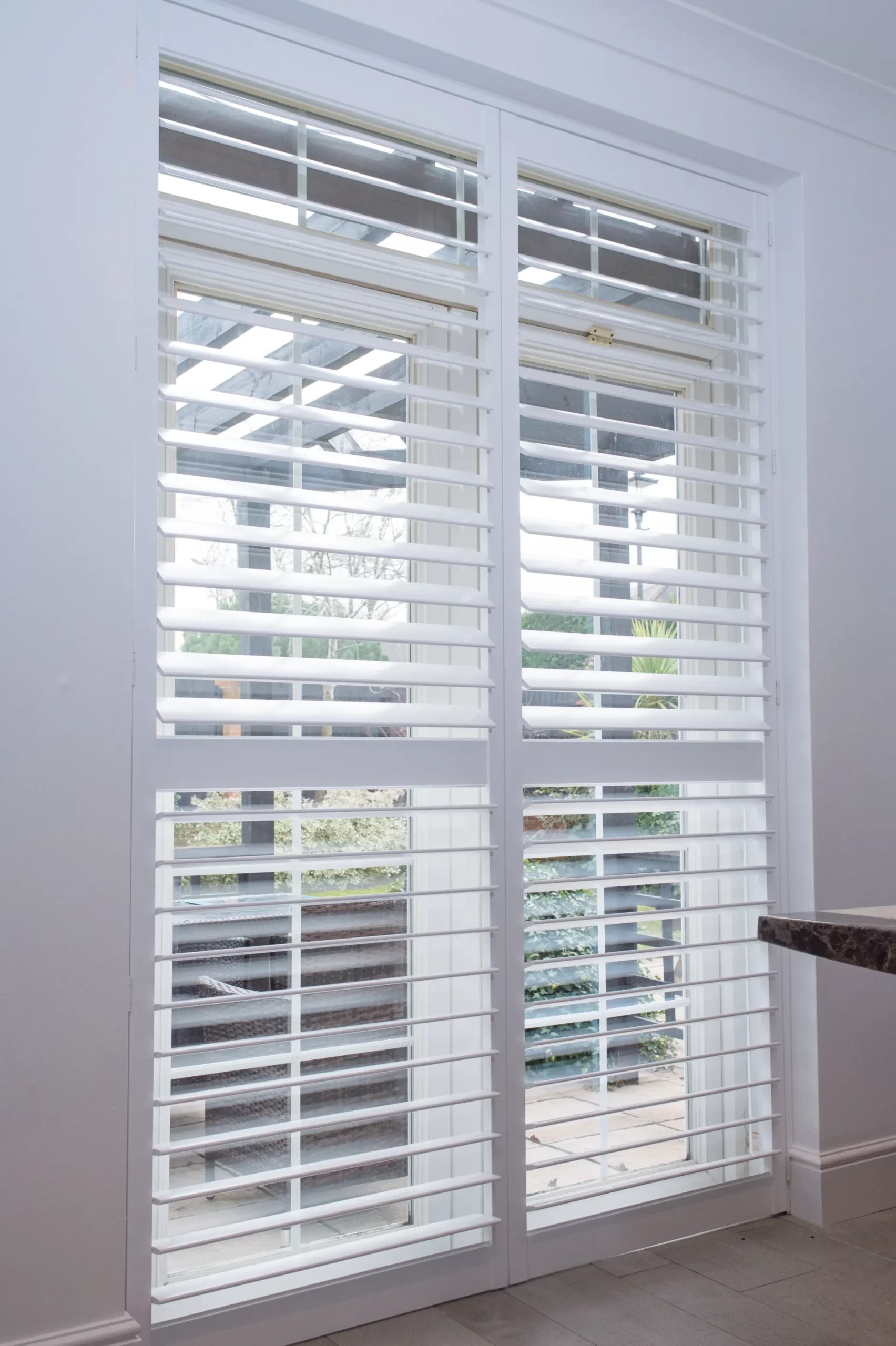
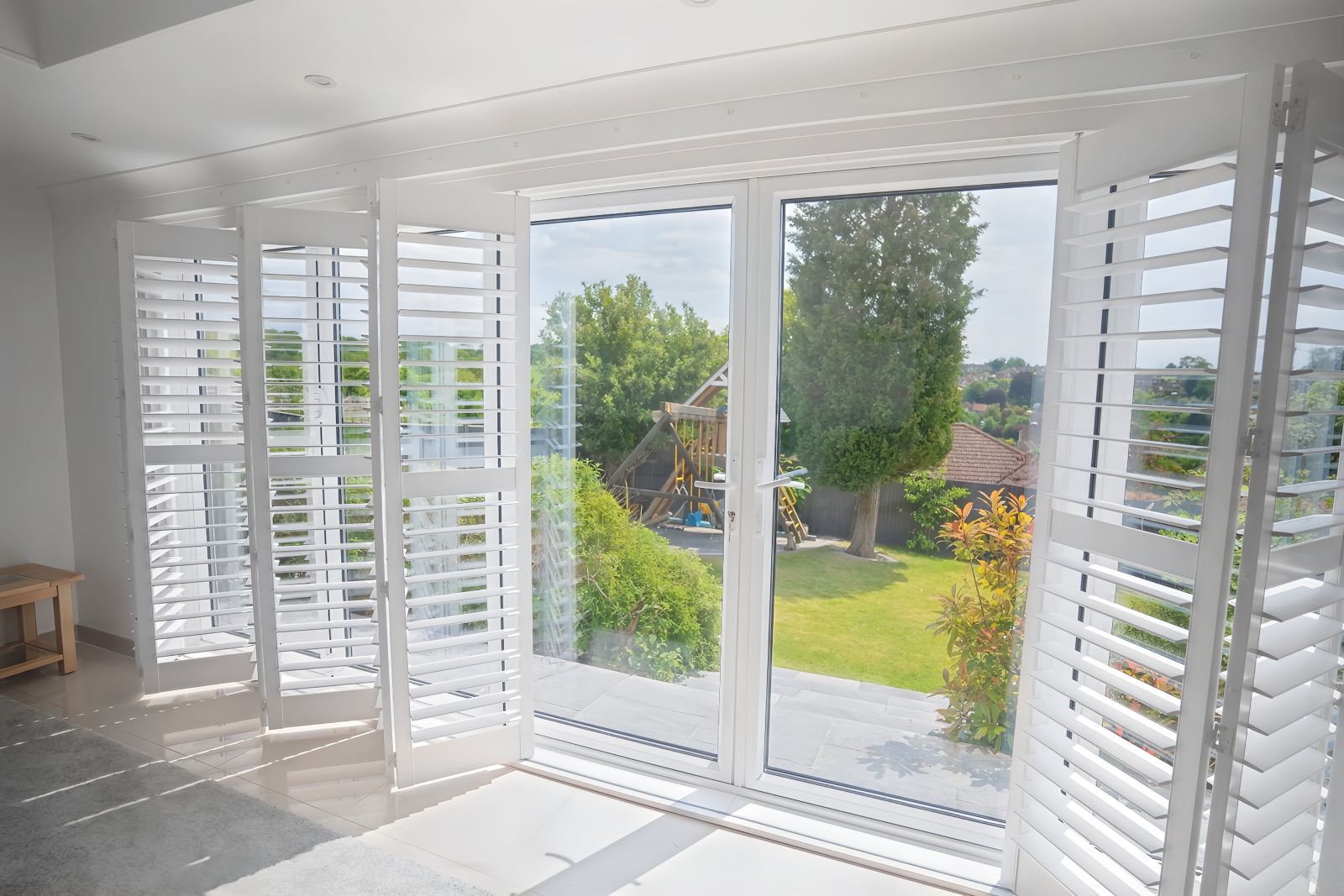
The defining glazing feature of contemporary Docklands apartments is the bi-fold or sliding door wall — panels of structural glass up to 3.5m wide and 2.4m tall opening to a balcony or terrace. Standard hinged shutters cannot span these openings; the panels would be too large to hinge and fold within the available reveal. The solution is a tracked shutter system, in which individual panels run on an overhead aluminium rail — and optionally a floor rail — allowing the full opening to be covered by a series of smaller, manageable panels that slide or bi-fold across the aperture. Our detailed article on tracked shutters for bi-fold and patio doors covers how the system works and all configuration options in depth.
For Docklands apartments, the most appropriate materials for tracked systems are composite and aluminium. Dura aluminium shutters are the premium specification for large tracked installations: the aluminium core and anodised finish are dimensionally stable across the full panel width, will not expand or contract significantly with temperature fluctuations, and are salt-resistant — important for apartments close to the Thames where waterside humidity is a consistent factor. Composite tracked panels offer a cost-effective alternative at larger spans; the 89mm louvre specification is generally the right choice for wide openings, maintaining visual proportion across the larger panel face and allowing maximum light when the louvres are open. Our guide to shutters for large windows walks through the tracked specification in detail and covers how panels are balanced for smooth operation across wide spans.
Full-height shutters for standard apartment windows
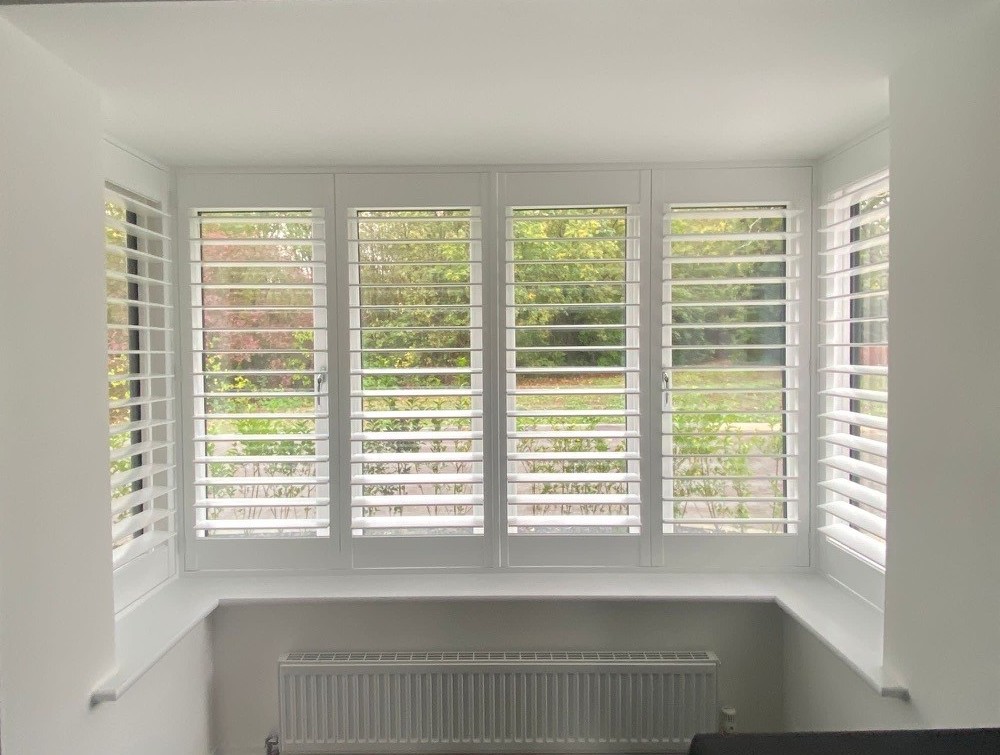
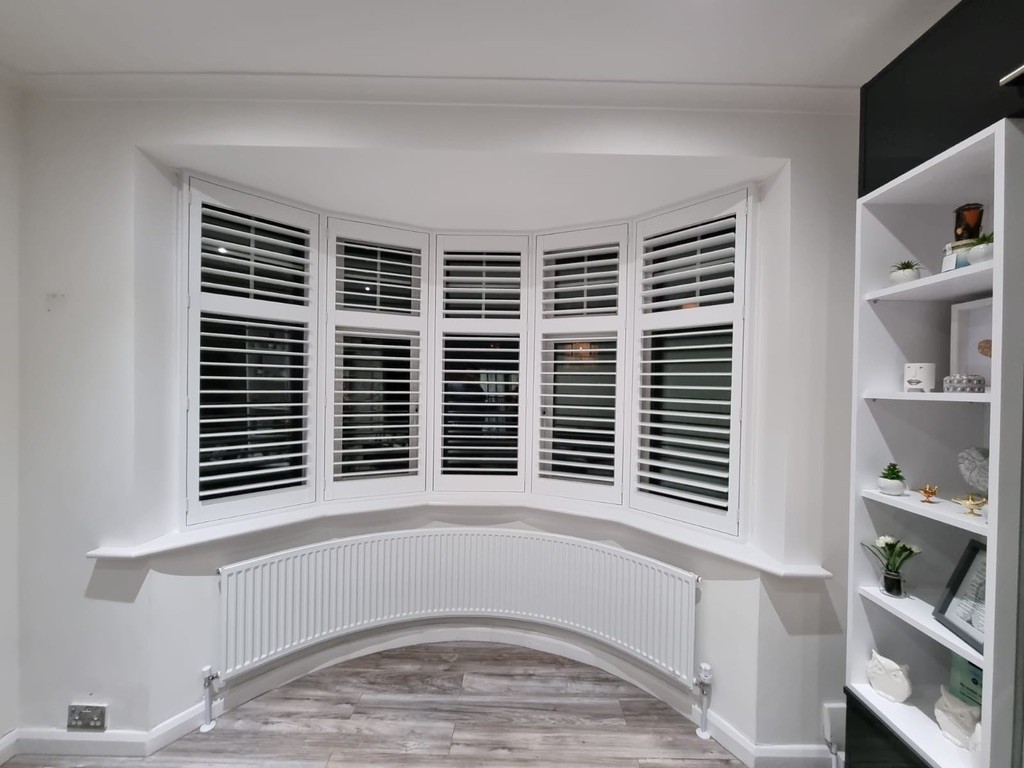
Not every window in a Docklands apartment is floor-to-ceiling. Bedrooms, home offices, and secondary bathrooms typically have standard casement or tilt-and-turn windows between 900mm and 1,500mm tall — windows for which hinged full-height shutters are the correct specification. In high-density buildings where bedroom windows face directly into an interior courtyard shared by dozens of other units, closed louvres create complete privacy without the weight and maintenance burden of blackout curtains. The clean, minimal appearance of a white-painted shutter suits the contemporary interior finishes typical of Docklands new-builds and warehouse conversions better than most fabric alternatives.
Mimeo composite shutters are the most commonly specified product for these standard apartment windows: moisture-resistant, dimensionally stable, and available from approximately £350–£400 per m² supply and fit. The 64mm louvre is typically the right choice for windows between 600mm and 1,200mm wide — our louvre size guide explains how to match louvre width to window dimensions for the most proportionate result. In converted warehouse properties with large casement openings, the 89mm louvre may better suit the scale of the window and the industrial character of the space.
Choosing the right material for a waterside apartment
The Thames riverfront and enclosed dock basins create a microclimate with higher ambient humidity than inland London locations — particularly in winter, when the temperature differential between water surface and surrounding air drives persistent condensation on glazing and frames. Material choice therefore matters more in Docklands apartments than in most other London postcodes. Untreated or poorly finished timber will take on moisture, swell, and eventually warp or crack in these conditions. The correct specification is a quality composite or aluminium product — both inherently moisture-resistant and dimensionally stable in humid, waterside environments.
Mimeo composite shutters are moisture-resistant throughout their construction — not just at the surface — and are guaranteed against warping and cracking in domestic conditions. Dura aluminium shutters go further: salt-spray tested and corrosion-resistant, they are the definitive specification for apartments with direct sightlines to open water. If a natural timber aesthetic is important — common in warehouse conversions where wood tones complement exposed brick and steel — Strato paulownia shutters offer a lightweight hardwood option with better moisture resistance than most heavier timbers, specified with a fully painted finish in this environment rather than an oiled or natural one. Browse all shutter products and ranges to compare materials and finishes before the survey.
Managing privacy in a high-density, high-rise setting
Privacy is the primary driver for shutter installations in most Docklands and Canary Wharf apartments. In tower blocks where windows face directly into those of neighbouring towers at the same height, the sightlines are fundamentally different from those in a period terrace: there is no garden depth, no pavement buffer, and no street width separating you from an adjacent unit's view. After dark, when interior lighting makes every lit room visible from outside, the privacy deficit is most acute — and the usual answer of closing curtains eliminates both the problem and the view entirely.
Plantation shutters solve this through precise louvre control. Louvres angled downward at 30–45 degrees admit significant natural light while cutting direct sightlines from opposite windows at the same height. Louvres angled upward direct light toward the ceiling while blocking the direct line of sight from outside. The ability to fine-tune this angle — rather than choosing between fully open and fully closed — is a meaningful daily advantage in high-density settings, and one that no standard blind or curtain system can replicate. Our dedicated Docklands page covers local installation considerations in full. Book a free home survey to see a live louvre demonstration with physical product samples in your own apartment before committing to a specification.
Costs, installation logistics, and lead times
Supply and fit pricing for Docklands and Canary Wharf apartments follows the same per-m² structure as installations elsewhere in London, with tracked systems carrying a modest premium over standard hinged shutters due to the rail hardware and additional installation time. A typical bedroom window of approximately 1.0m² fitted with Mimeo composite full-height shutters is in the range of £350–£400. A living room bi-fold door opening of 3.0m² fitted with Dura aluminium tracked shutters typically ranges from £1,600–£2,000 depending on panel configuration and track type. A complete two-bedroom Canary Wharf apartment with three standard windows and one bi-fold opening typically costs £2,800–£5,000 depending on product selection. Our 2026 UK shutter pricing guide provides a full breakdown across all products and room types.
Installation in high-rise residential buildings requires a small amount of practical planning. Most Docklands apartment blocks have lift access and building management protocols for contractor visits — the survey team confirms logistics on the booking call. Standard installation time for a two-bedroom apartment is three to five hours; tracked systems on larger openings may extend this to a full day. Lead times from survey to installation are four to six weeks for composite and aluminium tracked systems. Book a free home survey to receive an exact quote and confirmed lead time for your specific configuration. Browse the shutters gallery to see finished installations in contemporary apartment settings before the visit.