Why bi-fold doors need a dedicated tracked solution
Standard hinged plantation shutters — the type fitted to casement, sash, and French door windows — are mounted on a fixed frame within the window reveal and fold back against the wall or return when the window is opened. This mechanism works well wherever the hinged panels require only 200–350mm of clearance depth to one or both sides. On a typical casement window or French door pair up to 1.6 metres wide, that clearance is usually available within the jamb depth or against the adjacent wall.
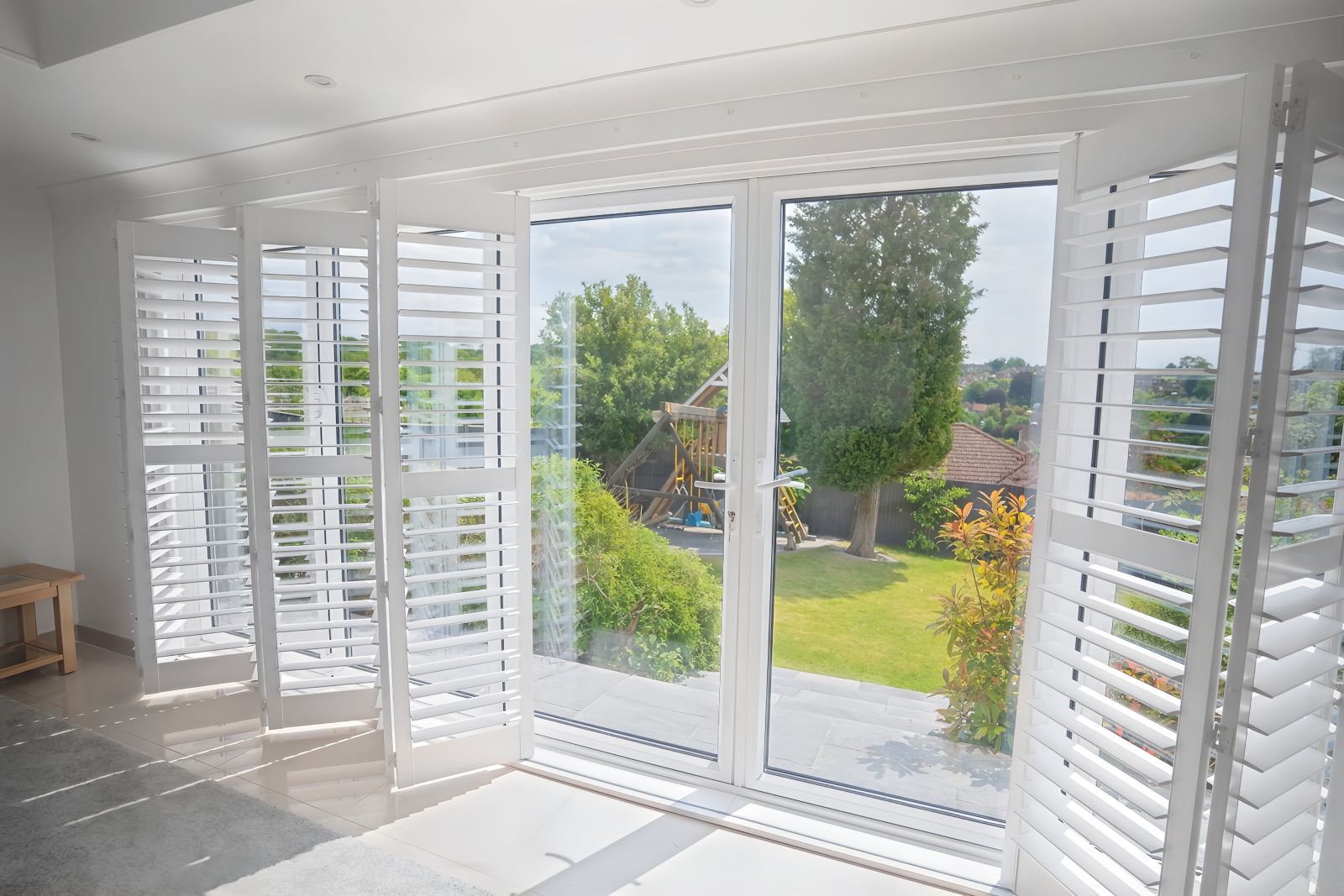
A bi-fold door opening of three metres or more creates a completely different geometry. Applying the same hinged principle — panels 700–900mm wide, each folding back on operation — would require four or five panels stacking to a depth of 350–500mm on each side of the room. In a kitchen extension or rear living room, this depth of fold is almost never available: the bi-fold doors themselves already occupy the perimeter wall, and there is rarely spare depth to receive stacked shutter panels as well. The second problem is dependency: hinged shutters fixed to a bi-fold door must move with the door each time it opens. A panel-track system mounted on its own independent overhead rail solves both issues simultaneously — the shutters travel on their own head rail, the door operates beneath them, and access to the garden or terrace is fully independent of the shutter position.
How a tracked shutter system is engineered for a bi-fold opening
A tracked bi-fold door shutter consists of individual louvred panels — typically 600–900mm wide, running the full height of the opening from head rail to floor — suspended from smooth-running aluminium carriages inside a precision overhead track. There is no floor rail. The panel bottoms hang freely a few millimetres above the floor surface, so there is nothing to trip over, no sill track to obstruct the door threshold, and no alignment problem from minor floor-level variation across a wide extension opening. The head rail is fixed to the underside of the lintel or ceiling immediately above the bi-fold frame, with structural brackets at each end and at approximately 600mm intervals along the span.
Each panel slides independently along the track. In a standard single-track configuration, all panels stack to one side of the opening when fully retracted — typically the side with the most available wall depth. On openings of four metres and above, a two-track bypass arrangement allows panels to travel in two separate lanes and stack to both ends simultaneously, giving a more balanced visual result when the shutters are open. Our guide to shutters on large windows and wide spans covers how track configurations are selected based on opening width, wall clearance, and door-opening direction, with worked examples for common UK bi-fold door sizes.
Material options: composite, hardwood, and aluminium
Mimeo composite shutters are the standard specification for tracked bi-fold installations across most UK homes. The solid polymer core is dimensionally stable — it does not flex significantly under its own weight across panel heights of 2.1–2.4 metres — and it is impervious to the condensation and humidity typical of a rear extension in a UK winter. Composite panels are available in 47mm, 64mm, and 89mm louvre widths. For most bi-fold openings, 64mm or 89mm is the better visual specification: wider louvres maintain proportion across a large panel face and allow considerably more light through when the louvres are fully open. Our louvre size guide for 47mm, 64mm, and 89mm options covers how to choose between the three widths for different opening sizes and room styles.
Aluminium shutter panels engineered for wide tracked spans — the Dura range — are the premium material specification for bi-fold openings of 3.5 metres and above, and for any tracked installation where panels exceed 2.3 metres in height. The extruded aluminium frame and louvres are dimensionally stable across the full domestic temperature range, do not flex under cantilever load, and carry a UV-resistant powder-coat finish that will not fade in direct south-facing sun. For riverside apartments and properties in coastal postcodes, the corrosion resistance of aluminium is an additional advantage over composite. Endura hardwood shutters in a tracked configuration are available for narrower bi-fold pairs — up to approximately 2.5 metres wide — where the warmth of natural timber is the aesthetic priority and individual panel widths can be kept below 700mm to manage cantilever load.
Panel configuration options — stack, bypass, and bi-fold on track
The right configuration depends on opening width and the wall clearance available on each side of the bi-fold frame.
- Stack to one side: all panels travel in a single track lane and nest together at one end of the opening. This is the simplest and most cost-effective arrangement. It suits openings up to 3.5 metres wide where at least 400mm of clear wall is available on one side — in a kitchen extension with a side return, the stacked panels can sit in the return recess and are entirely out of the way when the bi-fold is open.
- Bypass (two-track): panels run in two separate lanes at different depths from the wall, allowing each lane to stack independently at opposite ends. This suits openings of 3–5 metres where single-side stacking would require too much clearance, and the symmetrical result — half the panels at each end — creates a cleaner visual when the door is in use.
- Bi-fold on track: shutter panels fold in pairs as they travel along the rail, halving the stacked width compared to flat-panel stacking. This is the right solution for installations with limited wall clearance on both sides, though the additional folding mechanism adds cost and requires more attention over time than a flat-panel track system.
Light control and privacy on a bi-fold door wall
One of the functional advantages of a tracked shutter over a fabric blind on a bi-fold door is that individual panels can be positioned at any point across the opening — not just fully retracted at the ends or fully drawn across. Three panels positioned centrally across a five-panel opening create a privacy screen across the main sightline from a terrace or garden while leaving both sides open to air circulation. Individual louvres on each panel adjust independently of panel position: angled upward to direct diffused light toward the ceiling, downward to cut a low evening sun at eye level, or partially closed to reduce glare without blocking the view through. This continuous control is absent from any fabric solution on the same opening.
On south- or west-facing bi-fold walls, where afternoon sun is the primary management challenge, the difference between louvre adjustment and binary fabric control is most practically felt. A roller or Roman blind either blocks the sun entirely or admits it fully — there is no intermediate position that simultaneously manages glare and preserves the garden view. The long-term value case for plantation shutters over blinds and curtains covers this comparison in detail, and the bi-fold door wall is the setting where the operational difference is most immediately apparent in daily use.
What to expect at survey and installation
A tracked bi-fold door shutter is specified entirely during the home survey visit. The surveyor measures the opening height and width to the nearest millimetre, assesses the reveal depth, determines the appropriate panel width and track configuration for the opening, and confirms whether head rail fixings can go directly into the structural lintel above the bi-fold or require a surface-mounted timber backer. None of this assessment can be done accurately from photographs or architectural drawings — the physical site survey is essential for every tracked installation. For a technical breakdown of how panel count is calculated and how the head rail routes within a reveal, see the tracked shutters technical guide.
Track fixings into the structural head are the preferred installation method. Most steel or timber lintels above a bi-fold opening accept M6 or M8 fixings directly; where the lintel is exposed steel, an aluminium backer plate is fitted first. Installation on a typical three- to four-metre bi-fold opening takes one full day; wider bypass configurations or those with complex reveal geometry may take two days. View finished bi-fold door and extension shutter installations in our project portfolio to see all three track configurations on real UK homes before committing to a specification.
2026 UK pricing and lead times for bi-fold door shutters
Tracked bi-fold door shutters are priced per square metre of opening, supply and fit, and carry a modest track premium over standard hinged shutters reflecting the head rail, carriage hardware, and additional installation time. Mimeo composite tracked shutters start from approximately £550–£700 per m² supply and fit. A 3.0m wide × 2.1m high bi-fold opening (6.3m²) in composite typically costs £3,500–£4,400 fitted. Dura aluminium tracked shutters start from approximately £650–£800 per m² supply and fit; the same 6.3m² opening in Dura aluminium typically costs £4,100–£5,000 fitted. Endura hardwood tracked panels start from approximately £680–£800 per m² for openings where hardwood is suitable in span and panel dimensions.
Lead times from confirmed survey to installation are four to six weeks for composite and aluminium tracked systems across all standard product ranges. Why Dura aluminium is the benchmark specification for wide-span tracked shutter installations covers the engineering case in detail if you are weighing composite against aluminium for a large opening. Book a free home survey to receive a written quotation for your bi-fold door opening, with head rail configuration, panel count, and material confirmed on the day with no obligation to proceed. Browse all shutter product ranges and specifications online before your survey appointment if you want to arrive with a material or louvre-width preference in mind.