Why home offices demand more from window treatments than other rooms
Working from home places specific demands on windows that domestic use alone does not. Glare management matters more in a room where you spend six to eight hours looking at a screen; privacy from neighbours and passers-by matters more in a room where video calls are a daily reality; and thermal comfort in a north-facing or west-facing room affects concentration over hours in a way it does not when you are watching television. Standard roller blinds — the default specification in many home conversions and new-build homes — solve the privacy problem at the cost of daylight, and vice versa. Curtains are unsuitable for rooms used as offices because they require physically opening and closing rather than adjusting, and gathered fabric creates both visual clutter and a light-or-dark binary that does not match the task.
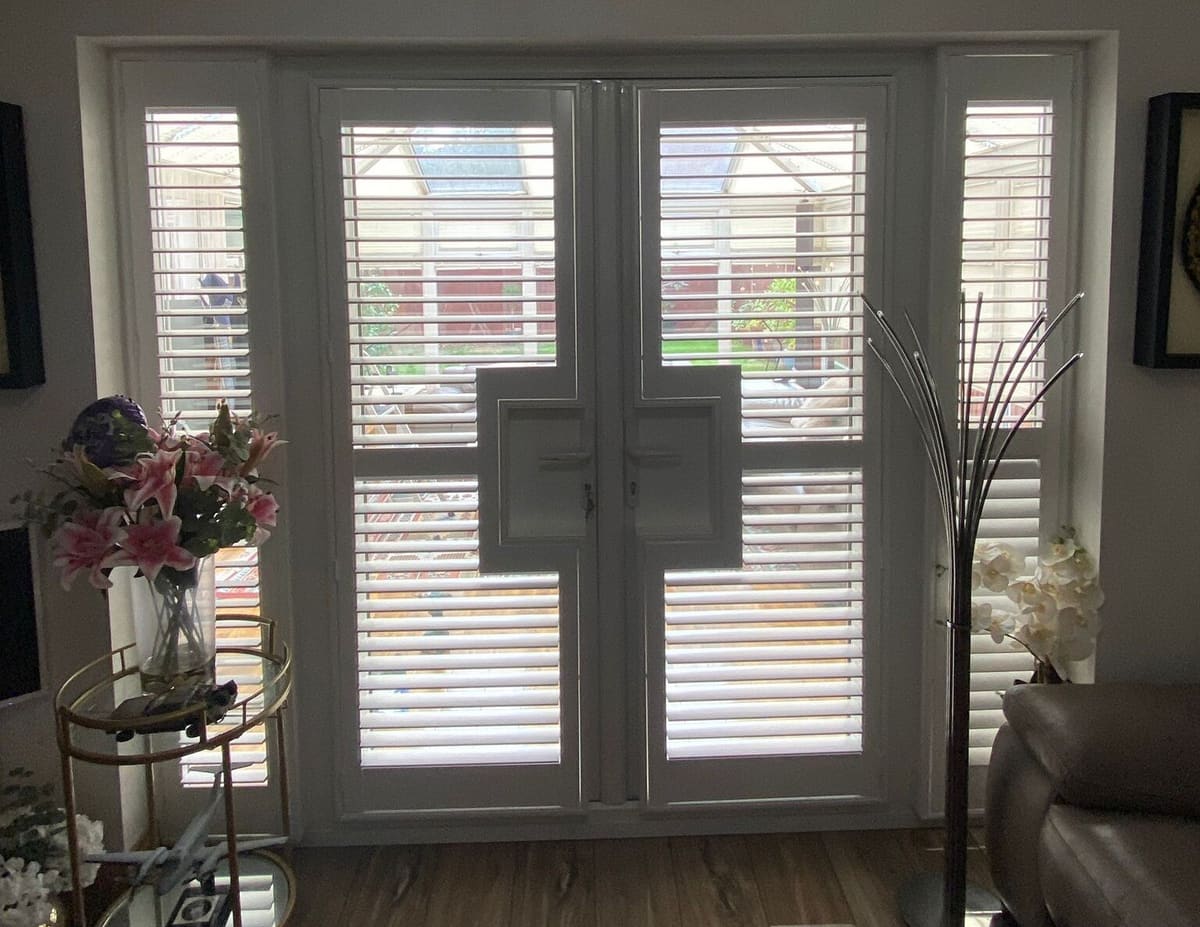
Plantation shutters address each of these problems with a single mechanism. The louvre angle governs the direction of light in the room; the panel angle governs whether the shutter is open or closed; and the two can be set independently. In practice, this means you can sit at a desk, angle the louvres toward the ceiling, admit diffused natural light into the room, and maintain visual privacy from the street — all simultaneously. Our independent comparison of shutters versus blinds covers the functional differences in detail across all the main window treatment categories.
Louvre size and angle: the home office specification
The louvre is the horizontal slat that runs across a shutter panel. Its width — typically 47mm, 64mm, or 89mm — determines how much each individual slat deflects light and how granular your control is. For home offices, 64mm is the most practical specification. It is wide enough to give a clean, architectural look when the louvres are open, narrow enough to give precise angle adjustment over a reasonable arc, and the industry standard across most made-to-measure shutter ranges. The wider 89mm louvre gives a more contemporary, open look but provides slightly less finesse over light direction; the 47mm louvre is more traditional in character and better suited to smaller sash windows than to the larger modern windows common in converted home offices.
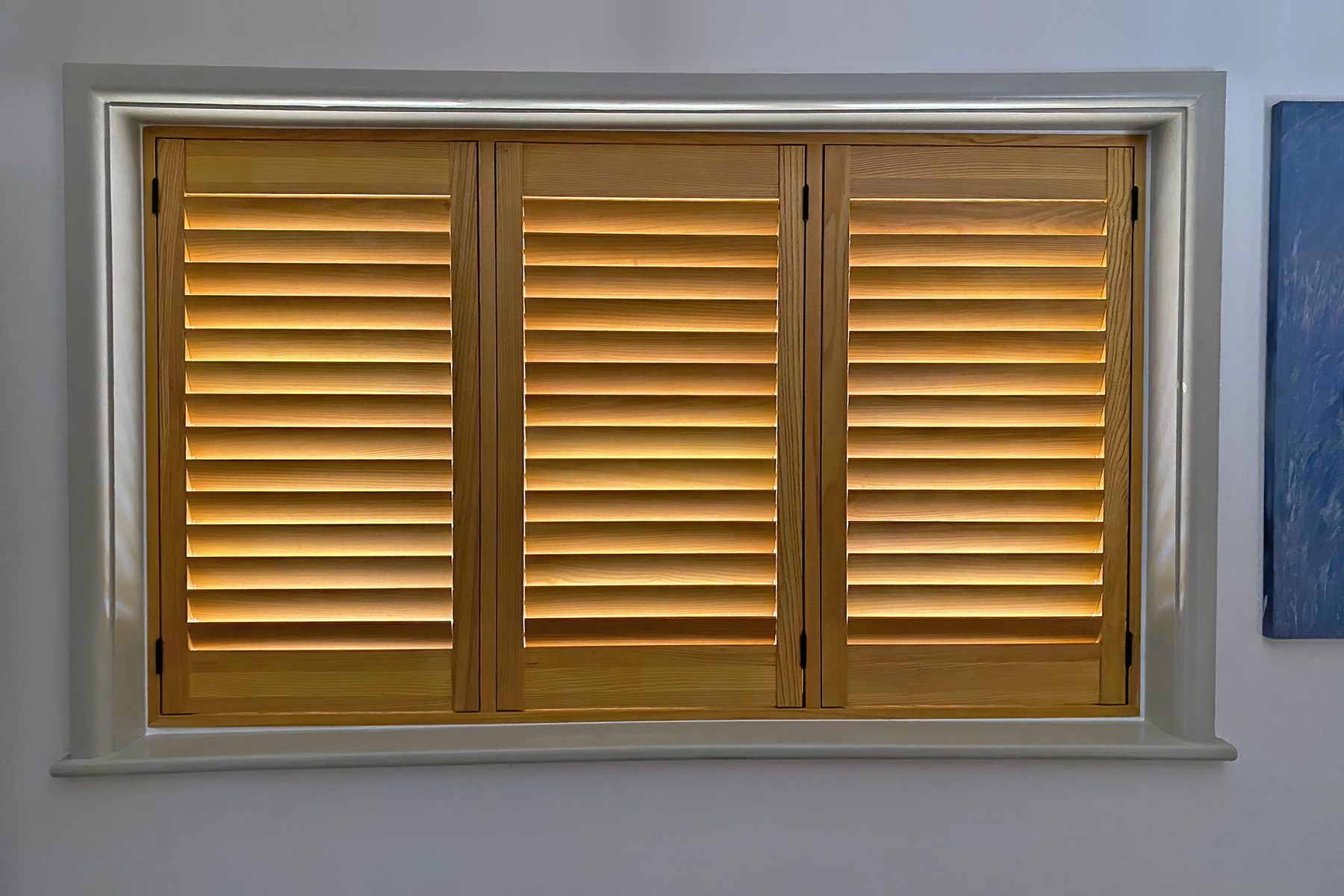
The angle of the louvre matters more than most people realise before fitting shutters. With louvres angled at roughly 30° upward — tilted so the front face directs light toward the ceiling rather than straight into the room — a window can admit most of its available daylight while reflecting almost none of it directly toward a screen positioned at desk height. This configuration, known in the trade as "upward tilt," is the standard working position for a home office shutter and should be confirmed with the surveyor at the time of the home visit.
Privacy from the street and neighbours without closing the shutters
This is the distinctively useful property of plantation shutters in a room used for video calls and client-facing work. At 45° louvre tilt, someone standing at street level or in a neighbouring window cannot see through a shutter panel into the room, even in strong natural light from inside. The angle creates a physical sight-line barrier without blocking the diffused light that passes through. Roller blinds and curtains can only be open (offering full visibility into the room) or closed (blocking daylight entirely). The shutter sits at a third position that neither blinds nor curtains can replicate.
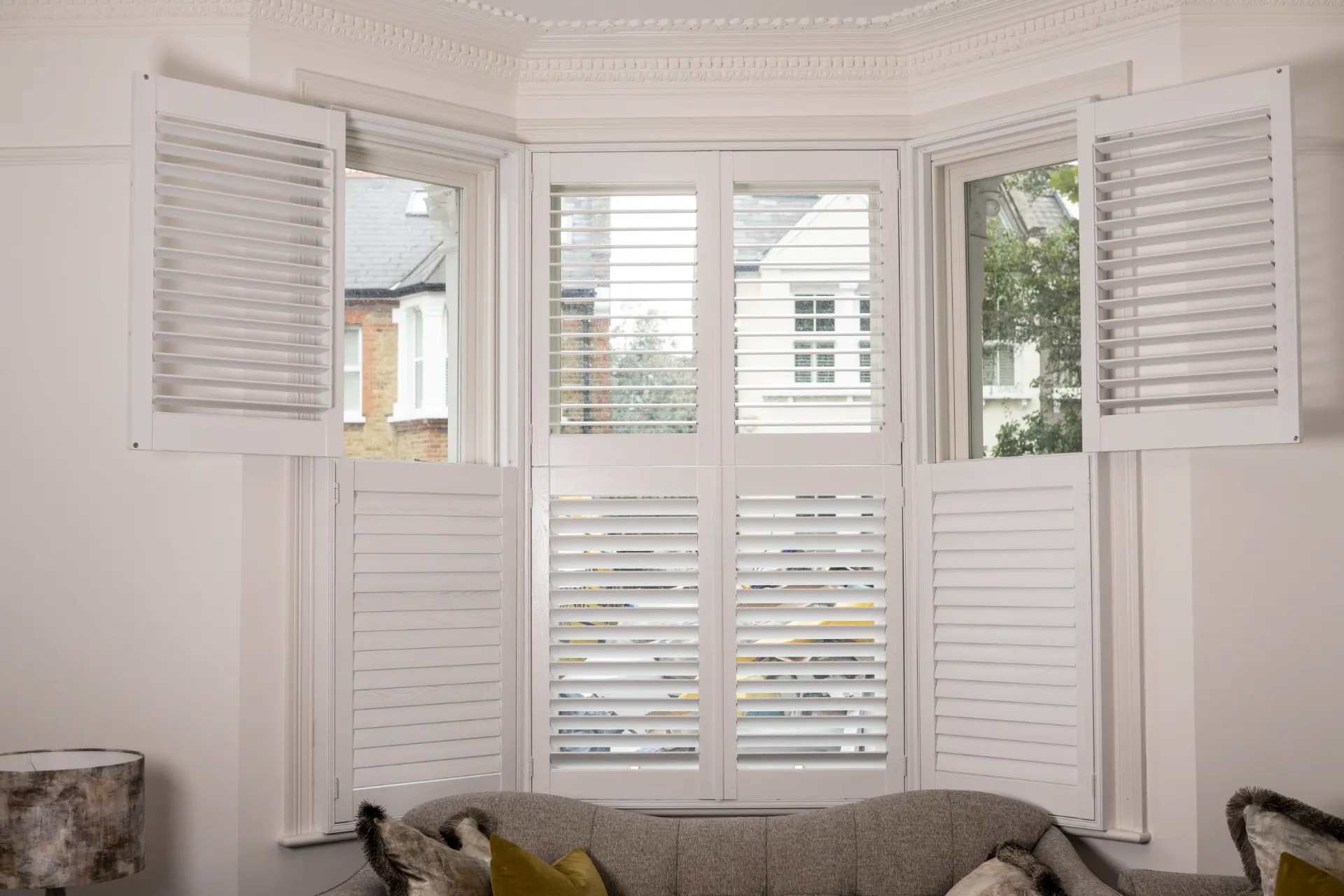
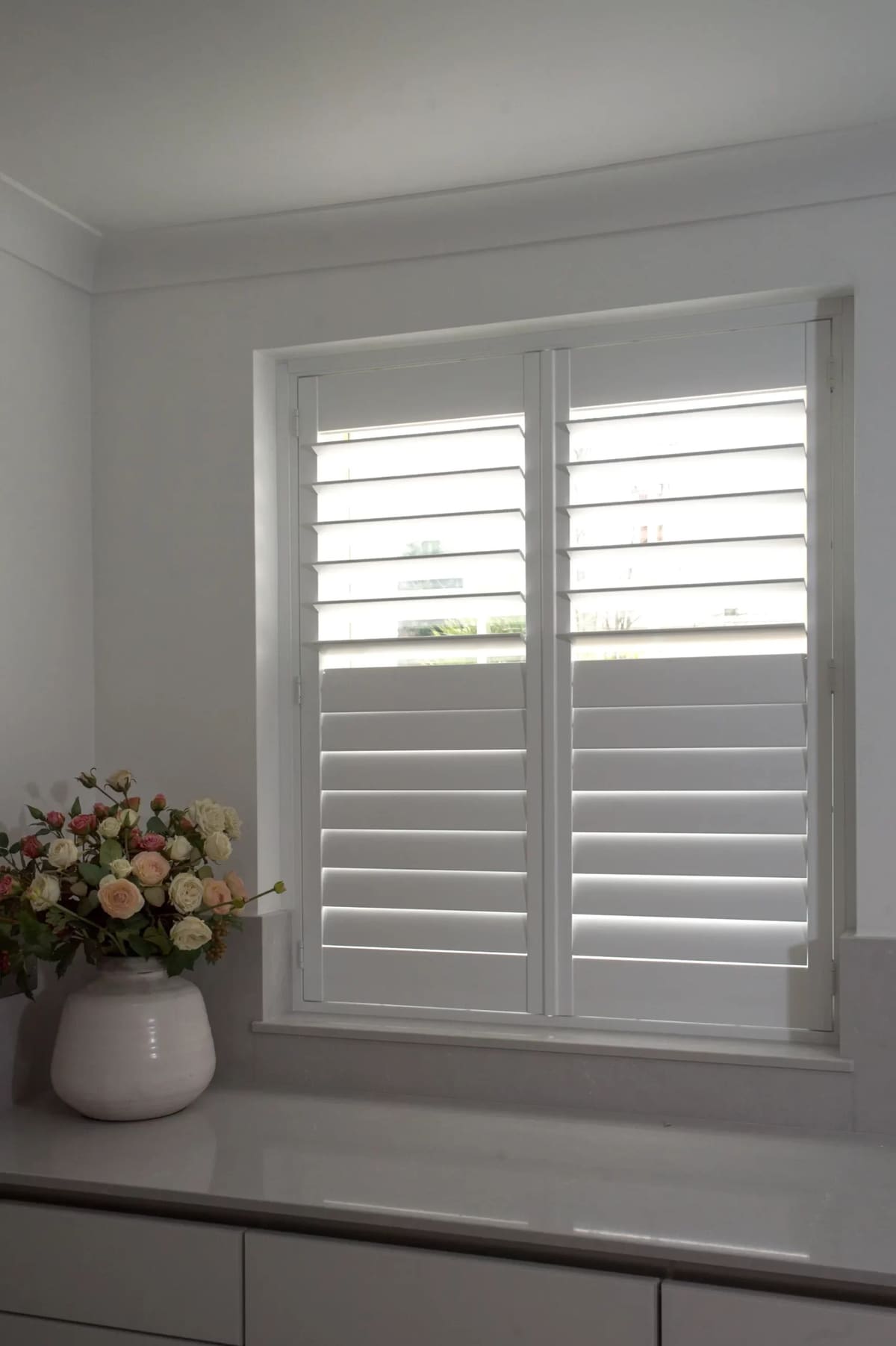
This matters specifically in the context of video calls: background management has become a professional concern, and a home office that faces a busy street creates a particular exposure. Shutters solve this at the architectural level, without requiring the occupant to remember to close blinds before every call. For rooms that face the street but need morning light — particularly the front reception rooms of Victorian and Edwardian terraces converted to home office use — café-style shutters deserve consideration as an alternative to full-height fitting. The café style covers only the lower section of the window, where sightlines from outside are most direct, while leaving the upper section fully open for unobstructed light. Our guide to café-style shutters and privacy covers the specific geometry of how partial-height fitting manages sightlines.
Glare reduction in practice
Screen glare in a home office is almost always caused by one of two sources: direct sunlight entering through the window and hitting the monitor, or light reflected off a pale wall or ceiling creating general ambient brightness that raises the perceived background. Plantation shutters address both. Upward-tilted louvres redirect incoming sunlight toward the ceiling, turning hard directional light into softer ambient fill that illuminates the room without creating glare paths at monitor height. This is measurably different from the effect of a diffusing blind fabric, which scatters light in all directions and reduces the directional glare problem at the cost of reducing light levels generally.
The practical implication is that a home office with plantation shutters at upward tilt will typically be both brighter and less glare-prone than the same room with diffusing blinds half-drawn — which is the daily compromise most home workers using blinds accept without examining. Full-height shutters are the standard configuration for home offices with floor-to-ceiling or standard sash windows, giving complete flexibility to angle the louvres as needed throughout the working day.
Acoustic softening: the less obvious benefit
Plantation shutters do not replace acoustic treatment in a dedicated recording space or a room with serious noise issues. But they provide a modest and consistent improvement in acoustic character that is more significant than most homeowners expect before installation. Solid timber or composite shutter panels add mass to the window plane — the weakest point in the thermal and acoustic envelope of most rooms — and reduce the amount of external sound energy that transmits through the window. For a home office above or beside a busy road, or in a converted Victorian or Edwardian terrace with original single-glazed sash windows, the combination of shutters and upgraded glazing provides a meaningful improvement in acoustic comfort during focused work and calls.
The acoustic benefit is collateral: it is not the reason to specify shutters in a home office, but it is a real return on investment for homeowners who find street noise a distraction. The thermal and acoustic benefits of shutters are covered in more detail in our auto-blog guide for homeowners who want a fuller picture of the energy and comfort return.
Choosing the right product for a home office
The product choice for a home office shutter follows the same principles as for any room, with one specific consideration: most home offices are not moisture-prone environments, which removes the strongest argument for composite over timber. In a dry room used exclusively as an office, hardwood and Paulownia timber shutters are as durable as composite and offer a richer painted finish.
Endura hardwood shutters represent the premium specification for a home office: factory-painted in white or any custom RAL or Farrow & Ball colour, with a stable hardwood construction that maintains precise louvre adjustment over years of daily use. They are the right choice for a room where the shutter will be the dominant architectural element and where colour accuracy matters. Mimeo composite shutters are the practical entry-level specification: moisture-resistant enough for a home office that doubles as a kitchen extension or garden room, and priced at the most accessible point within the made-to-measure range. For rooms where sash windows set the geometry — common in Victorian and Edwardian terraces used as offices — tier-on-tier shutters allow the top and bottom sections to be managed independently, admitting light from the upper sash while keeping the lower sash private. This is an elegant solution for a ground-floor home office on a street-facing wall.
Costs, lead times, and getting started
Supply-and-fit pricing for a home office shutter project follows standard room pricing. A typical single sash window at 900mm × 1,200mm in full-height configuration costs in the range of £750–£950 fitted, depending on material specification. A larger floor-to-ceiling window or a bay-fronted reception room converted to home office use would expect to pay £1,200–£1,800 depending on opening size and specification. Mimeo composite supply-and-fit starts from £380 per m²; Endura hardwood starts from £550 per m². Lead times are 4–6 weeks for composite and 6–8 weeks for hardwood from confirmed order to installation.
Browse colour and specification options across the shutters gallery, and see finished installation examples on the living room shutters and bedroom shutters pages — rooms similar in character to most home offices. To receive a fixed written quote for your specific windows, book a free home survey. The specialist will advise on louvre size, configuration, and product options based on your desk position and room orientation at no cost or obligation.