How motorised shutters work
Motorised plantation shutters use a compact, low-voltage DC motor — typically 12V or 24V — housed discreetly within the shutter panel or head rail. The motor connects via a thin cable run to a wall-mounted transformer or a battery pack concealed within the frame, powering a drive shaft that rotates the full width of the louvre bank simultaneously. A hand-held remote, a wall switch, or a signal from a smart-home hub triggers the motor to tilt the louvres to any preset angle or to drive the panel to a fully open or fully closed position. The mechanism stops automatically at the end of the louvre travel range and includes a manual override so the shutter can be operated by hand if the motor is unpowered or the control signal is unavailable.
The motors used in UK-specified plantation shutters in 2026 are substantially smaller and quieter than motorisation hardware available five years ago. A louvre bank across a 1,000mm-wide panel operates near-silently — the sound level when running is broadly comparable to a laptop fan, and most users are unaware of the motor sound from an adjacent room. Motorisation does not add appreciable depth or visual bulk to the panel: the drive components are contained within the vertical stile of the frame in most configurations, with no external wiring or bulge visible from the face of the shutter.
Which configurations and materials support motorisation
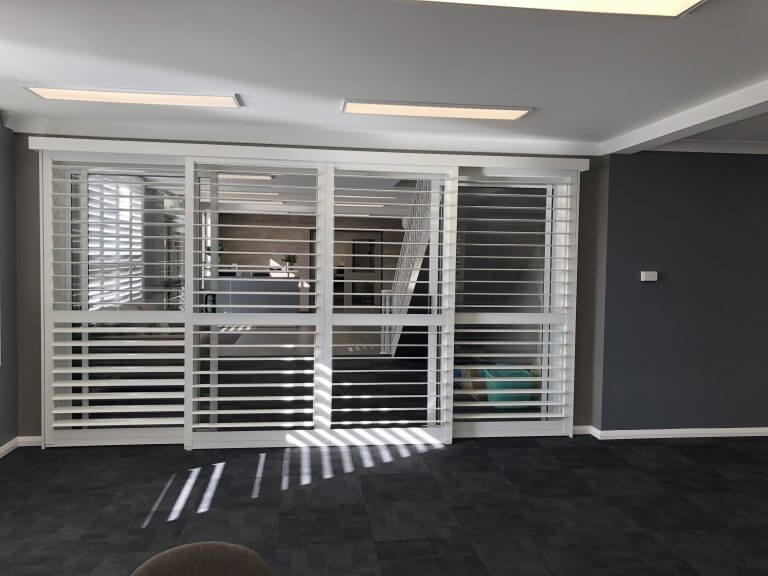
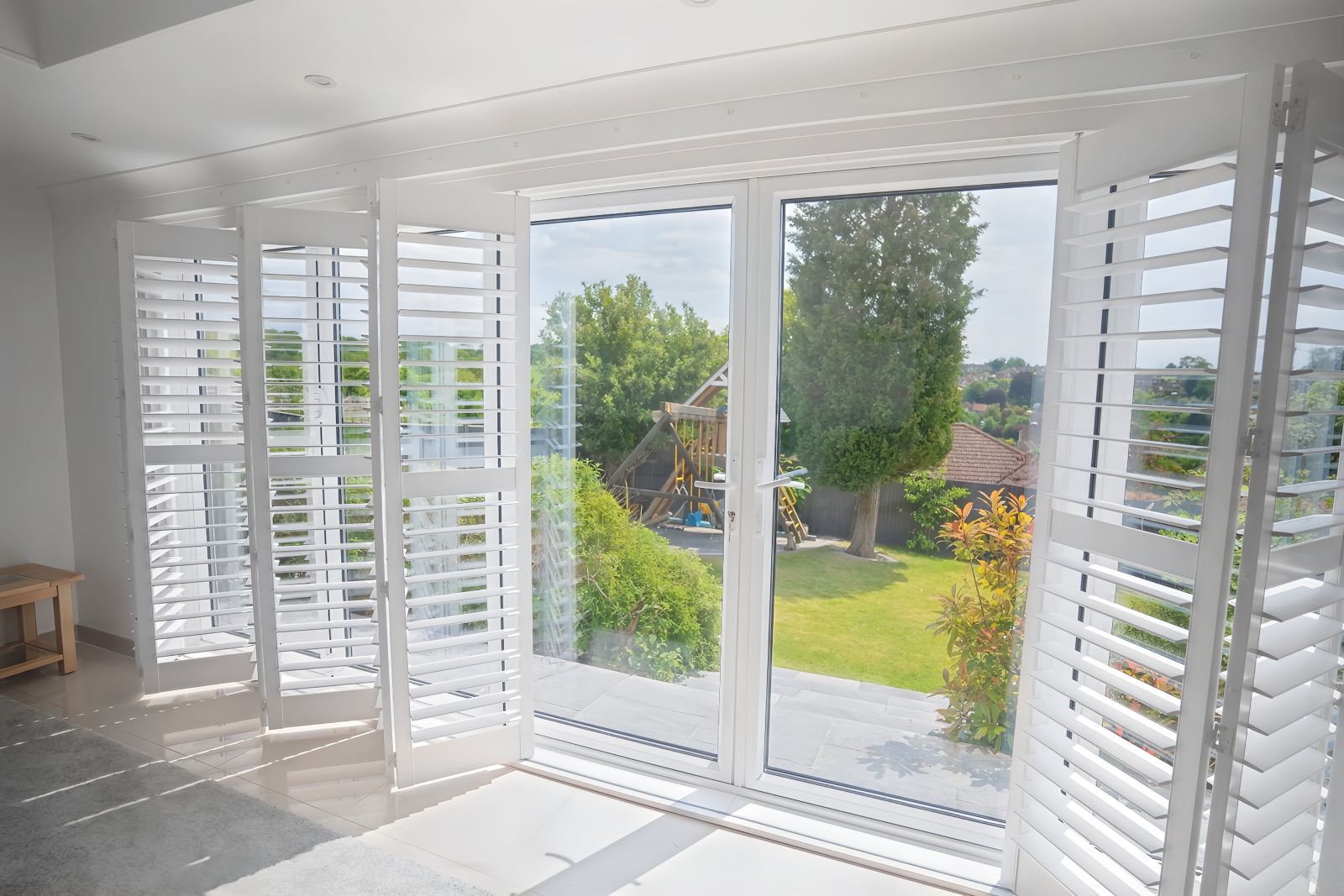
Motorisation is most commonly specified on two shutter types: louvred panels that slide across a ceiling-fixed track — typically serving wide bi-fold, sliding, or patio door openings — and full-height hinged panels on standard window openings. Tracked systems are the most natural fit for motorisation because a head-rail motor makes the entire system operable from a single control point, removing the need to reach across a wide opening to push multiple panels manually. On a 3.5m bi-fold wall covered by six tracked panels, manual operation requires moving each panel individually; a motor on the lead panel drives the full stack along the track in one action.
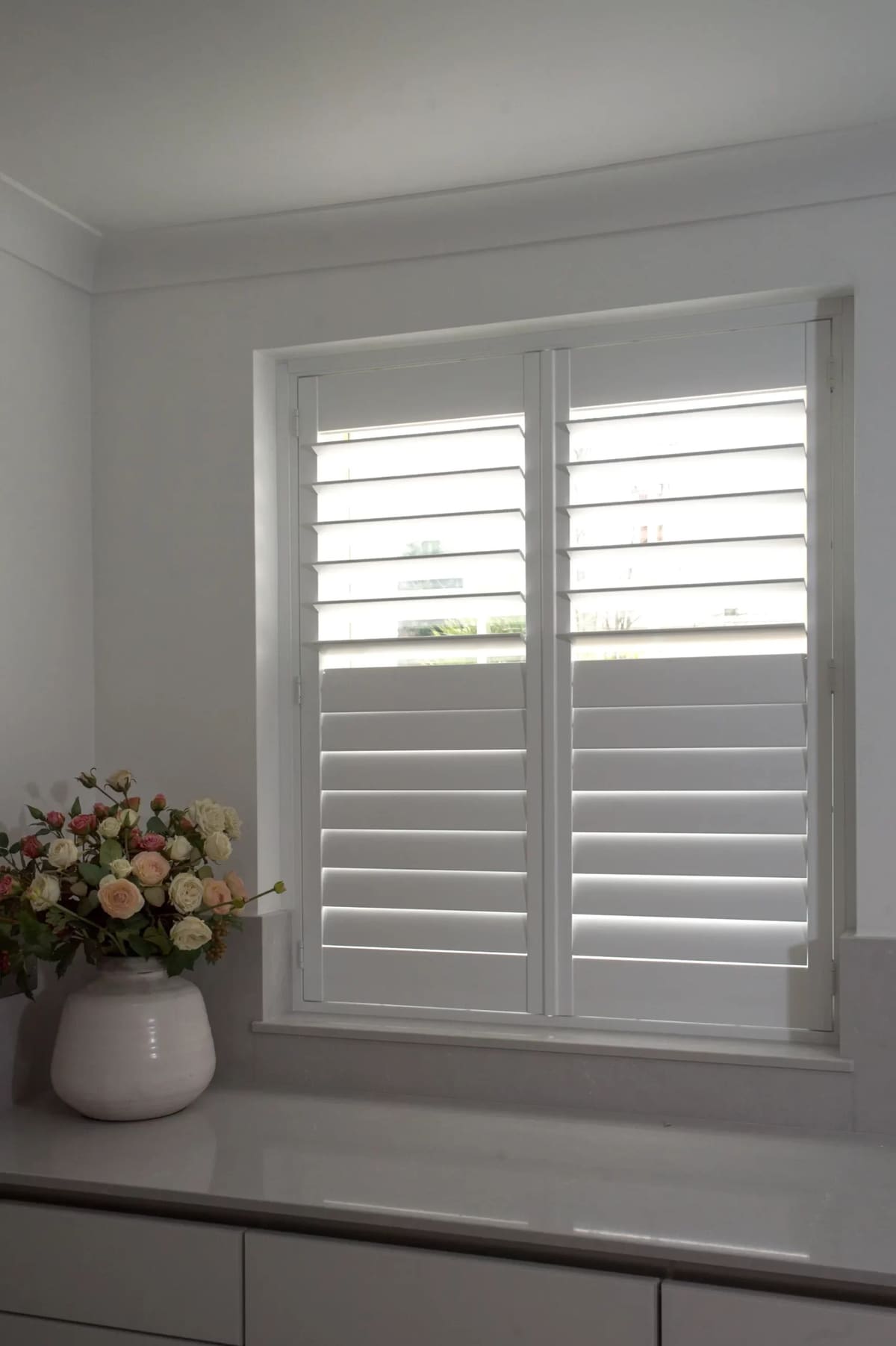
For hinged panels on standard windows, motorisation is most often specified in rooms where windows sit above comfortable reaching height, in conservatories with multiple window units, or where the occupant has a mobility restriction that makes manual louvre adjustment difficult. The motor in this configuration typically drives only the louvre tilt — the panel itself is opened and closed by hand — making it a lighter specification with lower cost and complexity than a fully motorised track system. The Dura aluminium range is the most common specification for motorised tracked installations: the extruded aluminium frame is dimensionally stable across temperature extremes, panels carry the additional motor weight without requiring reinforced hinges, and the powder-coat finish is unaffected by the minor vibration of repeated motor cycles over many years. Mimeo composite shutters support louvre-tilt motorisation on hinged panels and are a practical choice for mid-height windows where the tracked configuration is not required.
Smart home integration in 2026
The majority of motorised shutters supplied in the UK in 2026 integrate with the three principal smart home ecosystems — Amazon Alexa, Google Home, and Apple HomeKit — through a Wi-Fi or Zigbee-compatible hub. The hub connects to the home router and communicates with each motorised shutter panel; once paired, voice commands such as "close the living room shutters" or "set the louvres to forty-five degrees" trigger the motors without any physical interaction. Scheduling and automation are among the most valued features of smart shutter integration. A morning routine can open the shutters at a preset time; an evening routine can close all panels at sunset via a geofencing trigger; seasonal daylight adjustments happen automatically without manual reprogramming.
Integration with smart thermostats — Hive and Tado are both widely used across UK homes — allows shutters to close automatically when the thermostat detects solar gain is raising the room temperature above a set threshold. This solar-gain response works most effectively on south-facing rooms in summer, where manually tracking the sun angle across the day is impractical as a routine but feasible as an automated one. IFTTT automation extends integration further: closing all shutters when the front door locks as part of a leaving-home routine, or opening them when a security camera detects motion in a specific zone. The practical ceiling for most homeowners is Alexa or Google Home scheduling with a small number of custom automations; full IFTTT integration is used principally by homeowners with broader smart-home ecosystems already in place.
Where motorised shutters make the most practical difference
Wide tracked openings, south-facing rooms, and multi-room whole-house specifications are the three scenarios where motorisation delivers the clearest practical return over manual operation. For wide tracked openings of 2.5m and above — the typical span of a rear kitchen extension or a Docklands apartment's floor-to-ceiling glazing — manual operation requires walking each panel along the track by hand and then individually adjusting each panel's louvre angle. A motorised tracked system reduces this to a single button press. Shutters that are operationally easy are used more consistently, and consistently used shutters deliver their full light-management and privacy benefits rather than only in the moments when the user is willing to make the physical effort. Our detailed article on tracked shutters for bi-fold door openings covers the full range of configuration options for these wide apertures.
South-facing rooms present a solar-gain management challenge that manual shutters address imperfectly. Managing louvre angle continuously across a long summer day — tracking the sun arc to balance direct glare with usable daylight — is a task most homeowners perform once in the morning and leave unchanged until the light becomes uncomfortable. An automated schedule that moves the louvres to a shadow-casting angle at midday and returns them to a light-diffusing position in the afternoon would deliver meaningfully better indoor comfort; motorisation makes this feasible without occupant effort. For homeowners fitting shutters across an entire house — four to eight rooms, fifteen to twenty-five windows — motorisation adds whole-home remote capability that makes the installation feel like a single integrated system. The ability to close all shutters before leaving for work from a single app command, or to open bedroom shutters remotely, is practically achievable only with motorisation. Our review of how tracked shutter systems serve bi-fold and patio door openings covers the wider tracked-system landscape, including how panels and motors interact across different opening widths.
Cost, specification, and lead times
Motorisation adds approximately £120–£250 per panel to the standard supply-and-fit price for a hinged shutter with louvre-tilt motorisation, and £250–£450 per panel for a fully motorised tracked system including motor, track hardware, and smart-hub pairing. A typical three-window living room specification with louvre-tilt motorisation and Alexa integration runs to approximately £1,800–£2,400 for composite panels supply-and-fit. A rear kitchen extension with a 3.5m bi-fold opening on a full motorised tracked aluminium system with smart-home integration will typically cost £2,800–£4,200 all-in. The smart-hub device required for Alexa, Google Home, or HomeKit integration is a one-off cost of approximately £80–£150 for the whole installation, not priced per panel.
Lead times for motorised shutters are broadly consistent with standard shutters — six to nine weeks from survey confirmation to installation — with an additional one to two weeks where a smart-hub pairing or non-standard motor specification is required. The motor components are integrated into the panel during manufacture rather than fitted on-site, so the installation visit takes no longer than a standard supply-and-fit. The louvre size choice follows the same logic as manual installations; motorisation does not affect which widths are available or their light-control properties. Our guide to choosing between 47mm, 64mm, and 89mm louvre widths covers the proportioning and light-control considerations that apply whether the shutter is motorised or not. For a broader view of how motorised shutters sit within the 2026 UK window treatment market, the recent 2026 window treatment trends overview covers where motorisation is most commonly specified in new UK installations this year.
Survey, specification, and getting fitted
Book a free home survey with Shutters Factory — the surveyor assesses every window, confirms which motor specification suits each opening, and provides a fixed supply-and-fit quotation covering all motorisation components, cabling, hub hardware, and smart-home pairing. Motorised specifications require the surveyor to assess power source options: whether a mains spur is available near the installation point, or whether a battery-powered motor is the correct solution. Reveal depth and frame dimensions must also accommodate the motor housing — physical assessments that cannot be made from measurements alone, which is why a site survey is essential for any motorised shutter quotation.
Before your appointment, browse our installation gallery to see motorised tracked systems and whole-house shutter installations in finished UK homes, and compare how each configuration looks across room types comparable to your own. Our guide to shutters for large windows and wide tracked configurations covers sizing, proportioning, and material selection for wide apertures where motorisation is most commonly specified — useful background before the surveyor visits and confirms the right specification for your home.