The cord hazard: why conventional blinds raise a real risk
The hazard from window blind cords is well documented in UK child safety guidance. The Royal Society for the Prevention of Accidents (RoSPA) and the British Blind and Shutter Association (BBSA) both identify looped cords, chains, and inner cords on traditional blinds as a strangulation risk for children under five. A child can become entangled in a looped cord in seconds, often in the same room as a parent. The risk is highest for crawling babies and toddlers between approximately eight months and three years, who can pull themselves into a standing position by gripping a hanging cord before parents can intervene.
The UK introduced new regulations under BS EN 13120:2009+A1:2014 requiring that new blinds sold after a certain date either be cordless or come with fitted breakaway safety devices and cord tensioners. However, the regulations apply to new products — millions of homes still have pre-regulation blinds with looped cords fitted in them. Replacement at the point of a house purchase or renovation, or when children arrive in a home, is the practical safety step. Plantation shutters require no retrofit safety device and present no cord hazard regardless of which product line is specified. Our dedicated child safety guide covering the full cord hazard landscape explains the regulatory position and what the real-world risk looks like in more detail for families with infants and toddlers.
How shutters eliminate cord danger by design
Plantation shutters are rigid panel structures hinged to a fixed frame inside the window reveal. The louvres are adjusted by a vertical tilt rod fixed to the face of each panel — a 10–15mm diameter hardwood or composite rod that runs the height of the panel and is connected to the louvre mechanism internally. The tilt rod does not detach, does not loop, and has no loose end that could form a noose. To open and close the panels themselves, the homeowner simply pushes or pulls the panel face — no cord, no pull string, and no chain is involved at any stage of operation.
The absence of any free-hanging cord or chain is the defining safety feature. In a room with a crawling infant or a climbing toddler, there is nothing to grab, pull, or loop around a neck at any height from floor to ceiling. The bedroom shutters page covers how shutters are fitted and operated in the full context of a child's bedroom, including how to position panels so that even a fully open shutter leaves no accessible gap at cot height. For families in rental properties where permanent fixtures are not always permitted, Luma easy-fit shutters, designed for tool-free fitting without drilling, provide the same cord-free operation without requiring landlord consent for structural fixings.
Blackout for nurseries: solid panels versus louvred shutters
Sleep is the primary functional requirement in a nursery, and blackout performance is how window treatments are assessed by most parents. There are two approaches within the plantation shutter range. The first is panel shutters with no louvre gaps whatsoever — solid timber or composite boards fitting flush within the frame, with no horizontal slots for light to pass through. Closed solid panels produce near-complete light exclusion: the only light that enters the room does so through the small gap between the panel face and the frame perimeter, which is reduced to a minimum by the panel-and-frame construction. For a newborn's daytime naps or for a toddler's early-morning sleep routine, solid panels are the most effective single product for darkness.
The second approach is a louvred shutter combined with a blackout blind fitted within the window reveal behind the shutter frame. When the blind is down and the louvres are closed, darkness is complete. When the blind is raised, the louvres provide the usual precision light control — angled to admit diffused morning light, fully opened for maximum brightness during daytime play, closed at nap time without needing to lower the blind. This combination is slightly more expensive — the blind is an additional product — but more versatile as the child grows and the room's use evolves from newborn nursery to toddler room to school-age bedroom. Our complete guide to solid panel shutters covers the blackout performance in detail, including comparisons against blackout roller blinds and cassette-sealed Roman blinds on the same window type.
Tier-on-tier shutters for older children's bedrooms
As children move past nursery age and into primary school years, bedroom light management becomes more nuanced. An eight-year-old needs different light conditions for homework at a desk near the window than they do for sleeping at night or watching a screen in the evening. Independently-operated two-section shutters — split at mid-height so the upper and lower panels are hinged separately — handle this range of requirements within a single product. Close the lower panels to prevent ground-level visibility into the room from the garden; angle the upper louvres to direct afternoon light toward the ceiling for bright, glare-free desk conditions. At night, close both sections completely for full privacy and darkness.
The mid-rail split in tier-on-tier shutters typically falls at approximately the height of a standard window sill above the floor — around 900–1,100mm — which in a child's room separates the working or playing zone from the upper daylight zone neatly. For rear-facing windows where privacy pressure is lighter, louvred panels that span the window in a single continuous section are the simpler and marginally less expensive configuration. The choice between the two is best confirmed at survey, where a demonstrator panel can be held in the actual window reveal to compare the visual result. Our bedroom light control guide covers the full range of configuration options from solid blackout to graduated daylight for rooms at every stage of a child's development.
Durability and robustness in a family home
Children's rooms take more abuse than any other space in the home. The question parents frequently ask is whether shutters can withstand what children actually do to them — doors slamming, toys thrown, panels pushed and pulled impatiently. The honest answer is that plantation shutters are significantly more durable than any fabric alternative. A roller blind can be pulled off its mounting bracket in a moment of enthusiasm; a Roman blind has fabric and chain that degrade with repeated rough handling; a Venetian blind has aluminium slats that bend and tilt mechanisms that fail under impatient operation.
Plantation shutters are framed structures fixed to the window reveal by multiple structural mounting points. The panels are solid hardwood or composite — not fabric, not aluminium foil. The tilt mechanism connects louvres to the tilt rod via internal mortise joints, and the louvres themselves are typically 10–14mm thick across their full span. A louvre can be pushed firmly without bending or dislodging. In normal family use — including primary-school-aged children opening and closing their own bedroom shutters daily — the product requires no more maintenance than wiping down periodically. Our complete guide to cleaning plantation shutters covers the correct routine for maintaining shutters in family homes, including how to handle sticky fingerprints on painted panels and how often a thorough clean is actually needed.
Allergens, dust, and air quality in children's rooms
Children with allergies, asthma, or eczema benefit from low-dust window treatments. Curtains and soft roman blinds accumulate dust mites, pet dander, and airborne particles in their fabric folds — particles that are disturbed and redistributed each time the curtain is drawn. Plantation shutters have no fabric element. The louvre surfaces are smooth painted hardwood or composite — they can be wiped with a damp cloth in under two minutes and collect no embedded allergens over time.
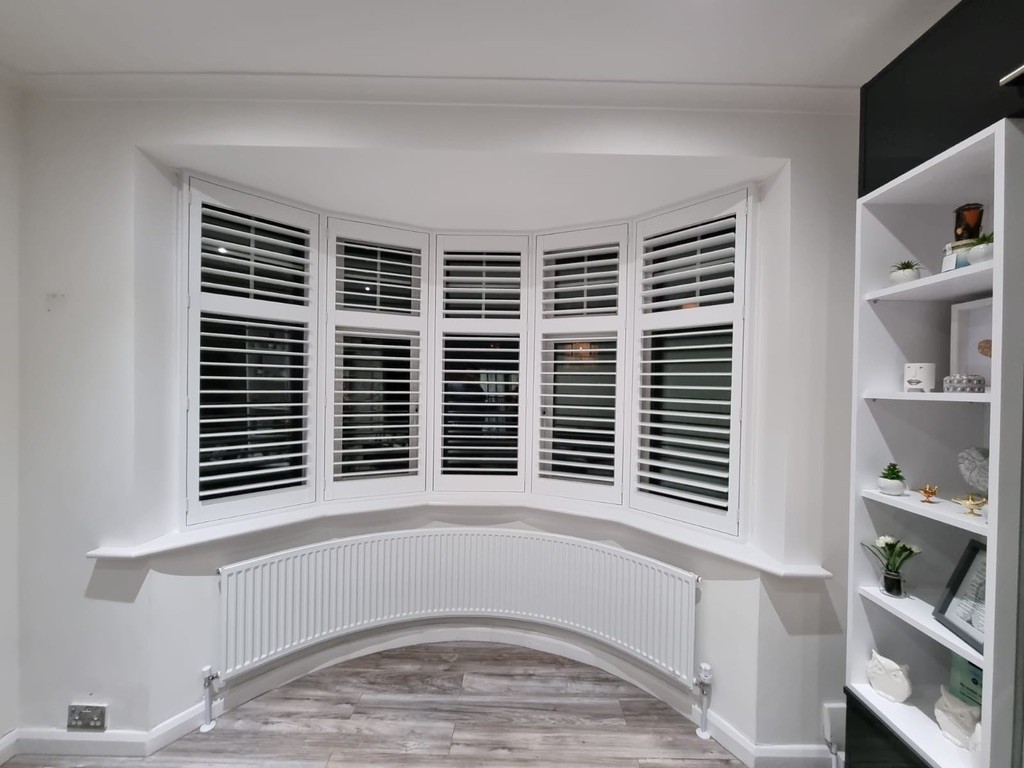
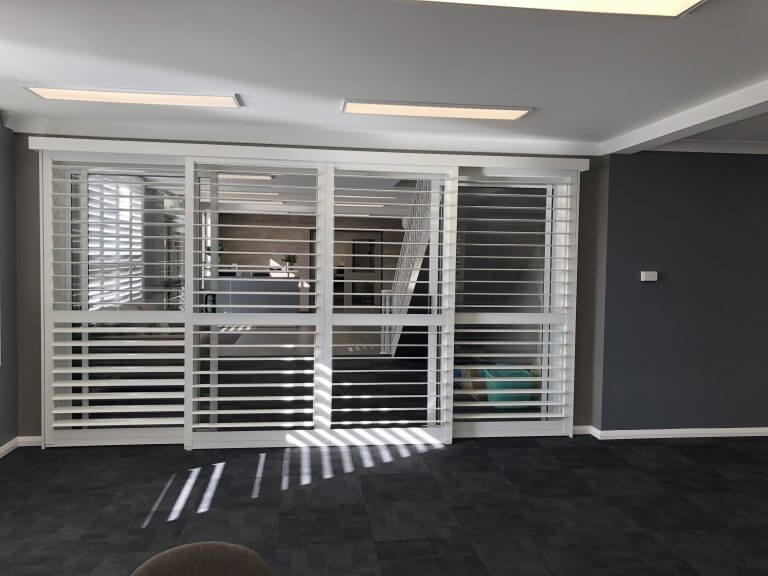
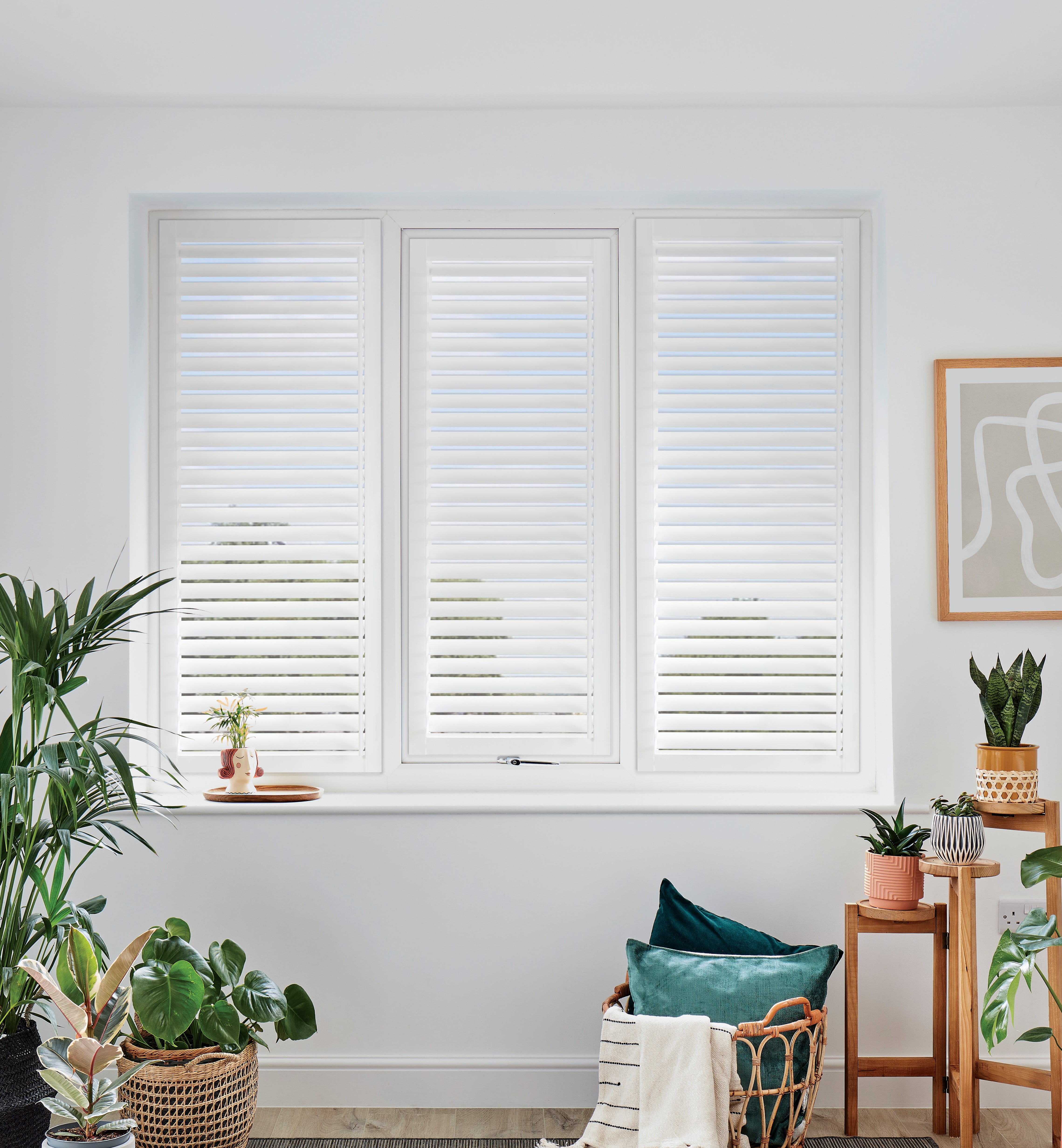
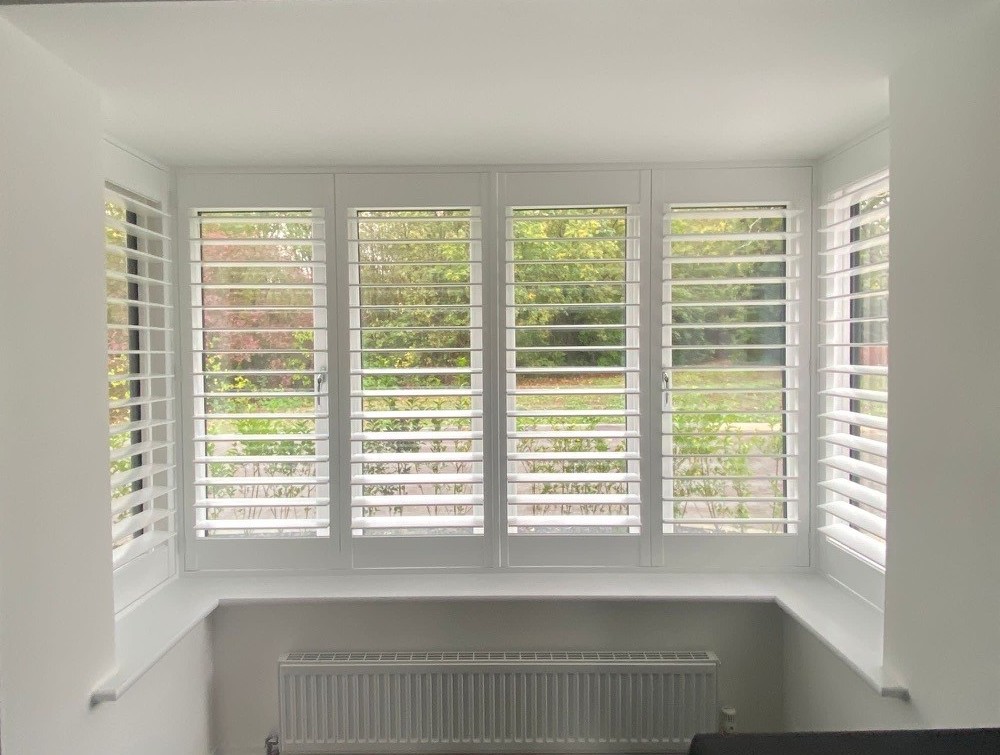
The smooth surface also makes cleaning effective rather than merely cosmetic. Wiping a louvre surface removes the accumulated dust completely; beating a curtain redistributes it. For families managing atopic conditions in a child's bedroom, the replacement of fabric curtains or blinds with plantation shutters is a commonly recommended environmental intervention by allergy specialists. Finished shutter installations across a range of children's rooms and family homes illustrate the clean, low-maintenance aesthetic that comes with an allergen-unfriendly surface finish. The same smooth surface means shutters are also practical in shared bathrooms and in kitchens where food splashes and steam are daily realities.
Prices for children's room shutters in 2026
For most nurseries and children's bedrooms, the standard material specification is moisture-resistant composite — the same material used in bathrooms — rather than hardwood. The composite panels are dimensionally stable, lighter than equivalent hardwood panels for a given width, and will not be affected by the humidity spikes common in a room with a bathroom-adjacent nursery or a child who regularly leaves a window open. Mimeo composite shutters supply and fit from approximately £350–£450 per m² for standard louvred configurations, with solid panel variants at a similar price point. A typical nursery window of 900mm × 1,100mm — approximately 1.0m² — costs £350–£500 fitted, including frame, panels, and installation.
Tier-on-tier configurations for older children's bedrooms carry a modest premium over full-height single-tier: typically £450–£550 per m² in composite, reflecting the additional frame work for the mid-rail split. Solid panel nursery shutters in composite fall within the standard louvred price range. Lead times from confirmed order to installation are four to six weeks for composite and six to eight weeks for hardwood. Book a no-obligation home survey to receive a confirmed written quote for the exact window dimensions in your child's room — the surveyor brings physical samples of all louvre widths, colour chips to match existing joinery, and solid panel examples so you can compare blackout performance directly in the room. Browse all shutter products suitable for family homes to see the full range of materials, louvre widths, and colour options before the survey.