The real comparison: upfront cost vs lifetime value
The reason plantation shutters feel expensive is simple: most window treatment budgets are built around products that cost less upfront to buy. A set of roller blinds for a living room might cost £150–£300 installed. A pair of quality lined curtains, £300–£600. A set of made-to-measure plantation shutters for the same window, £600–£900. The upfront gap is real and not worth minimising.
The comparison changes substantially when you factor in the product lifespan. A quality composite or hardwood shutter — fitted correctly and cleaned occasionally — will last 15–25 years without degradation. Roller blinds suffer from UV fading, mechanism failure, and fabric deterioration; most need replacing within 5–8 years in a south-facing room. Curtains fade, collect dust, and go out of style — the average replacement cycle in UK homes is 7–12 years. Over a 20-year window in a living room, two or three sets of curtains or blinds can easily match or exceed the cumulative cost of shutters installed once. The question of whether shutters are worth the money is, at its core, a question about the period over which you are measuring value.
What plantation shutters actually cost in the UK in 2026
Made-to-measure plantation shutters are priced by window area — typically quoted per square metre, supply and fit. For the most popular entry-level product, Mimeo composite shutters start from around £350–£400 per m² supply and fit. A standard living room window of approximately 1.2m² would cost roughly £420–£480; a typical three-bedroom house with six to eight windows is a realistic whole-house investment of £4,000–£8,000.
Stepping up to Endura hardwood shutters, prices start from approximately £550–£620 per m² for natural timber in painted finishes. Dura aluminium shutters — designed for maximum moisture resistance in bathrooms and kitchens — are priced individually based on panel configuration and span. Our dedicated UK shutter pricing guide for 2026 covers the full cost breakdown by product, room, and panel configuration, and our detailed cost breakdown article walks through exactly what drives price differences between quotes.
How shutters compare to curtains, blinds, and other treatments
An honest side-by-side comparison across the main alternatives shows why shutters are a genuinely different proposition rather than simply an expensive version of the same thing. Curtains are warm, soft, and effective at insulation, but they block the whole window when drawn and provide less precise light control. They require dry-cleaning or washing, fade in UV light, and collect more dust and allergens than hard surfaces — a meaningful consideration in homes with allergy sufferers. Roller and Venetian blinds are space-efficient and relatively affordable, but their mechanisms wear out and fabric and PVC surfaces degrade in direct sunlight within a few years.
Our article on window shutters vs curtains compares the two in detail across different room types, and our shutters vs blinds comparison gives a frank product-by-product assessment. The consistent finding is that shutters outperform both alternatives on longevity, light control precision, and low maintenance — but that curtains remain preferable in rooms where softness and insulation are the priority, such as bedrooms in cold-climate properties. For most living rooms, hallways, home offices, bathrooms, and kitchens, shutters win the total-value comparison convincingly.
The durability case: why longevity changes the maths
The most compelling argument for plantation shutters as a value investment is their durability. Unlike fabric window treatments, shutters have no component that degrades from UV exposure, washing, or humidity. The louvres, frame, and panels of a well-manufactured composite or hardwood shutter retain the same colour, structural integrity, and finish in year fifteen as they did in year one — provided they are cleaned occasionally and handled correctly.
Mimeo composite shutters are moisture-resistant and do not warp, crack, or swell in bathroom and kitchen environments where wood products would fail within a few years. Dura aluminium shutters are salt-spray tested and designed for coastal environments where corrosion affects virtually every other material. The maintenance requirement for any shutter is modest: a wipe down with a damp cloth every few weeks keeps surfaces clean and louvre mechanisms smooth. Our guide to cleaning plantation shutters properly covers the correct upkeep routine for all materials and finishes. There are no liners to replace, no mechanisms to lubricate, and no specialist cleaning required. The total cost of ownership over 20 years is very close to the initial installation price.
Privacy, light control, and what that is worth daily
The financial case for shutters is strengthened by the practical value they deliver in daily use. Full-height shutters with adjustable louvres allow you to manage light direction, intensity, and privacy on a continuous spectrum — from fully open panels admitting maximum daylight, to louvres tilted upward to direct diffused light toward the ceiling, to fully closed panels for complete blackout. This granularity is not matched by curtains (which are binary: open or closed) or by most blind systems (which struggle to direct rather than simply block light).
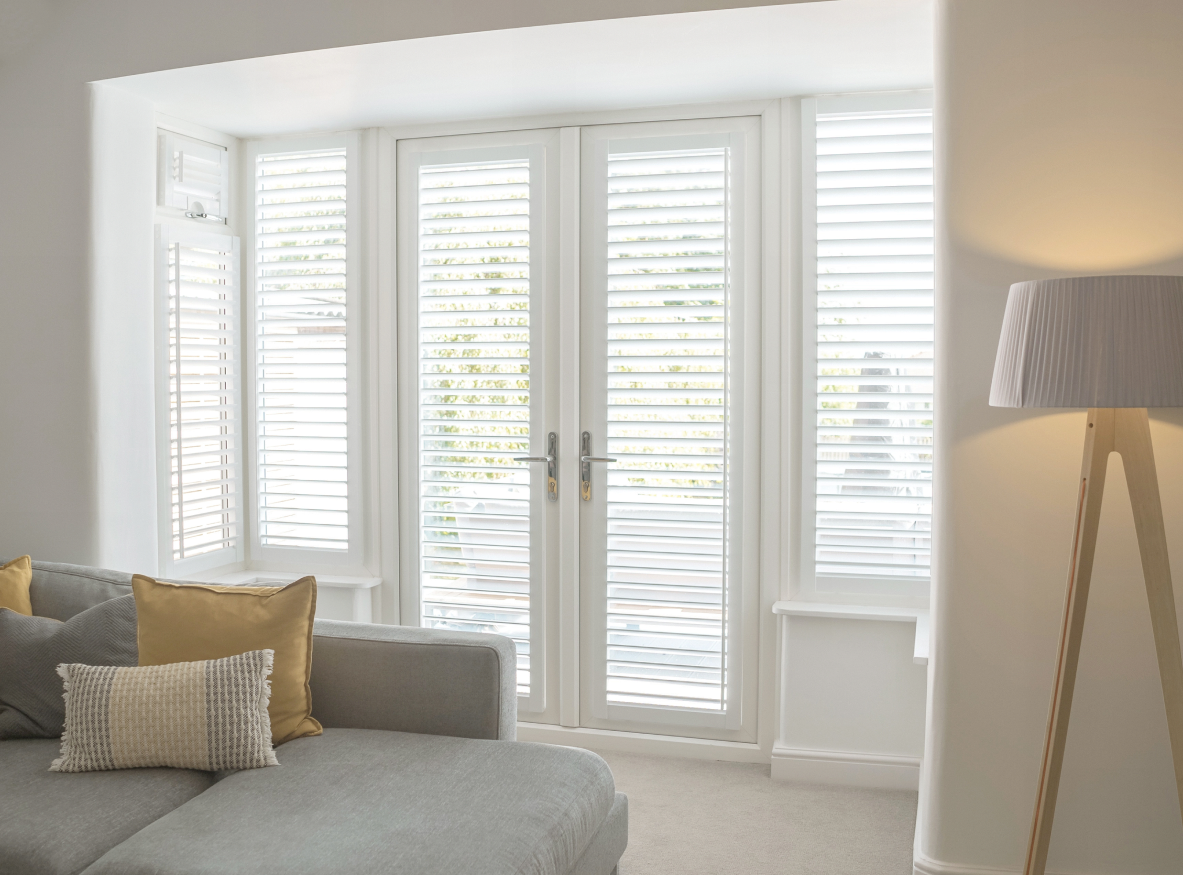
For a home office, the ability to angle louvres to eliminate monitor glare while maintaining daylight reduces eye strain through a working day. For a bedroom, closed louvres or solid panels provide genuine light exclusion without blackout liners, pelmets, or secondary treatments. For a ground-floor living room, the lower panels of tier-on-tier shutters can be kept closed for full street-level privacy while the upper panels admit bright daylight from above — a combination that fabric treatments cannot replicate at any price. Browse our shutters gallery to see how this works in real UK homes across different window types and rooms.
Do shutters increase property value?
There is no large-scale academic study on the specific property value impact of plantation shutters in the UK, and any supplier who cites precise percentage uplifts is extrapolating beyond the available evidence. What is well established anecdotally — and supported by estate agents and home staging professionals — is that shutters read as a premium finish in the buyer market. Properties presented with plantation shutters in key rooms photograph better, feel more considered to prospective buyers on viewings, and often feature in the rental market as a distinguishing characteristic that justifies a higher asking rent.
The more reliable way to frame the value question is to consider whether the investment is recoverable on sale, rather than whether it delivers a measurable uplift. In most mid-to-high-value London and South East markets, plantation shutters installed throughout a property are regarded as part of the fixture rather than a consumable. They remain with the property on sale and are viewed favourably by buyers who would otherwise need to budget for window treatments themselves. Whether or not this translates to a higher offer price depends on the overall condition and competition in the market — but it rarely reduces value, and in most cases recovers the installation cost at minimum. For a wider overview of plantation shutters across the UK residential market, see our complete UK plantation shutters guide.
When shutters are — and are not — the right investment
Shutters are worth the money in the majority of UK domestic situations: living rooms, bedrooms, home offices, bathrooms, kitchens, and hallways where the windows are regularly used, where light control and privacy genuinely matter, and where the occupants intend to remain in the property for at least several years. If you own rather than rent, the investment calculus is clear. If you rent the property, Luma easy-fit shutters offer a no-fix, no-drill installation that moves with you — a meaningful exception to the general rule that made-to-measure shutters are a permanent fixture.
Shutters are a harder sell in two scenarios: temporary accommodation where you cannot or will not be recovering the value on sale, and very large glazing areas where the total installation cost is genuinely beyond budget and a phased approach is the only viable option. In those cases, the right answer may be to start with the highest-impact room — typically the ground-floor living room or main bedroom — and phase the rest over subsequent years. Book a free home survey to get a room-by-room quote and a clear total cost before deciding how to phase the investment. The survey is free, takes under an hour, and gives you an exact price to weigh against the alternatives — with physical samples of every product in your own home, under your own light conditions. Browse all shutter products and ranges before the survey to narrow down which materials and styles interest you most.