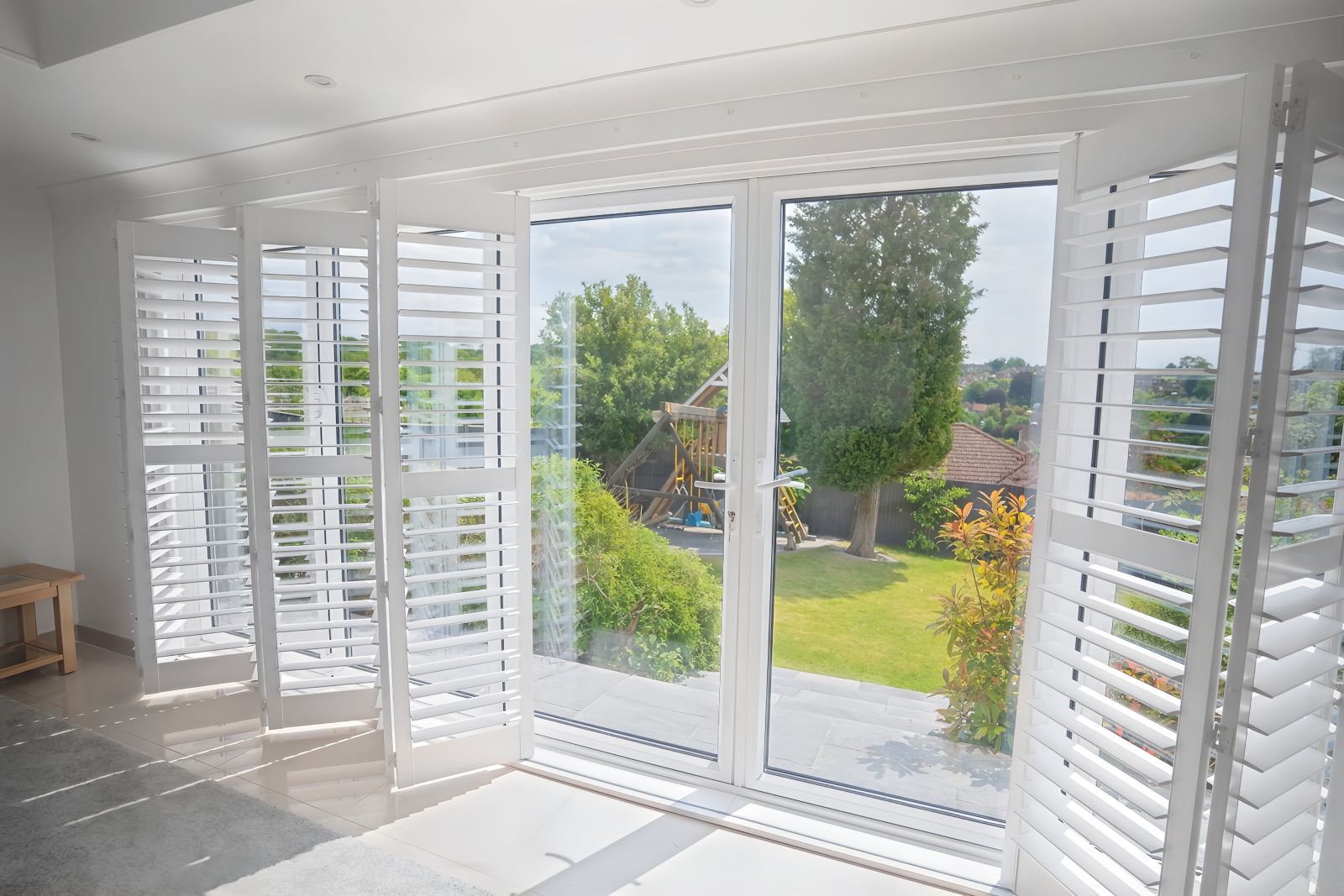
What “tracked” actually means
A tracked shutter sits on a top rail and slides sideways like a wardrobe door. When you want the doors open, you slide all the panels to one end and they stack flat against the wall. When you want privacy or shade, you slide them across the opening.
Compare with hinged shutters: those swing open into the room. On a 4 m bi-fold opening, hinged panels would need 4 m of clearance to fold out, which is rarely available. Tracked shutters solve that.
Where tracked shutters earn their money
They are not a style choice — they are a structural one. Use tracked when:
- Patio doors and bi-folds — the obvious case. Wide opening, no room to swing hinged panels.
- Wraparound corner glazing — tracks can run continuously round a corner.
- Long runs of fixed glazing — orangeries, garden rooms, lounge bay extensions.
- Doorways without clearance — internal door openings where furniture sits close to the wall.
How the panels stack
Three stacking layouts cover almost every install:
- End-stack — all panels slide to one end. Cleanest look, needs wall space equal to one panel width on the stack side.
- Centre-meet (bi-parting) — panels split, half slide left, half slide right. Suits symmetric openings.
- Bypass — panels slide on two parallel tracks past each other. Used when there is no wall to stack against.
Materials and span
Tracked shutters carry their own weight on the top rail, so material choice affects how wide a single panel can be:
- Composite (Mimeo): up to 800 mm per panel. Suits standard 2.4–3.6 m bi-folds with 4–5 panels. See Mimeo composite.
- Hardwood (Endura): up to 750 mm per panel. Best for indoor patio doors where the look matters. See Endura hardwood.
- Aluminium (Dura): up to 1.2 m per panel. The right choice for very wide openings (5 m+) or where you want fewer, larger panels. See Dura aluminium.
How much do tracked shutters cost?
Tracked installs cost more than hinged because of the track hardware and tighter manufacturing tolerances. For a typical 3 m wide × 2.1 m tall bi-fold opening (~6.3 m²), expect:
- Composite: £2,800–£3,400 supply and fit
- Hardwood: £3,400–£4,400 supply and fit
- Aluminium: £4,200–£5,500 supply and fit
- Add 10–15% for centre-meet or curved tracks
Mistakes to avoid
Three things go wrong on tracked installs:
- No wall to stack against. Buyers forget that end-stack panels need wall space — measure your stack zone before deciding on layout.
- Track sag. On wide spans, a cheap track will sag in the middle within a couple of years. Insist on aluminium tracks with proper bracing.
- Too few panels. Fewer, wider panels look elegant but stack into a thicker bundle. More, narrower panels stack thinner — better when wall space is tight.
Tracked vs hinged — quick decision
If your opening is wider than 2.4 m, or you have no clearance to swing hinged panels into the room, tracked is the right call. For anything narrower with normal room clearance, hinged is cheaper and looks more traditional.
Want a fixed quote for your specific opening? Book a free survey — we will measure the opening, work out the panel split, and confirm the right material in one visit.