Are shutters classified as fixtures or fittings?
In English and Welsh property law, the distinction between a fixture and a fitting determines whether an item must remain with the property on sale. A fixture is something affixed to the building in a permanent or semi-permanent way — attached with screws into the wall or reveal — and is legally presumed to transfer with the property unless the vendor explicitly excludes it in the sale contract. A fitting is a freestanding or simply hung item that the vendor may take without agreement.
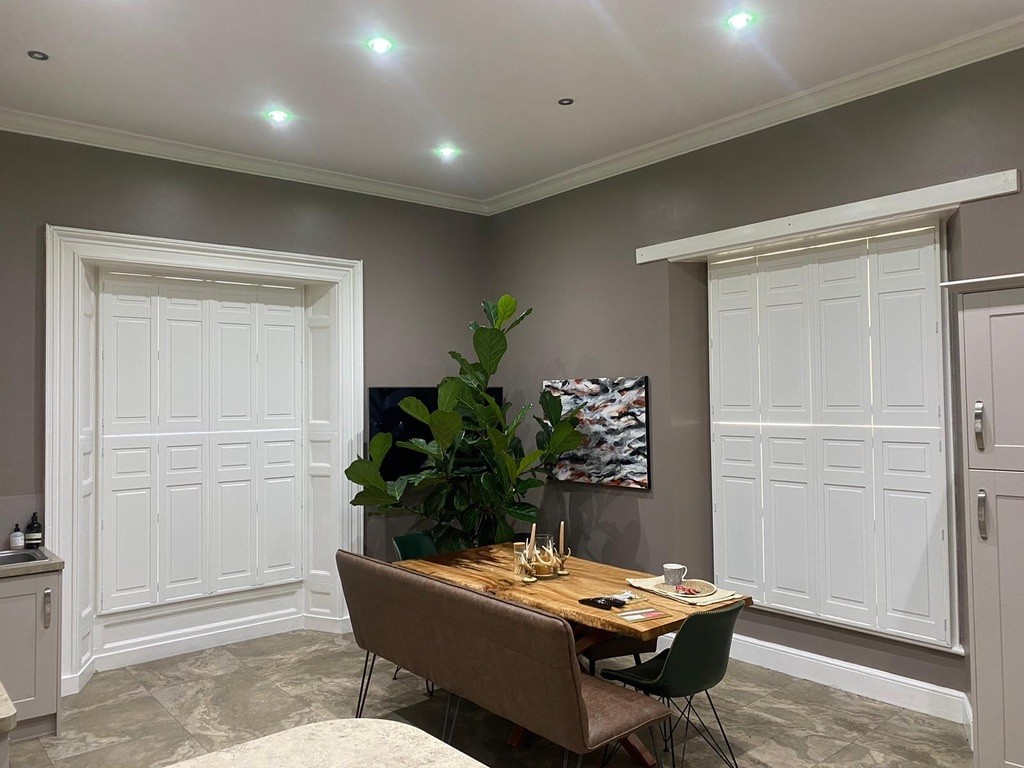
Plantation shutters occupy a legally grey position. They are screwed into the window reveal or wall-face and are not freestanding, which leans toward fixture classification. However, they are decorative window dressings rather than structural, which leans the other way. In practice, the seller's solicitor must list any items being removed on the TA10 (Fittings and Contents) form, and a failure to disclose removal — arriving at completion to find bare windows where shutters were photographed in the listing — constitutes a breach of contract. The safest course is to declare the intention to remove shutters early, agree it in writing with the buyer, and allow the sale to proceed on that basis. If the buyer objects and the shutters are a condition of the sale, the value of the shutters can be factored into the negotiated price. For context on the full range of supply and fitting services provided — including re-installation at a new property — the Shutters Factory services page sets out what the process involves from survey through to completion.
The practical reality of moving made-to-measure shutters
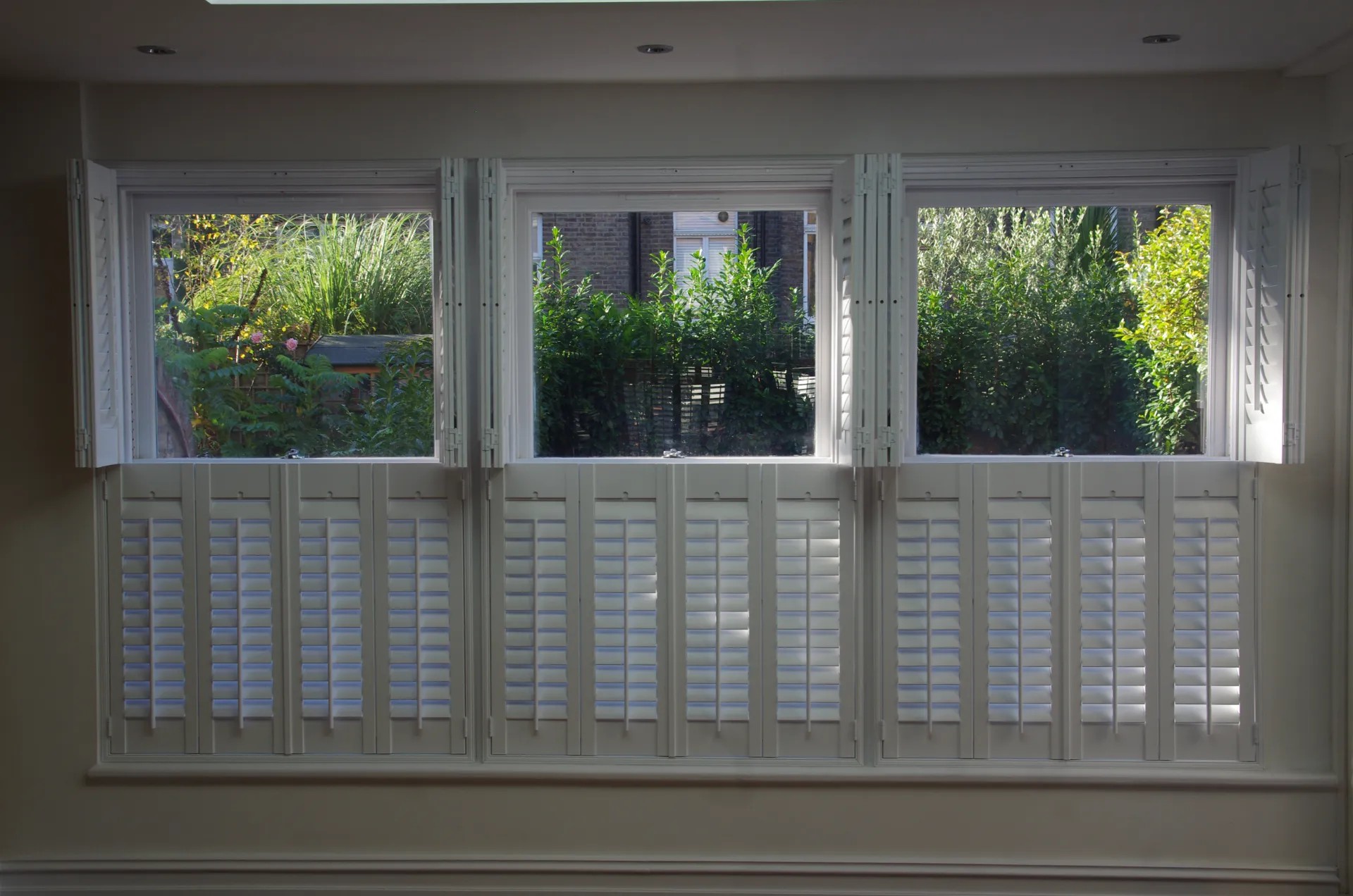
Made-to-measure shutters are cut to the millimetre for the window they were installed in. A window at your current property that is 900 mm wide and 1,200 mm tall will have shutters whose panels are dimensioned for that exact opening — typically two panels at 448 mm each with a small clearance gap, hung in a frame routed into the reveal at that specific depth. The probability that a window at your next property matches those dimensions precisely is very low. Even a 10 mm difference in width means the panels will not close flush; a difference in height means the frame cannot be seated at the correct depth in the new reveal.
There are two scenarios where removal and re-use is genuinely worth considering. The first is where the new property has windows of very similar dimensions — common within a single housing development where a builder used identical window units throughout. The second is where the shutters are from the Luma easy-fit range, which is designed to mount onto a standard window bead rather than a fitted reveal frame. Luma panels have more tolerance for dimensional variation because the mounting bracket adjusts slightly — though they are still sold in specific size increments and re-use depends on those increments matching the new window. For all other made-to-measure shutter ranges — hardwood, composite, and aluminium — re-fitting a panel from one property to a different-sized window is not practical.
How to remove plantation shutters without damaging them
If you have confirmed that removal makes sense — either because the windows match, or because you plan to store the shutters while the new property is under construction — the de-installation sequence matters both for preserving the panels and for leaving the reveal in a good state for the buyer.
Begin with the panels: open the shutters fully and unclip the magnetic catch at the centre stile. The panels are hung on pin hinges — a vertical pin seated in a socket on the top and bottom of each hinge leaf. Lifting the panel vertically by a few millimetres disengages the pin from the socket. Have a second person support the panel as it is lifted clear, particularly for larger panels with 89 mm louvres, which are heavy. Wrap each panel in moving blankets immediately, louvre-side inward, and stand them upright in storage rather than flat — flat stacking places uneven pressure on the louvre blades and can crack them.
The frame itself is secured with screws into the window reveal and sealed with decorator's caulk around the perimeter. Use a sharp craft knife to score through the caulk line before applying any force to the frame — attempting to lever out the frame without cutting the caulk will split the paintwork in the reveal. Once the caulk is scored, the fixing screws are removed and the frame lifts out. Fill the screw holes in the reveal and redecorate before completion so the buyer does not receive a property with exposed holes in the window surrounds. For the step-by-step installation process in reverse — which also illustrates how the frame seats in a reveal — the shutter installation process guide covers fitting in detail and is useful reference for a careful de-installation.
Storing shutters between properties
Plantation shutters are not designed for long-term storage and will suffer if stored incorrectly. Timber shutters — whether hardwood or paulownia — must be stored in a dry, climate-stable environment. A garage or loft that experiences temperature extremes and humidity fluctuation is the worst possible storage location: timber expands and contracts with moisture, and panels stored in damp conditions can warp, causing the frame joints to open or the louvre blades to stick in their sockets. A spare room or a climate-controlled self-storage unit is the correct approach for any period longer than six weeks.
Mimeo composite shutters are more tolerant of storage conditions because cellular PVC does not absorb moisture in the same way as timber, but they are still susceptible to distortion if stored flat under weight. All panels should be stored vertically on their stile edge, supported at each end, and wrapped to prevent dust and surface abrasion. Keep the frames and panels from the same window together, labelled clearly — a property with four windows generates eight or more panels plus four frames, and any confusion about which panel belongs to which frame will waste significant time during re-installation. For a comparison of how different shutter materials — timber, composite, and aluminium — respond to environmental conditions, the shutter materials comparison guide covers long-term durability in detail.
When leaving shutters with the property is the better decision
In most moves, the most straightforward financial decision is to leave the shutters as part of the sale and commission new shutters for the new property. Shutters add demonstrable value to a property sale: estate agents consistently report that fitted shutters photograph well, read as a quality specification, and attract comment from prospective buyers. Leaving a full installation — particularly in a bay-windowed Victorian terrace or a period conversion where shutters are expected — can strengthen the listing and support the asking price.
The cost comparison also tends to favour replacement rather than removal and re-fitting. Professional de-installation of a four-window property costs £200–£350. Storage for three months while a new purchase completes costs £80–£180. Re-installation at the new property — assuming the panels fit, which is the assumption most likely to fail — costs £150–£250. Total: £430–£780 for panels that may not fit the new windows. A new set of shutters at the new property, surveyed and manufactured precisely for those windows, typically starts at £800–£1,200 for a two to three window specification, and the result is guaranteed to fit. For an overview of what new shutters cost and what the supply-and-fit service includes, the supply-and-fit guide covers the pricing structure and what is included from survey to installation.
Ordering shutters for your new property
If you decide to start fresh at the new address — which is the right choice for most movers — the timeline for ordering shutters matters for move-in planning. Standard made-to-measure shutters have a lead time of five to seven weeks from survey to installation. The survey must take place after you have access to the property, which typically means after exchange of contracts at the earliest (when access can be agreed with the vendor) or after completion.
A survey booked the week after completion and a five-week lead time means shutters arriving around six weeks after you move in — a period during which temporary curtains or blinds are the practical window covering. Plan for this in the move-in budget and avoid the assumption that shutters will be ready for day one. For the full breakdown of lead times and what happens at each stage between survey and fitting, the shutter lead times guide explains the ordering timeline in detail. To see the range of shutter styles — full-height shutters, tracked systems, shaped panels, and café-style designs — that can be specified for any window type at the new property, browsing the styles pages is a useful starting point before the survey.
Getting shutters right the first time at the new address
A move is an opportunity to reconsider your window treatment specification from scratch — something that is rarely possible when you are adding to an existing installation. The new property may have different window types, different room uses, and different privacy requirements to the home you are leaving. A bay window in a front reception room may call for a different configuration to the sash windows at the rear; a basement kitchen may benefit from a different louvre size to a first-floor bedroom. Rather than assuming the same specification that worked previously will translate, a free home survey at the new address covers every window in one visit and produces written recommendations for each room.
Book a free home survey for your new property — the surveyor visits at a time to suit the completion schedule, measures every window, advises on material and style choices for each room, and provides a written quotation. There is no obligation to proceed, and the survey can be booked in advance of completion so the appointment is ready to take place immediately after you have keys. To explore shutter styles and finishes before the survey, the completed installations gallery shows real projects across a wide range of property types, window configurations, and room settings — a useful reference for arriving at the appointment with a clear sense of what you want.