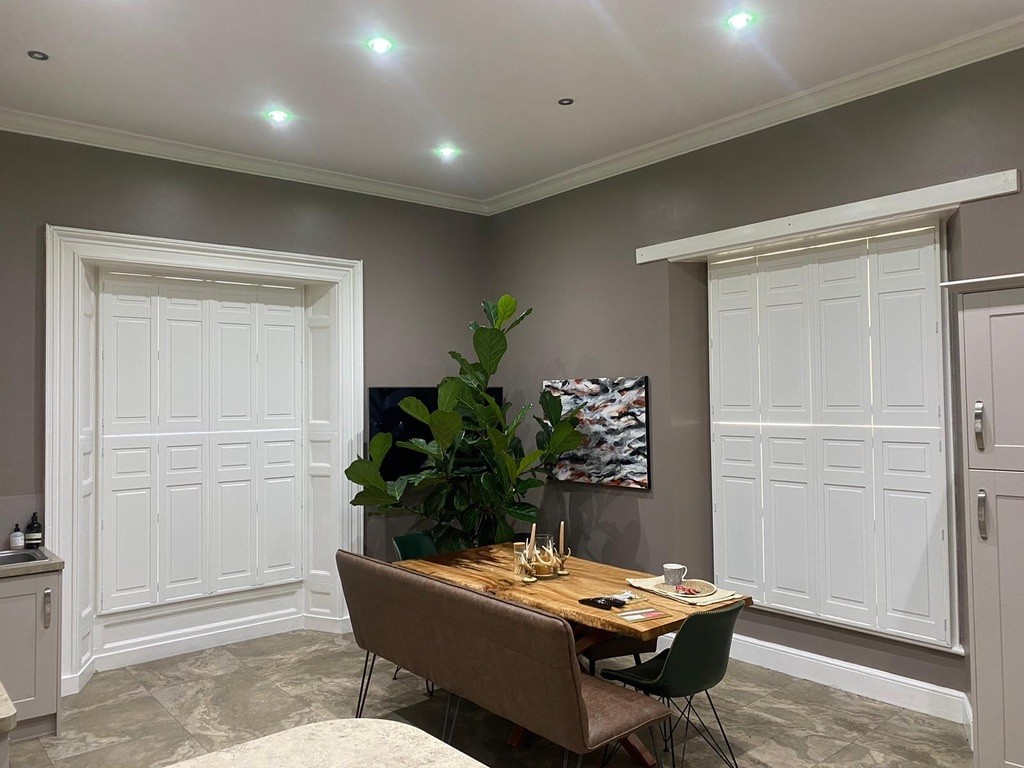
What solid panel shutters are — and how they differ from louvred shutters
Solid panel shutters are plantation shutters in which each shutter panel is a single continuous flat board rather than a frame carrying adjustable louvres. When the panels are closed, there is no gap between them and no gap around their edges (provided the reveal is squared correctly at survey). The result is a completely opaque barrier across the window opening.
Standard louvred shutters — whether full-height shutters, tier-on-tier, or café style — control light by adjusting the angle of the slats. Tilting the louvres to 45 degrees admits oblique daylight; closing them flat reduces but does not eliminate light transmission, because light still enters along the length of each louvre. For most rooms this is more than sufficient. For the rooms where total blackout is the priority, a louvred shutter will always fall short — and a solid panel will not.
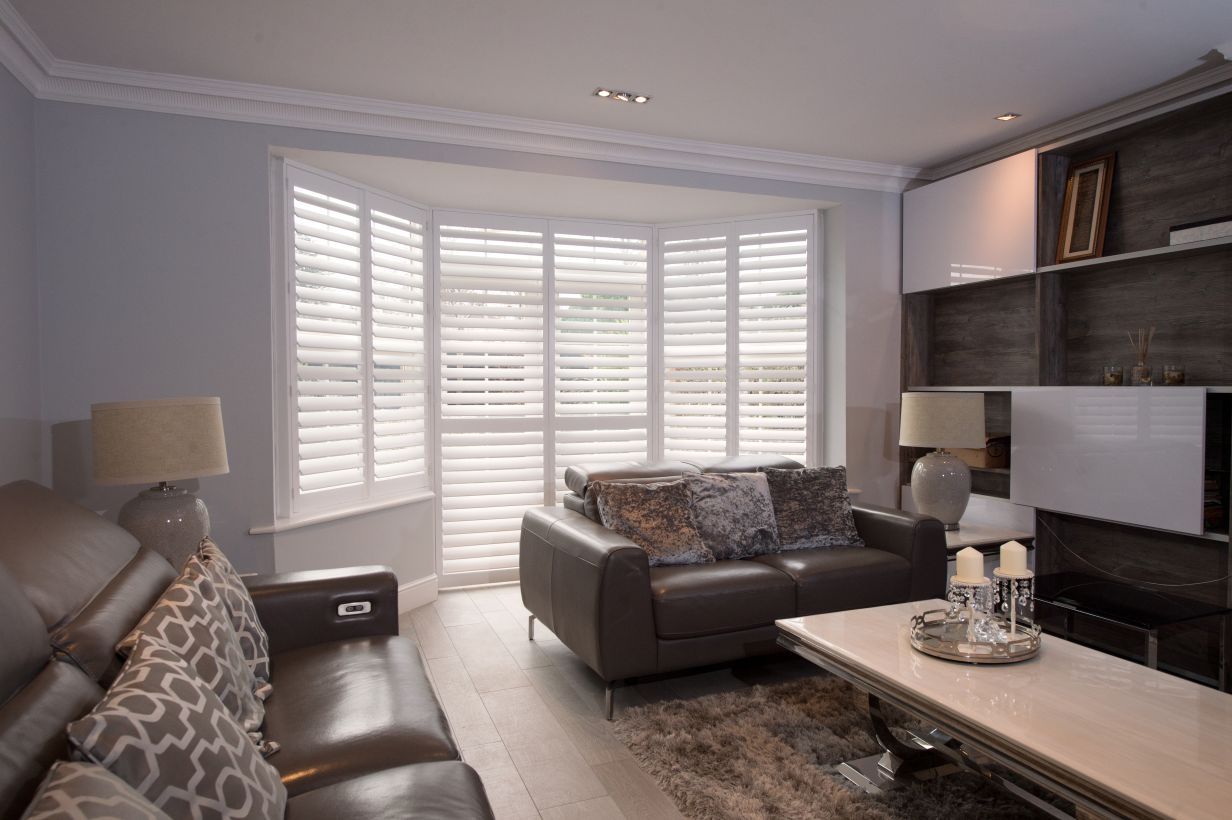
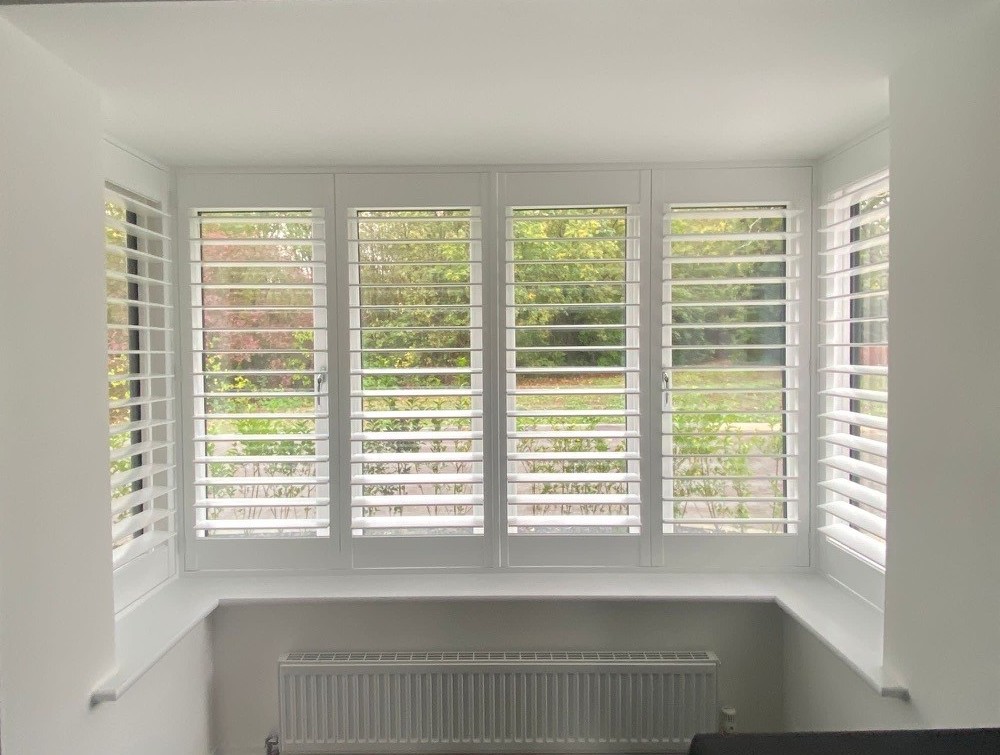
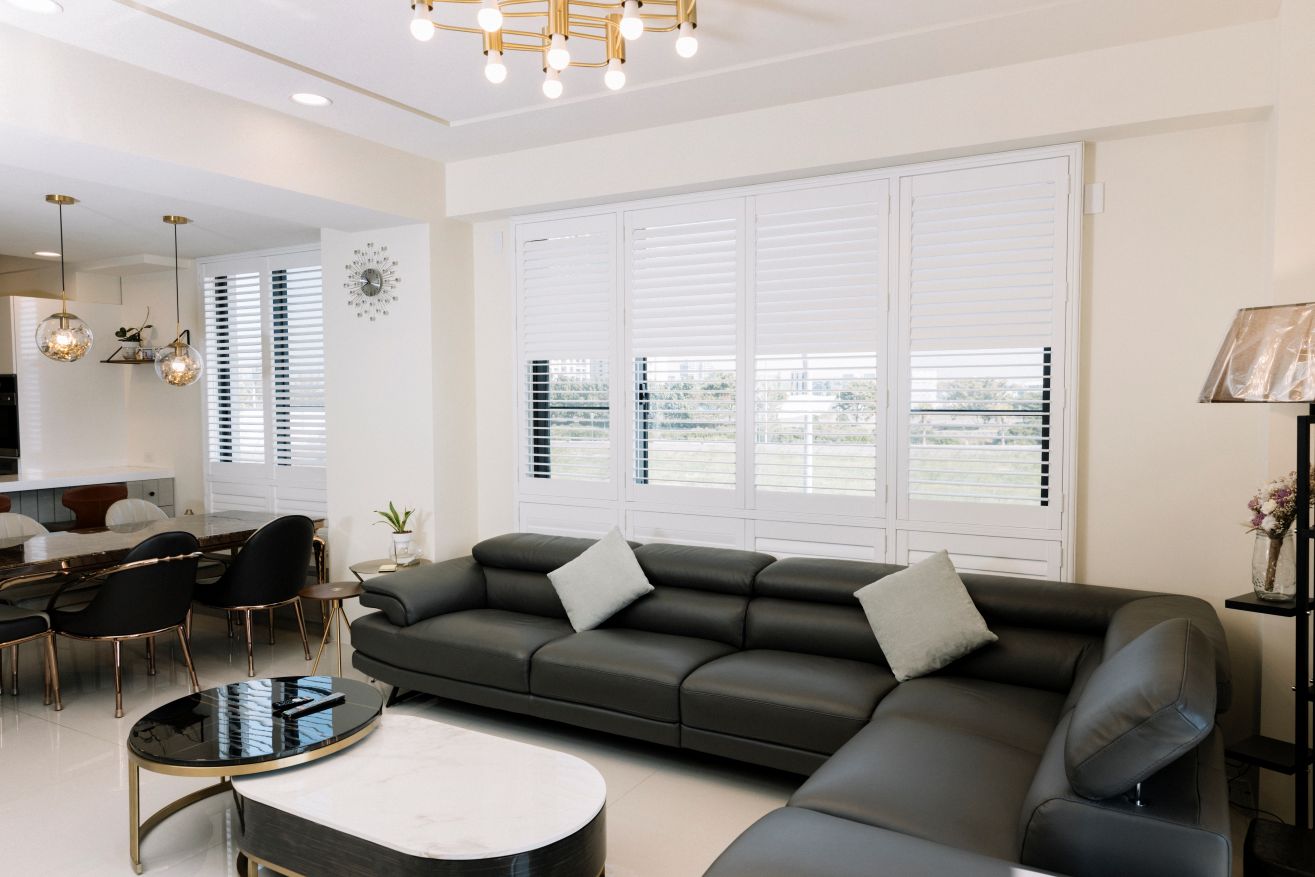
The operating mechanism is the same as for louvred shutters: solid panels are hinged to a fixed frame fixed into or face-mounted onto the window reveal, and they fold back against the reveal wall when you want the window fully open. From the street, they look identical to a closed louvred shutter. From inside with the panels closed, the room is dark.
The situations where solid panels beat louvred shutters decisively
Solid panel shutters make sense in a specific and well-defined set of circumstances. They are not a universal upgrade — for most living rooms and kitchens, the light-control flexibility of louvred panels is exactly what the room needs. But in these cases, the solid panel is the correct specification and nothing else achieves the same result.
- Shift workers and irregular sleepers — a nurse, paramedic, or overnight warehouse worker sleeping through the middle of a June day needs genuine blackout, not reduced light. A louvred shutter at full close still admits enough light at 9 am on a south-facing window to disrupt sleep. A solid panel does not. This is the clearest single case for solid panels in residential installation.
- Nurseries and young children's rooms — controlled sleep patterns in early childhood are strongly associated with reduced late-afternoon light. A bedroom that stays dark for the nap window — 1 to 3 pm on a summer afternoon — is a meaningfully different environment from one where louvre bleed fills the room with diffused light. Solid panels are the non-chemical alternative to blackout lining and blackout blinds that often fail to seal around their edges.
- Home cinemas and media rooms — a dedicated viewing room depends on controlled darkness for daytime use. Louvres at full close significantly reduce ambient light but do not eliminate it; in a west-facing room at 4 pm in summer, louvre bleed is enough to wash out a projected image. Solid panels close the room down to genuine cinema conditions without requiring blackout curtains over the top.
- South- and west-facing bedrooms in summer — even homeowners with no professional reason to sleep in daylight find that strong afternoon sun through a west-facing window shortens sleep. Solid panels in a west-facing master bedroom solve the summer waking problem without needing additional window dressings over the shutters.
- Ground-floor rooms requiring complete privacy — a ground-floor bedroom or study on a busy pedestrian route, a basement conversion, or any room where a louvred shutter at full close still permits a view-through in strong side-lighting. Solid panels eliminate the view from outside in every lighting condition. For more on designing privacy into window treatments, see our guide to shutters for privacy.
Solid panels in bedrooms and nurseries — the primary case
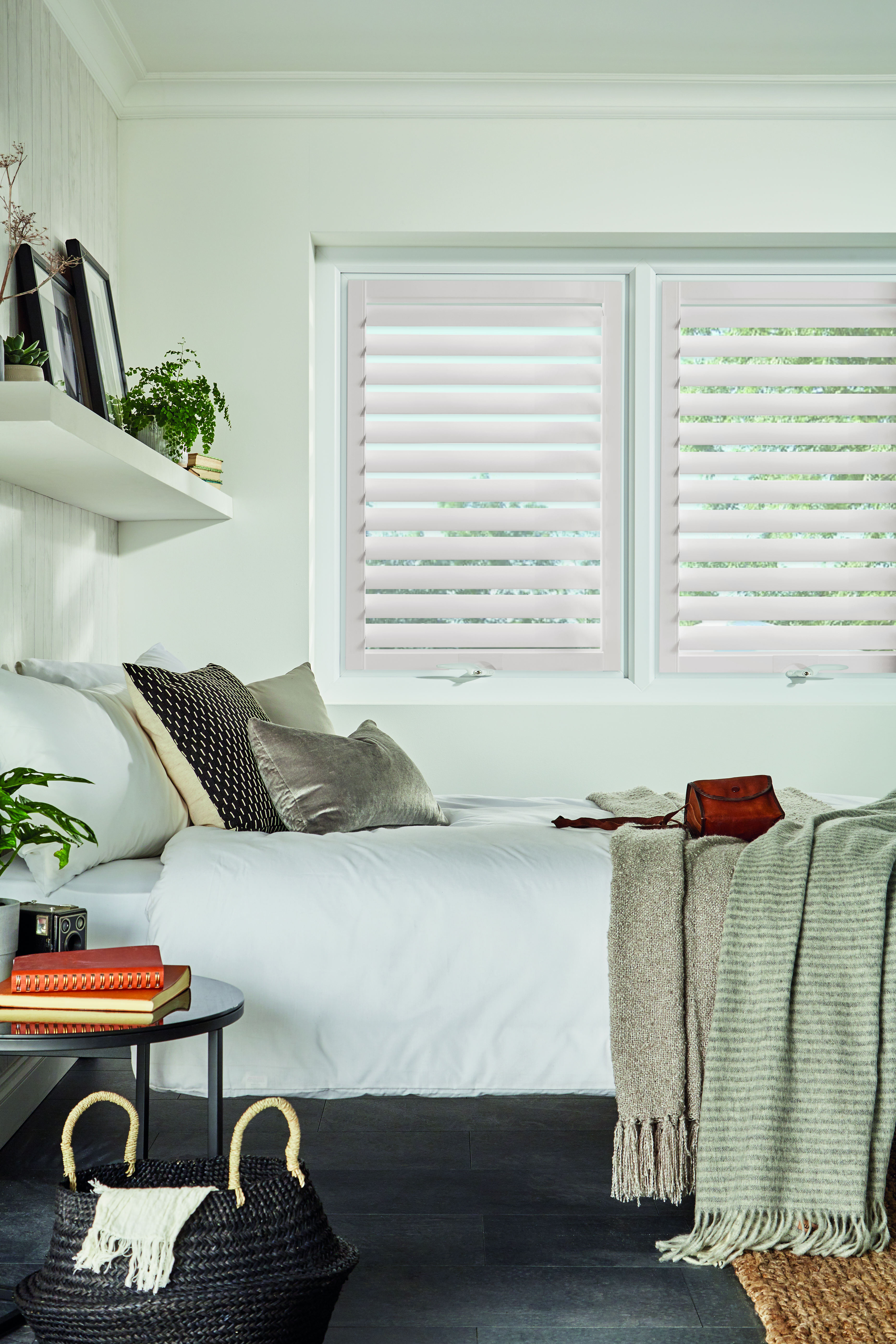
Bedroom shutters account for the majority of solid panel installations. The bedroom is the room where light control is most directly consequential — sleep quality, morning mood, and the ability to rest during daylight hours are all affected by how much light enters during closed-panel periods. Louvred shutters handle the bedroom well for most people in most conditions; solid panels handle it for everyone in all conditions.
For nurseries specifically, the practical advantage of solid panels over competing blackout products is the absence of cord hazards and the durability of the installation. Blackout roller blinds with a blackout cassette edge seal are the most common alternative; they work well when new but the seal degrades at the edges over two to three years, and the cord mechanism presents a safety concern. Solid panel shutters have no cord, no edges to degrade, and a lifespan measured in decades rather than years. For a full picture of how shutters address cord safety in family homes, see our child safe shutters guide.
The combination of blackout and thermal performance is worth noting for bedrooms. A solid panel shutter traps a significantly larger air pocket between the glass and the panel than a louvred shutter at full close, because there are no gaps for convective air movement. In a bedroom with a single-glazed sash window — common across London's Victorian and Edwardian housing stock — this makes a noticeable difference to overnight temperature and to the amount of external noise that reaches the sleeping area.
Thermal and acoustic performance — what solid panels add
Insulation is a secondary benefit of solid panel shutters, but in the right building it is a significant one. The air gap trapped between a closed solid panel and the window glass acts as an additional insulating layer — similar in principle to a secondary-glazing panel but installed without any alteration to the window itself. For a detailed breakdown of how shutters reduce energy bills by material and configuration, see our guide to shutters for insulation.
In a Victorian terrace with single-glazed sash windows — a window type with a U-value typically around 4.8 W/m²K — a well-fitted solid panel shutter reduces effective overnight heat loss through that opening by a meaningful margin. The same property in mid-winter benefits from closed solid panels in bedrooms that are not in overnight use, effectively reducing the heated zone of the house at the glass-and-reveal boundary.
Acoustic attenuation follows a similar logic: more mass and fewer gaps means more sound absorption. A solid panel shutter on a street-facing bedroom window in a period terrace on a busy road reduces the overnight noise intrusion noticeably compared with a louvred shutter at full close. The reduction is not comparable to double or triple glazing — it is in addition to whatever glazing the window already has — but for light sleepers disturbed by early morning delivery traffic or late-night pedestrian noise, it makes a real difference. For a broader look at how solid panels compare against other shutter configurations, see our detailed guide to solid panel shutters for blackout and insulation.
Material choices for solid panel shutters
Solid panels are available in the same three materials as louvred shutters. The correct choice depends on the room, the building, and the level of specification required.
Composite (Mimeo) is the practical default for bedrooms, nurseries, and any room where moisture, durability, or cost is a consideration. Mimeo composite solid panels are completely waterproof, wipe clean, and will not warp or crack through the seasonal temperature cycles of UK homes. At around 25–35% less per square metre than hardwood, composite is also the sensible specification for the multiple-room orders common when solid panels are being specified across a whole floor of bedrooms. The finish in standard whites and off-whites is clean and well-suited to both period and contemporary interiors.
Painted hardwood (Endura) is the choice for principal bedrooms and rooms where the interior finish level demands a material with real weight and depth. Endura solid panels accept a custom paint match to existing skirting boards and architraves — important in a period room where the shutters need to read as part of the room's architecture rather than an addition to it. In a Georgian or Victorian bedroom with surviving original cornicing and timber window surrounds, hardwood at the correct paint specification is the obvious choice.
Aluminium (Dura) is less commonly specified for solid panels than for louvred configurations, because the primary use cases for aluminium — wide-span patio openings, bi-fold doors, tracked systems across large glazed areas — are rarely the situations where blackout is the priority. Dura aluminium solid panels are available for those cases where they arise: a studio with floor-to-ceiling glazing, a media room with a wide glazed wall, or a basement bedroom with a large light-well opening that needs both solid coverage and rust-resistant hardware.
Realistic 2026 pricing for solid panel shutters
Solid panel shutters are priced similarly to louvred shutters of the same material and configuration — the manufacturing difference is in the panel construction rather than the frame or hardware, and the overall supply-and-fit cost difference is modest. All figures below are supply-and-fit, covering survey, manufacture, frames, hardware, delivery, and installation.
- Standard bedroom sash window, composite solid panel: from £390 per m² supply and fit
- Standard bedroom sash window, painted hardwood solid panel: from £570 per m² supply and fit
- Typical single sash window (approx. 1.0 m × 1.2 m), composite solid panel: from £470 total supply and fit
- Bay window solid panels (three panes, mitred frame), composite: from £1,350 total supply and fit
- Bay window solid panels (three panes, mitred frame), hardwood: from £1,750–£2,300 total supply and fit
- Louvred shutters for comparison — composite from £380 per m², painted hardwood from £550 per m²
- Custom paint colour on hardwood solid panels: add approximately £80–£120 per window
Getting started — survey, quote, and what to expect
The survey process for solid panel shutters is the same as for any shutter order. We measure every opening, check reveal depth and squareness, confirm the mounting method, and photograph every window. Solid panels are particularly sensitive to reveal alignment — a slightly out-of-square reveal that a louvred shutter tolerates because light leakage is minimal becomes more visible with a solid panel, where the goal is a clean flush close. At survey, we account for any out-of-square condition and manufacture the panels accordingly.
You receive a fixed written quote within 48 hours of the survey visit, covering panels, frames, hardware, delivery, and installation. Lead times are the same as for louvred shutters in the same material: 4–6 weeks for composite solid panels, 6–8 weeks for painted hardwood. Custom-colour hardwood solid panels take 8–10 weeks.
Browse the full range of materials and styles at Shutters Factory products before the survey if you want to arrive with a material preference already in mind. For visual reference on how solid panels look installed across different room types, explore the shutters gallery. To book a free home survey and get a fixed all-in quote, book a free home survey — we confirm pricing within 48 hours with no obligation to proceed.