Why nurseries need a different approach to window treatment
Most rooms in a house have a simple window treatment brief: control the light, maintain privacy, and look appropriate with the interior. A nursery asks for something more demanding. The room needs to function in near-darkness during the middle of the afternoon, when a sleeping infant cannot distinguish between a nap and bedtime if the room is flooded with light. It also needs to achieve genuine darkness by early evening — a 7 pm bedtime for a toddler is common, and on a July evening in the UK the sky outside is still bright at that hour. Any window treatment that allows a band of light around its edges, or that requires supplementing with a blackout curtain lining to do its job, introduces complexity that undermines the room's core function.
The second consideration is cord safety. Standard roller blinds, Roman blinds, and Venetian blinds all use pull cords or chains to operate. The UK's child safety guidance is clear: looped cords and chains on window blinds are a strangulation risk for children under five, and the Royal Society for the Prevention of Accidents has consistently urged parents to eliminate them from any room used by young children. Made-to-measure plantation shutters are operated via a tilt rod or hidden gear mechanism — a fixed element within the panel frame — and have no loose cords, dangling chains, or pull loops at any point in their design. They are cord-free by construction, not by modification. For a detailed breakdown of the cord hazard and how to assess existing window treatments in a family home, the child-safe shutters guide for parents covers the regulatory position and what to look for room by room.
A third consideration — less urgent than darkness and safety, but real over the years ahead — is durability and washability. Nurseries are not gentle environments. A fabric blind accumulates dust on a surface that cannot be wiped; a curtain hem trails across a carpet that has been crawled on; a fabric treatment absorbs the odours of a room that regularly needs airing. A composite or painted timber shutter panel wipes clean with a damp cloth, holds no fabric fibres that trap allergens, and is robust enough to withstand the curiosity of a toddler who has discovered they can reach the window. The treatment that works well at six months works equally well at three years and beyond.
Blackout performance: louvred panels versus solid-panel shutters
The question most parents ask first is whether a louvred shutter can achieve the same blackout as a blackout blind. The honest answer is that a well-specified louvred panel — with a tight louvre overlap and a sub-frame that sits flush against the window reveal on all four sides — blocks the vast majority of incoming light. The louvres, when fully closed, overlap their neighbours by several millimetres and admit no direct light through the blade faces. The frame, if measured and fitted correctly, leaves no gap between the panel edge and the plasterwork. The result is a room that reads as dark to the eye and that satisfies the sleep requirements of most infants and young children.
For light-sensitive sleepers, or for nurseries on east-facing aspects that receive direct morning sun at the angle most likely to find gaps at the top of the frame, the better specification is a solid-panel shutter. Solid-panel shutters replace louvred blades with a continuous flat board across each panel — timber or composite, painted to match the frame — that provides complete surface coverage with no louvre gaps at all. When the panel is closed and the frame sits flush in the reveal, there is no path for light to enter through the panel face. Light can still enter at the very edge of the frame if the reveal is not perfectly square or if the sub-frame depth does not fill the reveal completely, but the panel face contribution to light ingress is eliminated. Solid-panel shutters also have excellent acoustic properties — the continuous panel face absorbs more sound energy than the louvred equivalent — which is a secondary benefit in a room where ambient noise can disturb sleep.
For deeper guidance on when solid panels outperform louvred shutters and in which room types the difference is most material, the guide to solid-panel shutters and their blackout and insulation properties sets out the full comparison. The practical recommendation for a nursery is straightforward: if the baby or toddler is a light sleeper or if the window faces east or south, specify solid panel. If the room has limited direct sun exposure and the child sleeps reliably in low-light conditions, a well-fitted louvred panel will be sufficient and gives greater flexibility as the room transitions away from nursery use over the years ahead.
Child safety: cord-free hardware throughout
Every plantation shutter installed by Shutters Factory is cord-free. There are no pull cords for raising or lowering the panel — the panel is hinged at the frame and is pushed open or pulled closed by hand. There are no operating chains for tilting the louvres — the louvres are connected to a tilt rod running vertically through the panel, and the rod is turned by a finger push directly on the louvre face or on a small gear-driven nub at the edge of the panel. There is nothing in the design that produces a hanging loop or a free end of cord at any height. The magnetic catch mechanism that holds the panel closed when not in use has no exposed mechanical parts and does not require a pull or a tug to open — the panel swings free when the finger pushes the edge of the panel inward.
This cord-free design is not a safety modification applied to a product that is otherwise corded. It is the standard configuration of every shutter panel in every range — Mimeo composite, paulownia, hardwood, and aluminium. Parents do not need to specify a special child-safe variant or pay a premium for cord-free hardware. The absence of cords is the baseline. For a fuller explanation of why this matters in practice and how the cord-hazard risk in UK homes compares with the regulatory environment, the cord-free shutter safety guide covering every product line is the most thorough reference available on the subject.
Materials for nurseries: what performs best near a cot
The two material families most commonly specified for nurseries are composite and paulownia. Both are available with 76 mm louvres — the mid-range louvre size suited to standard bedroom window proportions — and both are painted with a durable factory finish that does not require periodic refinishing or waxing.
Mimeo composite shutters are the more resilient choice for nurseries where moisture is a factor. Nursery humidifiers — commonly used to raise air humidity during dry winter months and to ease infant congestion — release water vapour into the room air, and timber-based panels absorb this moisture over time. Composite panels are made from a polymer core that does not absorb water, will not warp through seasonal humidity cycles, and holds its factory paint finish without the micro-cracking that can occur in timber when it repeatedly swells and contracts. The composite panel surface is smooth, non-porous, and wipeable with a damp cloth — important for a room that will be cleaned regularly. Composite is the pragmatic default for any nursery where a humidifier is in use, where the window is above a radiator, or where the room faces a damp elevation with limited sun exposure.
Paulownia shutters — available in the Strato and Graino ranges — are a lighter, timber-feel alternative suitable for nurseries with stable, well-ventilated conditions. Paulownia is a fast-growing hardwood that is lighter than most domestic timber species, naturally resistant to moisture at normal domestic humidity levels, and finished with the same durable factory paint as the composite range. For a nursery in a modern well-insulated house with double glazing, good heating, and no humidifier, paulownia is entirely appropriate and gives the panel a slightly warmer, more furniture-like quality. For a full comparison of all materials and how they perform across different room conditions, the Shutters Factory product range shows each option with finish samples and installation photographs.
Style choices: full-height panels and the room beyond the nursery years
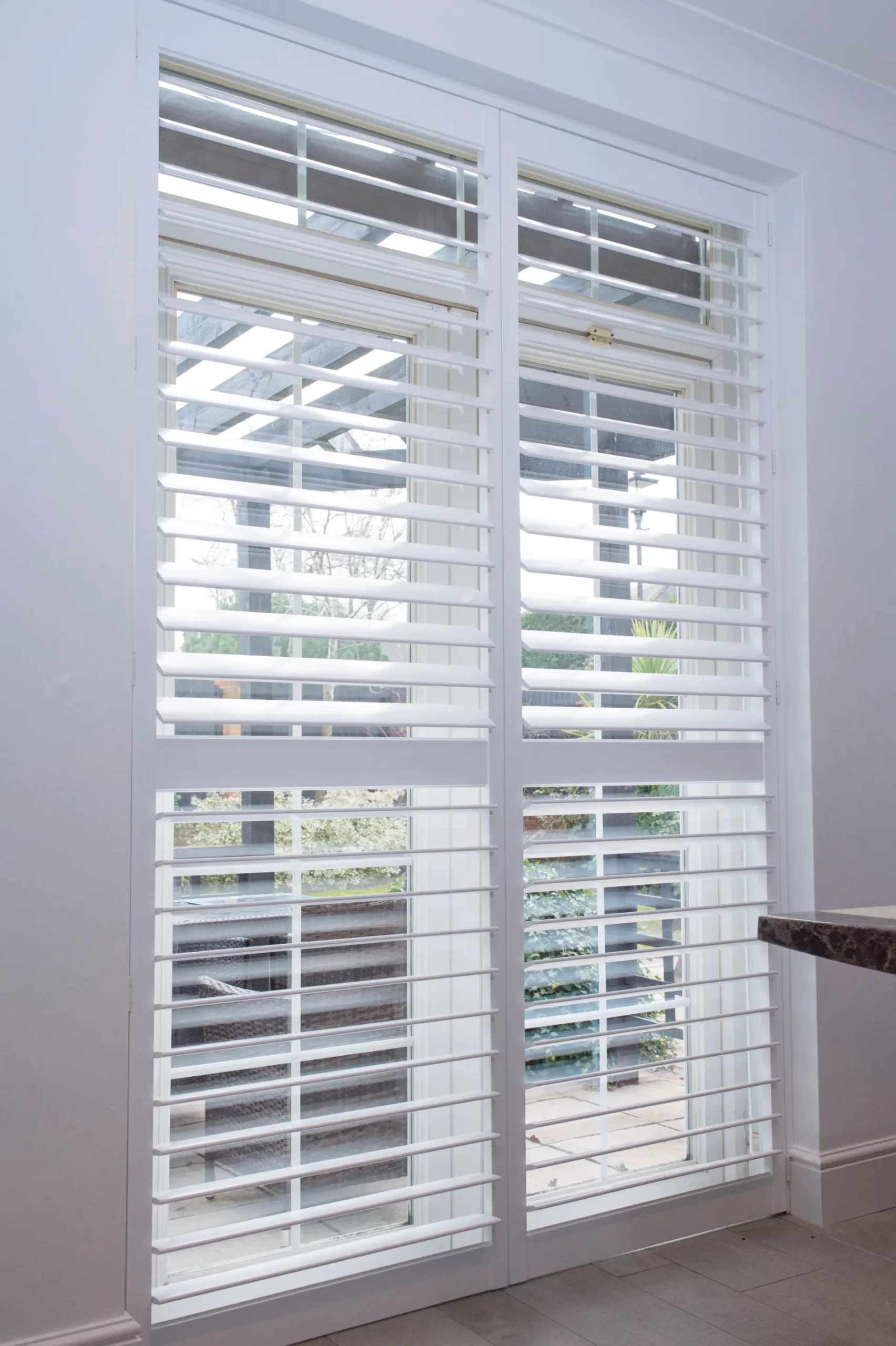
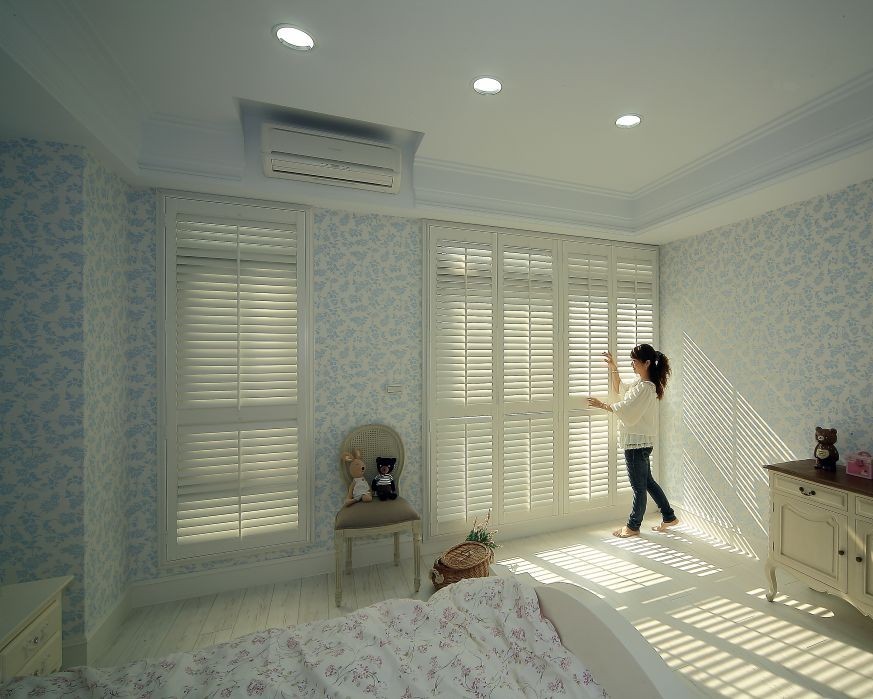
The most appropriate shutter style for a nursery is a full-height panel covering the complete window from head to sill. A nursery window does not need the upper-and-lower independent operation of a tier-on-tier panel — the room is used for sleep, not for the split-light management that tier-on-tier achieves in a street-facing living room. A full-height panel with either solid boards or tightly overlapping louvres covers the entire opening, installs cleanly within the reveal, and operates with a single push of the panel edge. Full-height louvred panels are the most versatile choice if the parents intend to use the same shutters as the child grows older and the room transitions from nursery to toddler room to child's bedroom — the louvres provide light flexibility that a solid panel does not, and a solid-panel installation can always be replaced by a louvred panel within the same sub-frame at a later date.
The internal link from this room to the rest of the house is worth considering from the outset. Bedroom shutters across all ages and room types — from a newborn nursery to a teenager's bedroom — follow the same installation logic: a made-to-measure panel in a bespoke sub-frame fitted within the window reveal. Parents who specify nursery shutters as part of a wider house installation — covering the main bedroom, a second bedroom, and the nursery in a single survey and order — benefit from a single consistent material and finish across all rooms, a single fixed-price quotation, and a single installation appointment rather than three separate visits. The surveyor covers every window on a single visit, and the order is placed and manufactured as a single batch. For guidance on how shutters perform specifically in the full range of bedroom types — from box rooms used as nurseries to large principal bedrooms — the complete guide to bedroom shutter light control and privacy is the most detailed reference for parents planning a bedroom floor.
Pricing and what to expect at the survey
In 2026, indicative prices for nursery shutters are consistent with the standard bedroom range. A single window of typical nursery proportions — approximately 700 mm wide by 1,100 mm tall — in composite or paulownia with 76 mm louvres costs approximately £440–£620 supply and fit, including the survey, manufacture, and installation appointment. Solid-panel shutters on the same window run approximately £480–£680 depending on material and frame configuration. A slightly larger window — 900 mm wide by 1,200 mm tall — in the same materials costs approximately £520–£720 in louvred form or £560–£760 in solid-panel form. Lead times from confirmed order to fitting are currently six to eight weeks across the composite and paulownia ranges.
The free home survey is the right starting point for any nursery installation. The surveyor measures the window precisely — noting reveal depth, the squareness of the aperture, the position of any radiator below the sill, and the room's aspect and light exposure — and places physical sample boards in the aperture so the blackout performance of different louvre overlaps and panel options can be assessed in the room's own conditions. For a nursery, this is particularly useful: the surveyor can demonstrate the difference between a louvred panel in the closed position and a solid-panel specification in the same reveal, which gives the parents a direct comparison before committing to a specification. The quotation provided at the end of the survey is fixed-price and covers supply and fit; there is no obligation to proceed. To arrange a survey at a day and time that suits you, book your free nursery shutter survey online. For a look at finished installations across bedrooms and nurseries of different sizes and window types, the Shutters Factory gallery shows the full range of real-home results.