Why shutters are visible — and effective — from the street
Curtains and blinds are interior products: they hang behind the glass and their effect on a home's external appearance is largely accidental. A rolled-up blind, a set of drawn curtains at different heights, or a mix of different window treatments across a façade produces visual noise from the street. Plantation shutters work differently. The louvred panels sit inside the reveal but are immediately legible from outside: the even geometry of the louvres, the clean lines of the frame, and the coherent colour read as a considered, architectural detail rather than a practical afterthought.
This visibility is one of the main reasons shutters have become the dominant window treatment on residential streets in London, Surrey, and the South East. Walk along any Victorian or Edwardian terrace in Chelsea, Fulham, or Richmond and the pattern is consistent: properties with plantation shutters stand out from those with curtains in the same way a freshly painted front door stands out from a scuffed one. The difference is not about expense; it is about visual order and intentionality.
The effect is strongest when shutters are fitted consistently across a façade — front bedroom, living room, and ground floor all matching in louvre size and colour. A single window of shutters against curtains in neighbouring openings is less impactful; a complete front elevation unified by a single clean specification reads as a deliberate design choice. Browse real-home photographs of completed UK shutter installations to see how consistency across a street-facing frontage transforms the external appearance of a property.
Which shutter styles deliver the strongest kerb appeal
Shutters running from sill to head on every window are the most impactful specification for kerb appeal because they present a unified panel face across the full glazing area — no gap at the top, no curtain above, no blind rail at the head. On a tall sash window in a period property, this full-height coverage reads as deliberate and generous. On a modern floor-to-ceiling window, it produces a clean, minimal exterior face that suits contemporary architecture. Full-height is the right default for any front-of-house room where external appearance is a consideration.
For Victorian and Edwardian sash windows — which make up the majority of street-facing openings in London's older housing stock — two-tier shutters with separate top and bottom panels on independent hinges are the period-appropriate specification. The horizontal mid-rail reads as an authentic detail that references the original internal shutters many of these properties once had, and from the street, a tier-on-tier set on a Victorian terrace façade produces a particularly coherent and characterful external appearance.
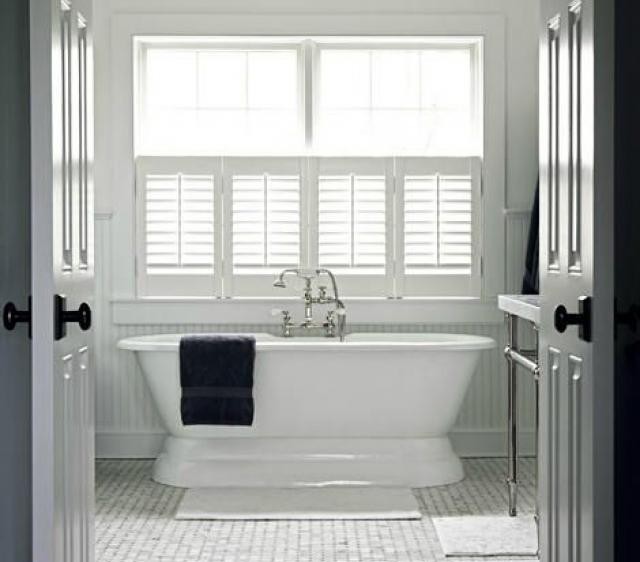
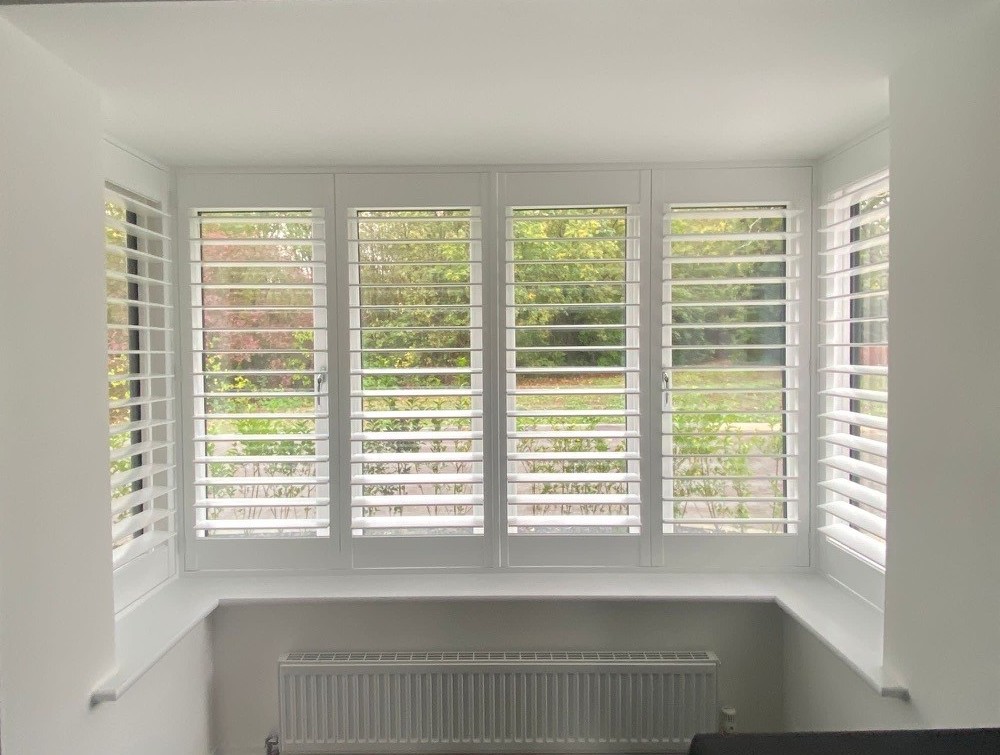
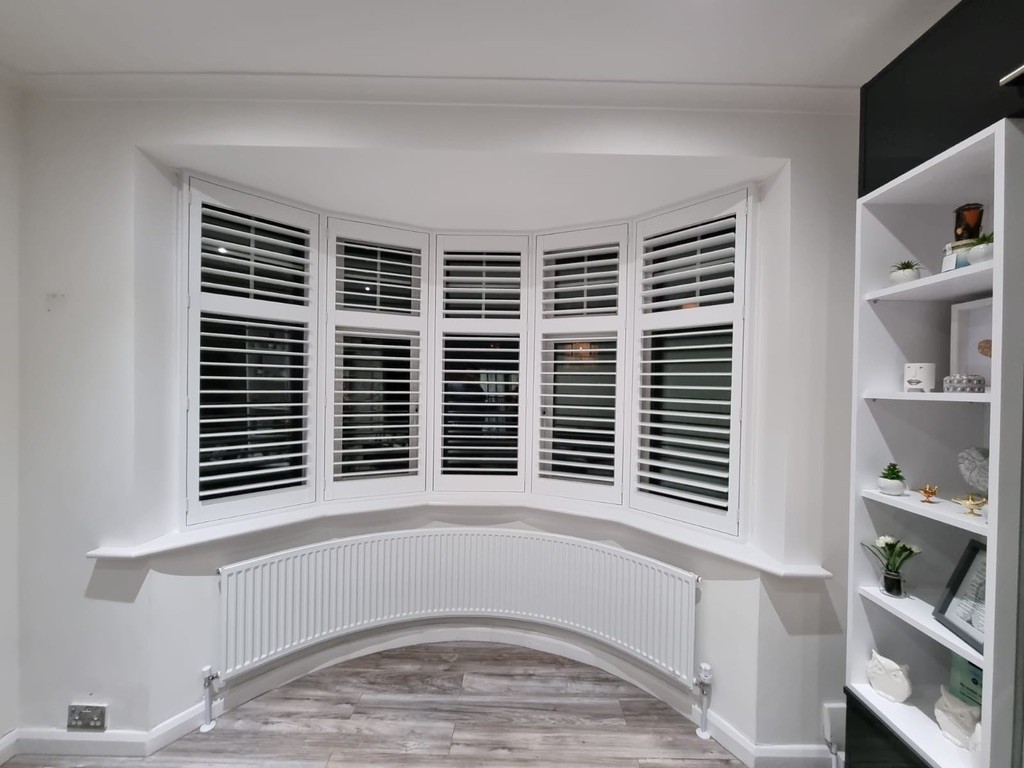
On ground-floor street-facing rooms where full-height coverage is the priority for privacy rather than style, ground-floor café-style panels covering only the lower sash offer an alternative: privacy at eye level from the pavement, with the upper glass permanently open for sky light. Bay windows are among the most visible features of a UK period property, and shutters that follow the full angle of a bay window — individual panels sized to each facet, with frames that follow the bay geometry — produce one of the most striking external impressions a window treatment can achieve.
Colour and finish: what reads best from outside
Off-white and heritage cream account for the vast majority of plantation shutter orders in the UK, and those finishes also perform best for kerb appeal. A warm off-white — rather than a stark brilliant white — sits comfortably against period brick, stone, and painted render, and harmonises with the variety of surface materials and tones a typical UK residential street presents. Pure brilliant white can read as slightly clinical in some lighting conditions; an eggshell or heritage white reads as considered. For guidance on the full palette of available finishes, the 2026 guide to shutter colours for UK homes covers every available finish and which suit which property types.
Custom colour matching is available on most material lines, and some homeowners opt for a darker tone — slate grey, stone, or anthracite — to complement a dark front door or a contemporary exterior scheme. These bolder choices can work very well on modern properties and urban conversions, but they require more confidence in the overall exterior palette. On traditional period terraces, off-white almost always produces the strongest and most enduring external result. The complete guide to shutter colour options includes examples of both pale and darker palettes in real installations across a range of UK property types.
Period homes: restoring what was always meant to be there
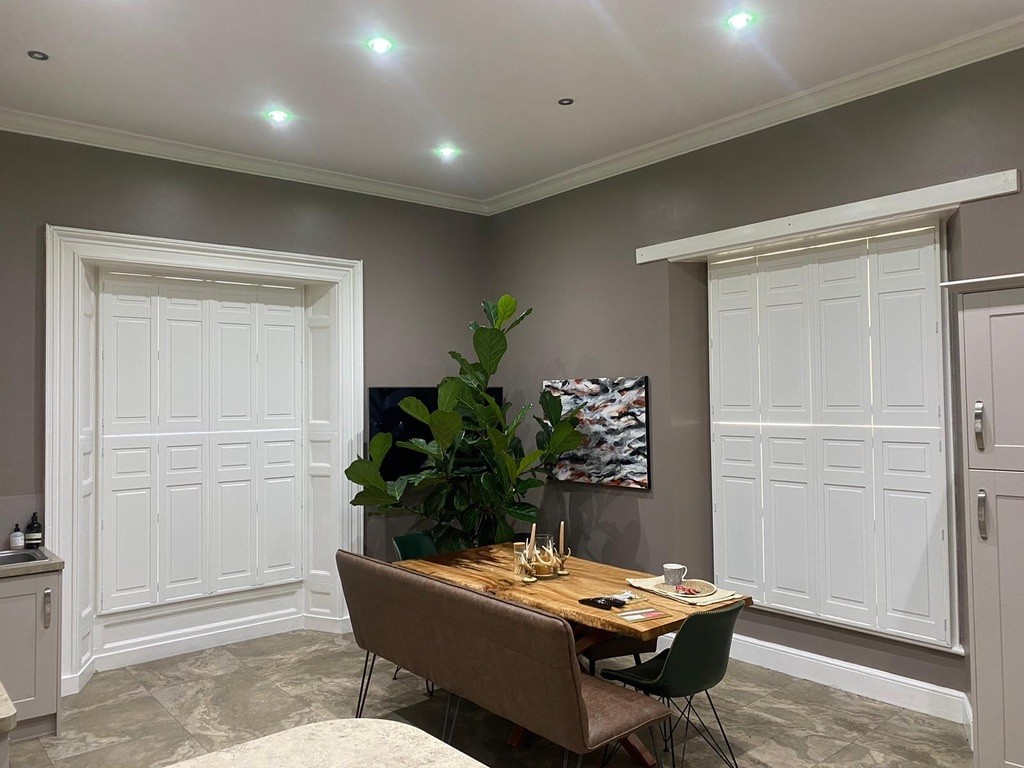
One of the strongest arguments for plantation shutters in period properties is historical legitimacy. Victorian and Georgian terraced houses were originally built with folding internal shutters — solid panelled wooden panels that closed across the window reveal at night for privacy, security, and draught exclusion. Most of these original shutters were removed during the twentieth century as tastes changed and they were boarded into the reveal. Modern plantation shutters, properly fitted in off-white within the reveal, restore the visual logic these homes were designed around and read from the street as if they belong — because architecturally, they do.
On Georgian properties, where windows are typically taller, more evenly proportioned, and set in deeper reveals than Victorian equivalents, the visual discipline of louvred shutters suits the architectural style particularly well. A Georgian terrace with matching off-white full-height shutters across the front elevation produces one of the most refined residential street impressions available without any external alteration. The guide to shutters for Victorian and period homes covers which styles best suit the different window proportions and architectural details found across the Victorian and Edwardian housing stock.
For properties in conservation areas, internal shutters are an appropriate intervention that does not require planning permission in England or Wales — the louvred panels sit inside the reveal and do not alter the external fabric of the building. Grade I and II listed buildings may require listed building consent for internal works in some circumstances, and it is worth confirming with your local conservation officer before ordering. The detailed guide to shutters in conservation areas and listed buildings explains the regulatory position clearly.
Modern and new-build homes: shutters as a design statement
Plantation shutters are not only a period property product. Contemporary new-builds, modern conversions, and recently constructed townhouses all benefit from the clean-line aesthetic shutters provide, and the contrast is often even more striking: a property where every design decision has been made deliberately benefits from a window treatment that carries the same sense of intention. On modern homes with large fixed glazing or wide sliding patio door walls, tracked shutter panels — hanging from a ceiling rail and sliding horizontally — provide the coverage that wide openings require. To see every material and configuration available, browse the complete made-to-measure shutter range across composite, hardwood, and aluminium lines.
For new-build apartments and conversions where the primary concern is managing street-level privacy on ground-floor or overlooked windows, plantation shutters solve the problem without the visual compromise of frosted glass or the mechanical fragility of a roller blind. The louvres can be angled to admit diffuse daylight from above while screening direct sightlines from the pavement — a level of control no opaque treatment can offer. From the street, a block of apartments where every ground-floor window has matching off-white louvred panels presents a coordinated, finished exterior that signals quality to buyers and passersby alike.
What estate agents say: shutters and property value
Estate agents in London and the South East regularly note that plantation shutters are one of the few interior window treatments that register positively with buyers at the point of sale. Buyers recognise that shutters are a permanent, made-to-measure fixture the incoming owner does not need to replace; they understand the upfront cost has already been absorbed; and they perceive them as a quality signal that extends to the rest of the property's specification. An honest long-term assessment of whether plantation shutters justify their cost sets out the full financial case, including the comparison with curtains and blinds replaced repeatedly over a twenty-year period.
The kerb appeal benefit is not separate from the property value argument — it is part of it. A buyer's first impression is formed before they step inside, and plantation shutters visible through the front windows shape that impression. Unlike external changes — fresh render, a new front door, repointed brickwork — internal shutters require no planning application, no building work, and no disruption to neighbours. They are the highest-impact, lowest-disruption kerb appeal upgrade available to a UK homeowner, and the visual benefit begins the moment the fitter completes the installation.
Getting started: survey, pricing, and next steps
Supply-and-fit pricing in 2026 runs from approximately £150–£230 per square metre for composite shutters and £220–£320 per square metre for kiln-dried hardwood. A typical front-of-house specification for a Victorian terrace — living room bay, front bedroom, and hallway landing window — will generally fall between £1,800 and £3,500 depending on configuration and material. Bay windows and shaped heads carry a modest premium. Lead times run from four to six weeks for composite and six to eight weeks for hardwood from the confirmed order date following the survey appointment.
Book your complimentary home survey with Shutters Factory and a specialist will visit your home, measure every street-facing window, advise on style and specification for the best external result, and provide a fixed written quotation at no cost and no obligation. Before your appointment, see how shutters look from the street in our portfolio of finished UK home installations — including Victorian terraces, bay-fronted Edwardian semis, and contemporary new-builds — to confirm the specification you want before the surveyor arrives.