Kent's architectural range: from fishing towns to the Garden of England
Kent's housing stock is more varied than most Home Counties, reflecting a geography that stretches from commuter-belt suburbs hard against the M25 to open farmland, hop gardens, coastal cliff tops, and ancient cathedral cities in under forty miles. That diversity translates directly into window treatment decisions: a 1970s semi-detached property in Sevenoaks, a weatherboarded farmhouse in the Weald between Cranbrook and Tenterden, and a seafront Victorian terrace in Broadstairs present entirely different conditions — different window geometries, different material requirements, different privacy contexts. A single off-the-shelf specification cannot cover them. Our Kent shutter survey and fitting service covers the full county, from Dartford and Gravesend in the north to Hythe and Dungeness in the south-east, with made-to-measure installations confirmed at a free home survey.
The architectural types that define Kent shutter installations fall into four broad categories. The first is the Victorian and Edwardian terraced and semi-detached housing that lines the residential streets of Canterbury, Maidstone, Tonbridge, and Royal Tunbridge Wells — double-hung sash windows on upper floors, projecting bay fronts at ground level. The second is the converted agricultural building: oast houses, hop barns, and weatherboarded farmhouses common to the Weald and the Medway valley, with their non-standard window geometries and unusually deep masonry reveals. The third is coastal housing — the Victorian and Edwardian seafront streets of Whitstable, Deal, Broadstairs, Margate, and Folkestone — where salt air and humidity are the overriding material considerations. The fourth is post-war and new-build suburban Kent: Sevenoaks, Tonbridge, Swanley, and the estates around Ebbsfleet — where casement windows, uPVC frames, and bi-fold garden doors are the standard configuration.
Coastal Kent: salt air, humidity, and the right shutter material
The defining environmental condition for a coastal Kent property is elevated atmospheric salt. Sea wind deposits salt on every surface it reaches — not just the exterior of the building, but on interior furnishings, window reveals, and louvre mechanisms reached by air movement through opening windows or ventilation gaps. In a conventional window treatment context, this accelerates fabric fading, degrades metal components, and causes timber to absorb salt and then swell when humidity rises. For shutters fitted inside the window reveal, the direct exposure is lower than for exterior fittings, but a property within a kilometre or two of the sea — a cottage on Whitstable beach, a terrace on Broadstairs' Albion Street, or a flat above Deal seafront — will still experience higher-than-average ambient humidity throughout the year, with periodic salt-laden air reaching the interior when windows are opened.
Mimeo composite shutters, built on a polymer core that does not absorb atmospheric moisture, are the recommended specification for coastal Kent properties. The dimensional stability is structural rather than cosmetic — the panel does not swell in high humidity, the louvres maintain their movement, and the tilt mechanism does not bind after a wet winter on the coast. For properties directly facing the sea — a beachfront bungalow in Kingsdown, a Deal cottage on the Strand — Dura powder-coated aluminium shutters are the alternative to consider. Aluminium is completely unaffected by salt air and salt deposition; the only maintenance required is occasional wiping. The trade-off is visual: aluminium profiles suit contemporary coastal interiors and modern beach architecture more naturally than Edwardian bay-fronted terraces. Our earlier overview of professional shutter fitting across Kent postcodes covers material selection by coastal proximity in more detail.
Victorian terraces in Canterbury, Tonbridge, and Royal Tunbridge Wells
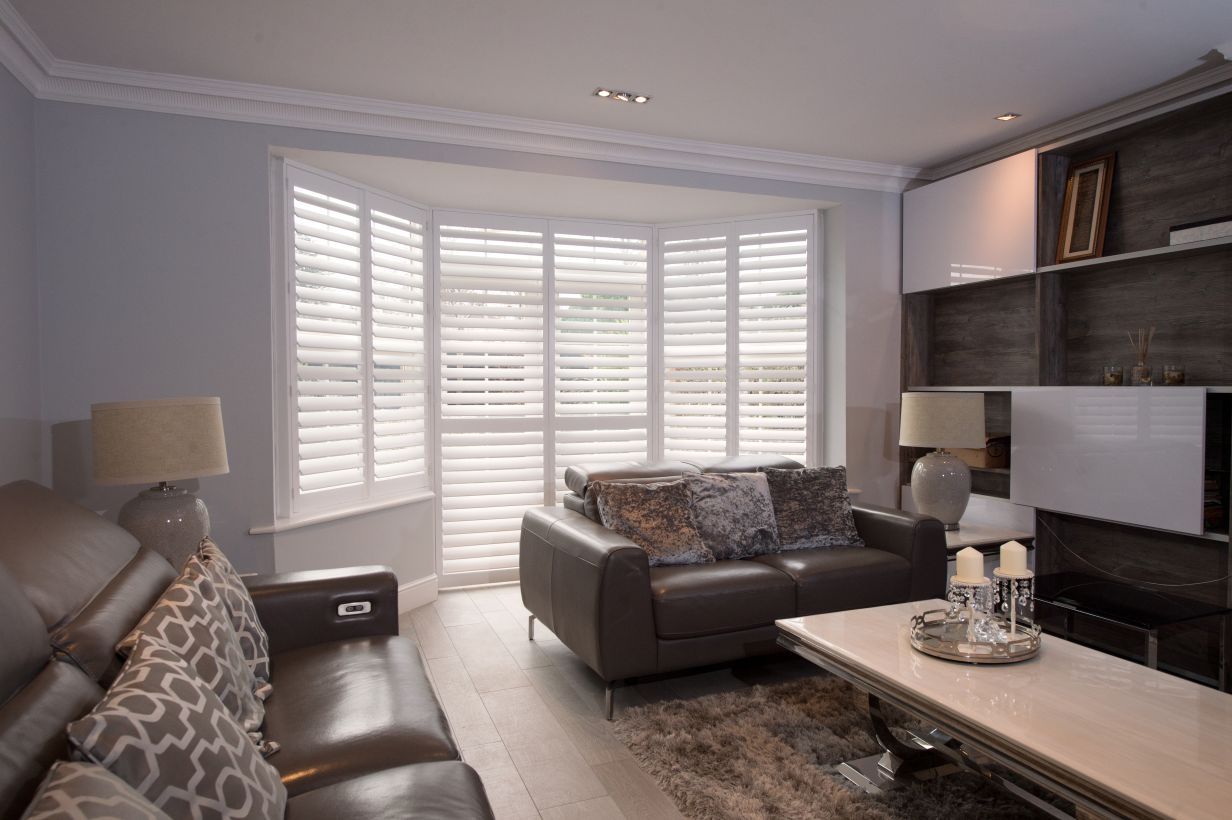
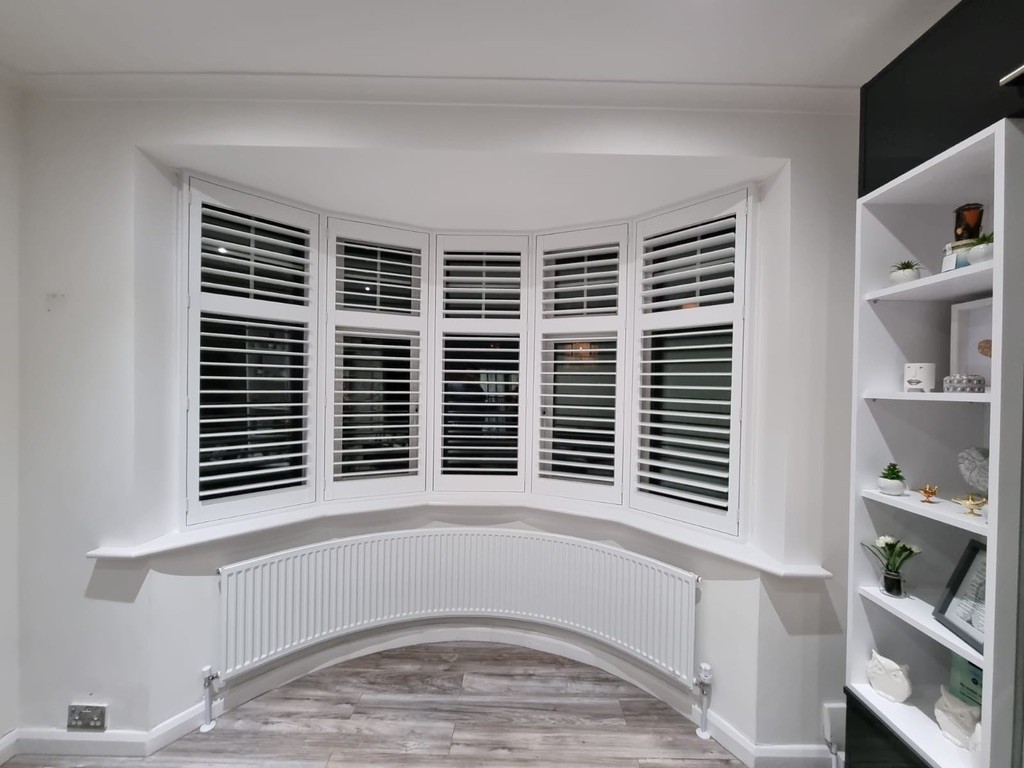
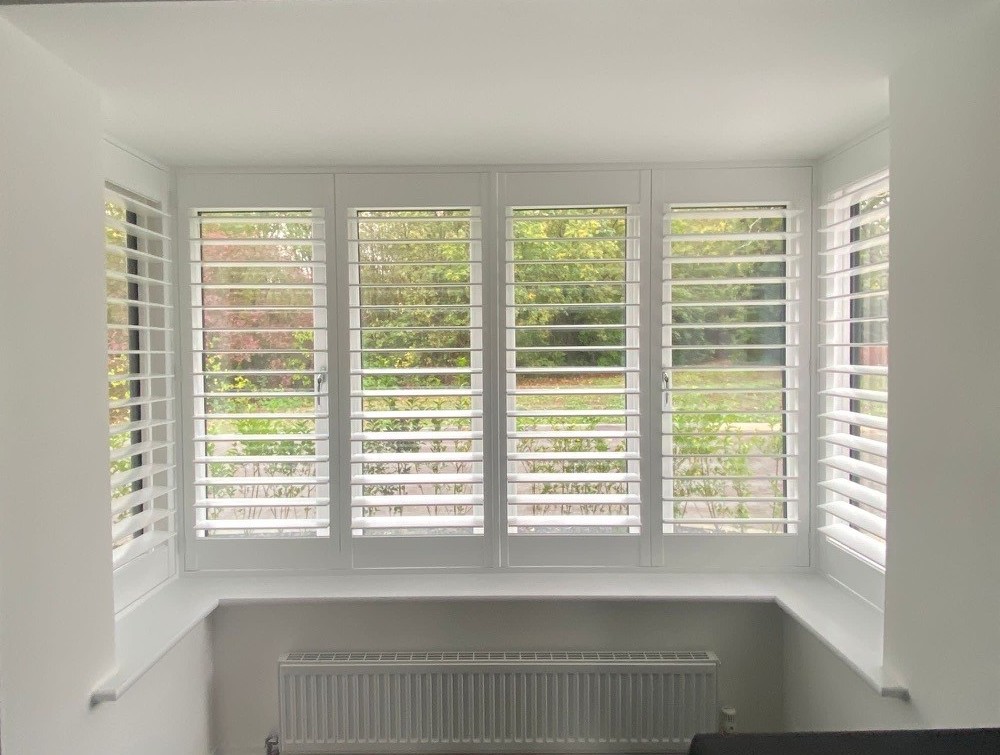
The inland period towns of Kent — Canterbury's St Dunstan's and Wincheap districts, the residential avenues near Tonbridge station, and the Calverley Park and Nevill Park areas of Royal Tunbridge Wells — are architecturally very close to the inner London terraces that form the core of our installation base. The ground-floor bay window and the upper-floor double-hung sash are the dominant window types in all of them. Both require made-to-measure manufacture. Shutters built and framed to the bay's own projection angles require on-site templating: the surveyor records each light's width, the depth and projection of the bay, and the precise angle at every corner. The resulting frames are manufactured with mitred joints at those corners so adjacent panels align cleanly — the result reads as architecturally integrated rather than an applied afterthought. Off-the-shelf panels cut for rectangular openings cannot produce this in an angled bay.
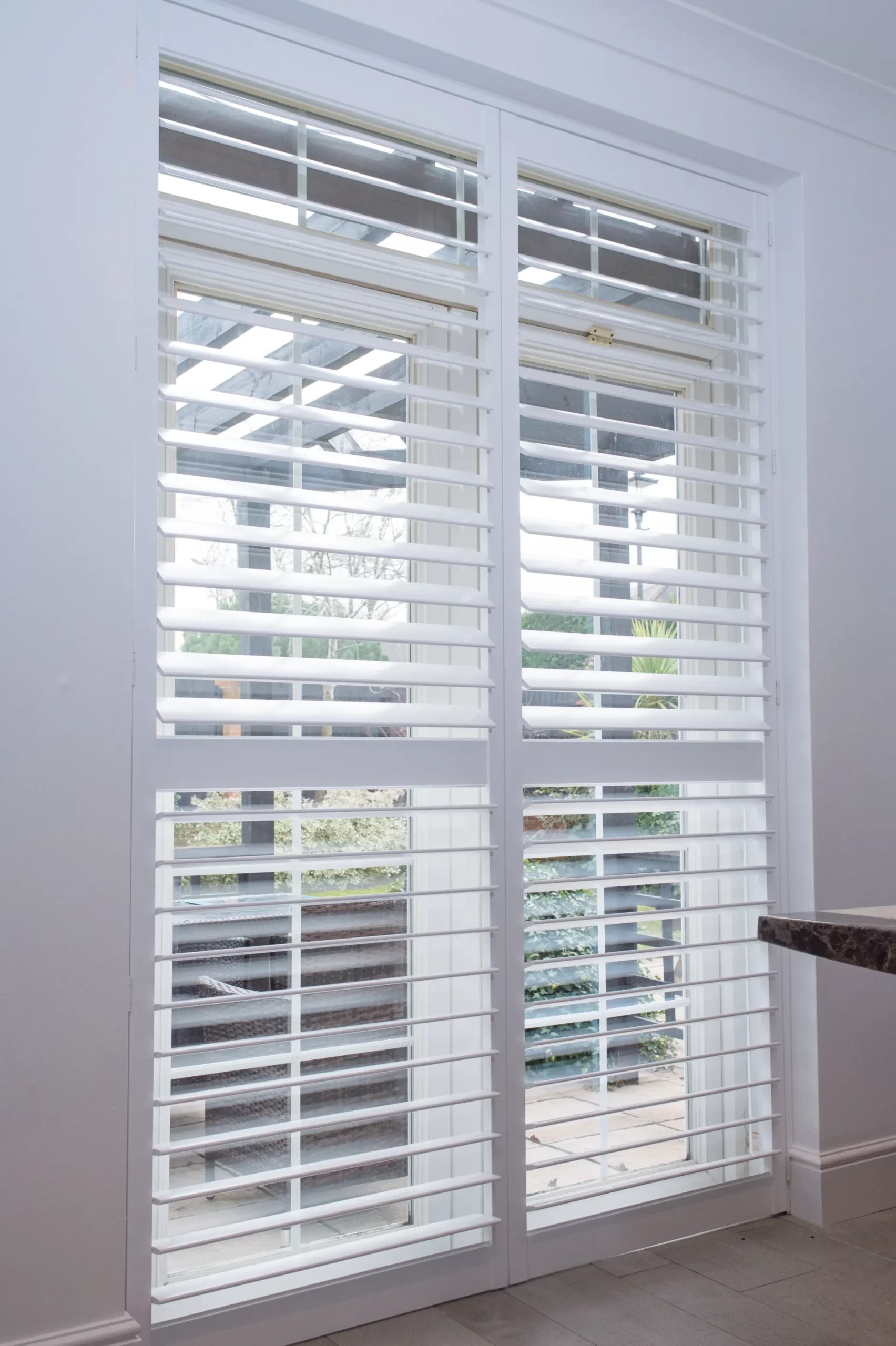
For the upper-floor sash window, the configuration question is privacy. A front bedroom on a busy Tunbridge Wells street has a different requirement from a rear garden-facing first-floor room in a Canterbury terrace. Where the sash faces the street directly, shutters where the upper and lower sections open independently address the most common domestic privacy scenario: the lower panel is kept closed to block pavement-level sightlines while the upper section is angled to admit sky light from above. For rear-facing sashes with lower privacy pressure, louvred panels that span the window from sill to head in an unbroken single tier are simpler to operate and marginally less expensive to produce. See finished Kent and Home Counties shutter installations across a range of Victorian window types to compare the visual result before committing to a configuration.
Oast houses, converted barns, and the rural Weald
Converted oast houses in the Weald of Kent — in the countryside around Cranbrook, Tenterden, Biddenden, and Marden — are among the most architecturally distinctive buildings in England, and they present window challenges not found in standard residential work. The round or square kiln towers, converted into living rooms or bedrooms, have tall, narrow window openings set into thick masonry walls. Reveals can be 150–200mm deep or more — considerably deeper than the 100–130mm typical of a Victorian brick terrace. In these conditions, a standard shutter frame depth is insufficient; the frame specification is confirmed at survey, where the surveyor measures the reveal depth precisely and quotes for the appropriate frame construction. Single louvred panels running the full height of the opening suit these tall, narrow windows well: the louvres provide precise light control in rooms that receive strong directional sun through relatively small apertures, and the single-panel format keeps the installation visually clean in a space with its own strong architectural character.
Converted hop barns and agricultural buildings in the same area frequently have much wider openings — gable-end glazing spanning two to three metres, or large casement windows following the original loading-door positions. For apertures above approximately 1.2 metres across, a single hinged panel becomes both heavy and visually dominant when open. A panel system that slides along a ceiling-fixed track, with panels stacking at one end or dividing symmetrically from the centre, handles wide apertures cleanly without the structural demands of a hinged panel at that scale. For a useful comparison with the similarly characterful rural properties just over the county boundary, our guide to shutters for Surrey villages and country homes covers converted farmhouses, cottages, and the deep-reveal window conditions common across the Home Counties.
New-build and commuter belt: Sevenoaks, Tonbridge, and Ebbsfleet
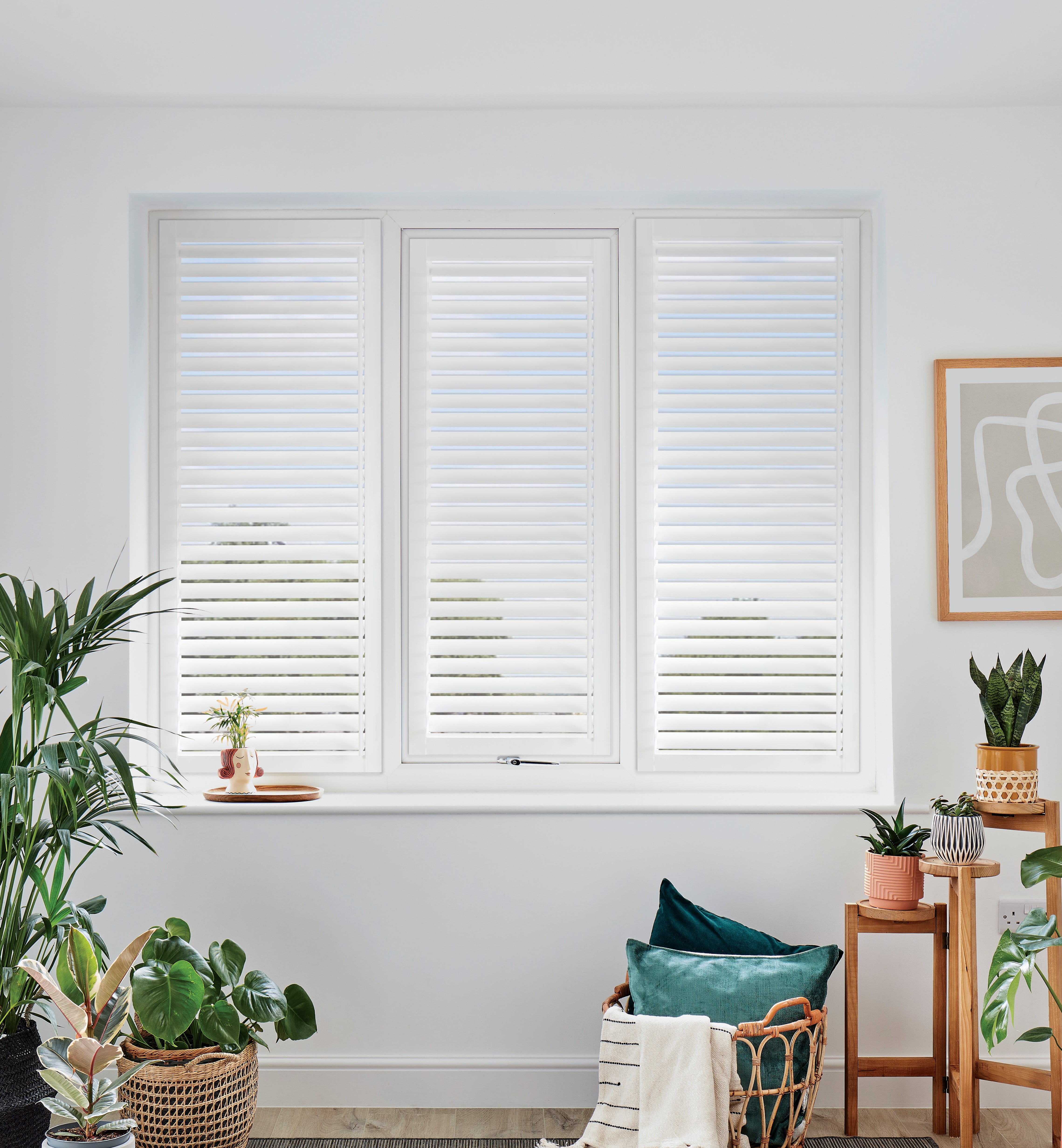
Kent's commuter towns along the Southeastern mainlines and the newer development zones around Ebbsfleet and Ashford International carry large quantities of post-war semi-detached housing alongside a growing volume of 2010s and 2020s new-build estates. These properties typically have casement windows in uPVC frames and living areas opening to rear gardens through bi-fold or sliding door systems — a very different window geometry from the sash-and-bay vocabulary of the Victorian stock. Full louvred panels across each casement light are the standard configuration for these windows. Wider windows in rooms with higher ceilings often suit 89mm louvres, which maximise the open view when the louvres are turned; standard rooms are generally better served by 64mm louvres. Our guide to louvre width selection covers the practical and aesthetic case for each size in the context of different window proportions.
For bi-fold or sliding door openings in Kent extensions and garden rooms, a tracked shutter system is the only practical specification — hinged panels in a wide opening have no room to swing without obstructing the door mechanism or intruding into the living space. Tracked installations are also common in the riverside and waterfront apartment developments in Gravesend and Medway, where floor-to-ceiling glazing is standard and the track is fixed to the ceiling or wall head above the opening, leaving the floor entirely clear. Book a free home survey for your Kent property — the surveyor measures every opening, discusses your light and privacy requirements, brings physical louvre and colour samples, and leaves a confirmed written quotation. There is no obligation to proceed at survey stage.
Prices and lead times for Kent properties in 2026
Supply-and-fit plantation shutters for a typical Kent window — a standard bedroom or living room casement of approximately 900mm × 1,100mm — cost approximately £380–£580 in composite in 2026. A three-bedroom Victorian terrace in Tonbridge or Canterbury with five to seven windows runs to approximately £2,200–£3,800 for composite supply and fit, inclusive of survey, frames, panels, and installation. Hardwood installations start from approximately £550–£750 per window and run from approximately £3,200–£5,500 for a similar whole-house project, depending on window count and specification. Coastal composite specifications, where the material selection is driven by humidity resistance, fall within the same price range as inland composite work. Tracked systems for bi-fold door openings and wide glazed panels carry a supplement for the rail hardware, typically running from £550–£700 per linear metre of aperture.
Lead times from confirmed order to fitting are four to six weeks for composite and six to eight weeks for hardwood across all Kent locations; our fitters cover the full county and can combine survey visits with fitting appointments in adjacent postcodes to minimise travel time. All prices are supply and fit inclusive of survey, framing, panels, and installation. Our dedicated Kent shutters page outlines the postcode areas covered and includes examples of recent county installations. Book a free home survey to receive confirmed pricing for your Kent property with no obligation to proceed.