Why holiday let hosts are choosing plantation shutters
A holiday let or short-term rental property faces a specific set of demands that no long-term rental or owner-occupied home shares: very high guest turnover, repeated viewings of listing photographs, guest expectations shaped by boutique hotel standards, and the certainty that every surface will be handled by strangers on a weekly basis. Most window treatments fail at least one of these tests. Fabric curtains absorb cooking and condensation odours, stain unpredictably, and date a room as soon as a more contemporary aesthetic is expected by guests. Roller blinds handle the first cleaning well but the spring and cassette mechanism degrades quickly under repeated use by people unfamiliar with the operation.
Plantation shutters avoid all of these failure points. The louvred panel mechanism — blades rotating on mortise-and-tenon joints, panels folding on knuckle hinges — is operated by a push-pull motion that requires no springs, no cords, and no cassette mechanism. A guest who has never encountered a plantation shutter can operate it correctly within seconds. The wipe-clean surface handles anything from the condensation of a morning shower to the greasy hand of a child without absorbing the contact. And the result in listing photography on Airbnb, Booking.com, or any agency platform is consistent: the parallel louvre lines add visual structure, the white finish reflects light, and the room reads as considered and quality-specified.
For many hosts, the decision is partly financial. Blinds and curtains in a holiday let must be budgeted for replacement at intervals of two to four years — more frequently in the highest-turnover properties. A well-specified plantation shutter installation is a one-time capital expenditure with a realistic service life of fifteen to twenty years. The compounded saving across that period, in a property operating at even modest occupancy, typically exceeds the installation cost by a material margin.
Material selection for holiday let properties
The material choice for a holiday let shutter should be driven by the specific conditions of each room rather than a single specification applied throughout. Moisture exposure and cleaning demands vary significantly between a guest bedroom and a combined kitchen-diner, and the correct shutter material for each differs accordingly.
Mimeo composite shutters, made from a cellular PVC compound that does not absorb moisture, are the first choice for bathrooms, shower rooms, and kitchens in any holiday let property. The integral colour runs through the full cross-section of the panel, meaning a minor knock or scuff does not reveal a contrasting substrate — an important detail in a property where guests may not report minor damage before checkout. Composite panels can be wiped with household cleaning products including surface sprays and diluted bleach without damage to the finish. The 2026 supply-and-fit price for Mimeo composite is approximately £320 per m², with a four-to-six-week lead time from survey to installation. For a complete comparison of composite against timber options, our composite shutter buyers' guide explains the construction, performance, and cost differences across the full cellular PVC range.
For bedrooms and living areas, a paulownia hardwood or composite shutter offers the best balance of appearance and durability. Paulownia — the timber used in the Strato range — is lightweight, dimensionally stable, and takes a factory-lacquered finish that closely mimics solid painted wood. Endura hardwood shutters start from approximately £480 per m² and are the premium option where the property is positioned at the upper end of the short-term market and the guest expectation is hotel-grade quality throughout. For properties in the middle of the short-stay market, a composite specification throughout — wet rooms and dry rooms alike — is perfectly appropriate and simplifies the survey and order process.
Bedroom shutters: sleep quality and five-star reviews
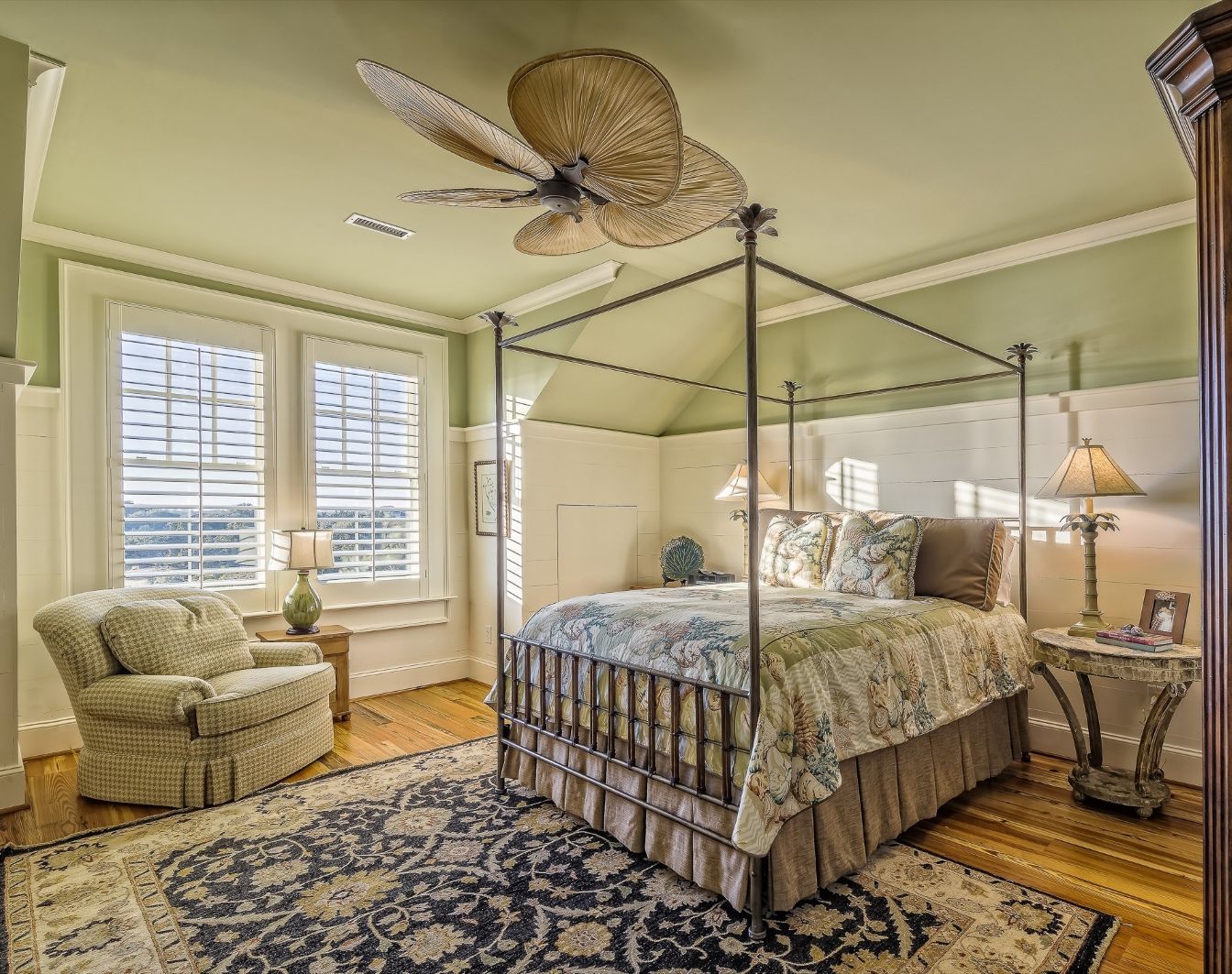
Guest sleep quality is one of the most cited factors in Airbnb and holiday let reviews. A bedroom that cannot be made dark in summer — when early sunrise falls across a light-coloured blind and the room is bright by 5 a.m. — generates sleep complaints that no other aspect of the property can compensate for. Plantation shutters, specified correctly, provide a level of light exclusion that roller blinds and curtains rarely achieve.
Bedroom shutters are most effective when fitted inside the reveal with an l-frame that closes any visible gap between the frame and the surrounding plasterwork. A correctly fitted shutter installation in a reveal with no gaps allows a guest to close the louvres fully and achieve near-complete darkness regardless of the season or the orientation of the window. For north-facing rooms this may be a minor consideration; for south and east-facing rooms in summer properties, it is the specification decision that directly determines the star rating.
The louvre size to specify for a holiday let bedroom is the 64 mm blade — wide enough to read as a premium specification and to allow good light transmission when open, but proportionally correct in the range of bedroom window sizes found across UK holiday properties from converted cottage to coastal apartment. The most detailed guidance on bedroom shutter specification — louvre size, frame type, tilt rod position, and mid-rail options — is in the bedroom shutter light control and privacy guide, which covers every variable that affects sleep performance in a short-let context.
Living areas and kitchen shutters: light, warmth, and easy cleaning
In a holiday let living room, the shutter specification serves three functions simultaneously: light control during the day, privacy from neighbours and street in the evening, and a visual backdrop for listing photography. A full-height installation covering the complete window opening achieves all three. The louvres can be tilted to provide filtered daylight for breakfast or afternoon reading, closed fully for evening privacy, or opened to maximise the connection to a garden, terrace, or view that the property's listing trades on.
For ground-floor front rooms in terraces or cottages where street-level privacy matters, lower-sash shutters covering only the bottom half of the window are worth considering. They maintain privacy at seated eye level while allowing full daylight from the upper portion of the window — an arrangement that keeps a living room bright without the sensation of being overlooked from the pavement or a passing path. This configuration is particularly well-suited to UK coastal properties where front rooms face a road or public footpath with significant footfall.
Kitchen shutters in a holiday let require the same moisture and cleaning performance as bathroom shutters. Composite is the correct material choice regardless of the kitchen's aesthetic — the white factory finish matches most kitchen cabinet ranges, and the wipe-clean surface survives the cooking residue and steam of every guest cycle without degradation. For a sense of how shutters look installed across kitchen, living room, and bedroom configurations in real properties, browse real shutter installations in our customer project gallery.
Large glazed openings, patio doors, and tracked shutters
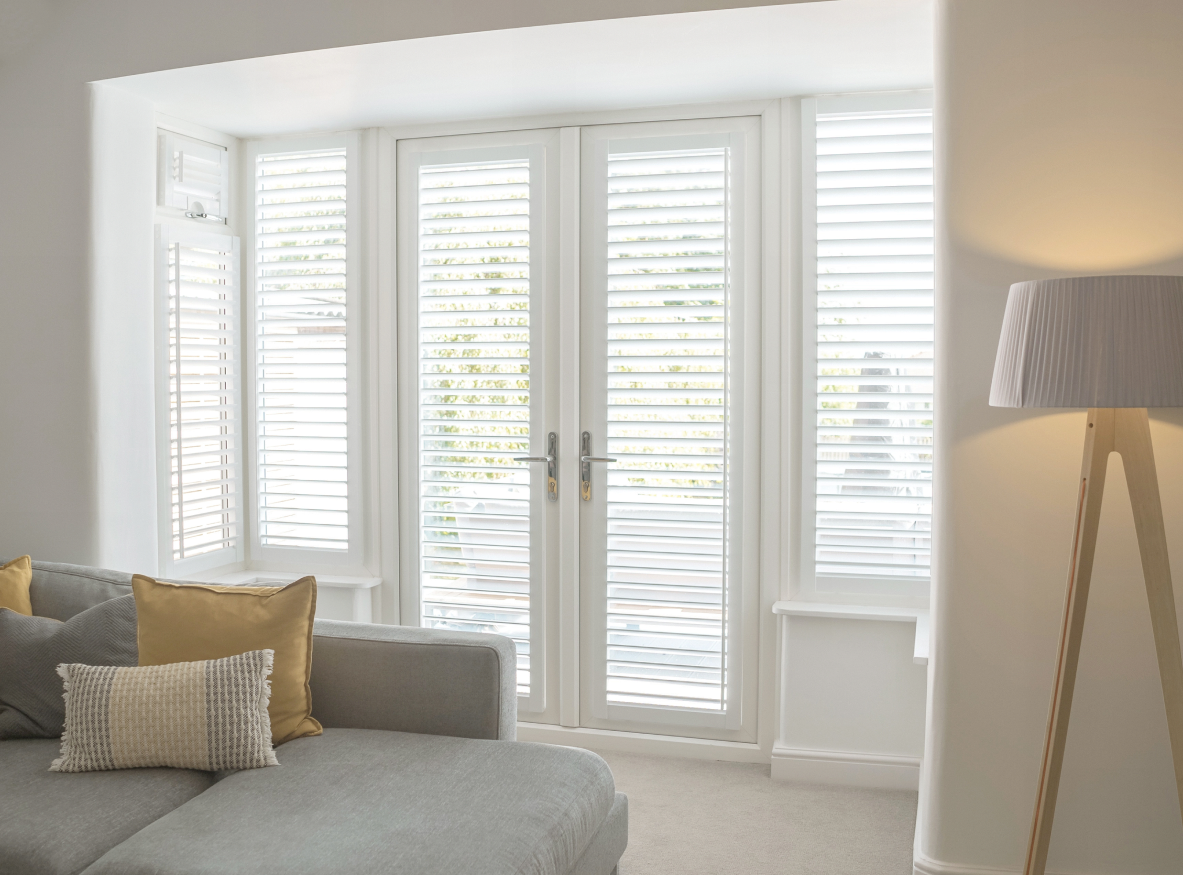
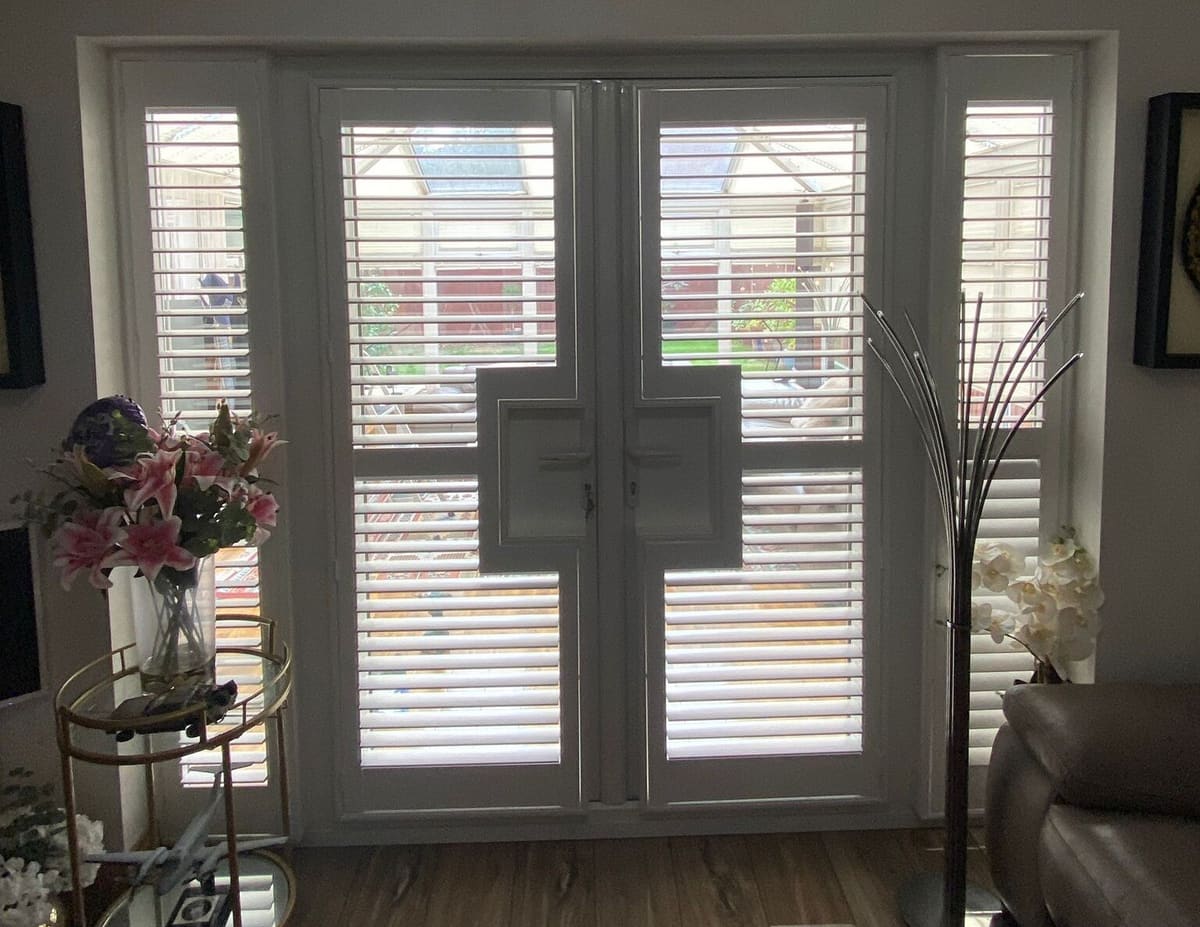
Many holiday let properties — coastal houses, rural retreats, and modern converted barns — feature large glazed openings: wide patio doors, bi-fold sets, or picture windows that are a key selling point of the property. A standard hinged shutter cannot span these openings without becoming too wide to fold back neatly against the wall. The solution for any opening wider than approximately 1.2 m per panel pair is a tracked system.
Tracked plantation shutters run on a ceiling or wall-mounted track and slide rather than fold — the panels stack to one side when open and glide across to cover the full glazed area when closed. For a bi-fold door set of three or four metres, a tracked system covers the complete opening in a single specification with no sight-line interruption when open. The aesthetic when closed is identical to a standard hinged shutter: white louvred panels that tilt for light control and privacy. Tracked systems are manufactured to exact dimensions and carry a lead time of five to seven weeks from survey to installation.
Realistic pricing and lead times for holiday let properties in 2026
A two-bedroom holiday let cottage with a living room, kitchen, two bedrooms, and a bathroom — a common property format in the UK short-stay market — will typically have between eight and twelve windows of varying sizes. A full composite specification across all rooms at the 2026 headline rate of approximately £320 per m² falls in the region of £3,200–£5,500 supply and fit depending on window dimensions. A mixed specification — composite in wet rooms, paulownia in bedrooms and living areas — is priced similarly, as the material cost difference is partly offset by the frame cost in wet rooms.
Hosts who need to maximise the income period of the property should plan the installation during a gap in the booking calendar rather than rushing the order. Made-to-measure shutters cannot be expedited significantly — the manufacturing process runs on a fixed cycle — and a survey conducted while the property is occupied by guests is disruptive to both the measurement process and the guest experience. A survey can be booked to coincide with a vacant fortnight, with installation following five to six weeks later during the next available vacancy. Our guide to shutter lead times and the ordering timeline explains each stage in detail and identifies where time can be recovered if the calendar is tight.
For hosts who also operate a longer-term rental portfolio and are converting a property to short-stay use, the material and style considerations for holiday lets overlap significantly with those for residential lets — though the bedroom blackout priority is more acute in the short-stay context. The full comparison is in our guide to shutters for landlords and rental properties, which covers HMO specifications, Luma easy-fit options for tenanted properties, and portfolio pricing across multiple units.
Arranging a survey around a busy booking calendar
A free home survey for a holiday let follows exactly the same process as any residential survey: a specialist visits the property, measures every window accurately, brings physical louvre and colour samples, and discusses the specification requirements room by room. The resulting quote is fixed, itemised by window, and includes everything from manufacture through to installation with no variation orders or hidden extras.
Surveys can be booked during any vacant period, including short gaps of a few days between bookings. For properties that are fully let and difficult to access, a weekday morning slot during a changeover day can usually be arranged — the survey itself takes between forty-five minutes and ninety minutes depending on property size and window count. Installation requires a half-day to full-day clear of guests depending on the number of windows being fitted. To arrange a survey at a time that works around your bookings, book a free home survey at your holiday let property — pricing is confirmed in writing within 48 hours of the visit. To see the range of full-height louvred shutters suited to holiday let bedrooms and living rooms, the style page includes specification detail, frame options, and louvre size guidance.