Hampstead and Belsize Park: the architectural context
Hampstead and Belsize Park lie within the London Borough of Camden on the high ground north of Regent's Park. NW3 is defined by its steep terrain and the mix of building periods that occupy the hillside: large Georgian and early Victorian detached houses on and around Hampstead village and Willow Road; Victorian and Edwardian bay-fronted terraces concentrated across Belsize Park — Belsize Avenue, Buckland Crescent, Fitzjohn's Avenue, England's Lane — and in South Hampstead and West Hampstead at the NW3 fringes; and the 1930s and 1960s mansion blocks that front Haverstock Hill and the streets between Belsize Park station and Chalk Farm.
The consequence for shutter specification is a wider range of window types than in more homogeneous London neighbourhoods. A large Georgian sash in a Hampstead village house has a reveal depth of 180–220mm and a window opening of 600–800mm wide by up to 1,800mm tall — proportions suited to a full-height louvred panel in a deep-set frame. A ground-floor bay in a Belsize Avenue Victorian terrace has a three-light projecting bay that needs mitred corner frames built to the specific angle of the projection. A lower-ground flat on Buckland Crescent or Antrim Road sits at pavement level with direct street overlooking, requiring effective privacy without sacrificing daylight. Each type is a distinct specification question. For an overview of what we install across North and Central London, our North London shutter survey and installation coverage includes lead times, area coverage, and the full range of property types we serve.
Large sash windows in Hampstead period houses
The defining window type in Hampstead's older housing stock — the detached and semi-detached Georgian and early Victorian houses around the High Street, Branch Hill, Redington Road, and the streets near Hampstead Heath — is the tall, narrow double-hung sash. These windows are typically 600–750mm wide and 1,600–2,000mm tall, set into deep masonry walls with reveals that can exceed 150mm. The proportions are markedly different from the broader, shallower sash windows of mid-Victorian London terraces, and they require a shutter panel calibrated to that specific narrow, tall format.
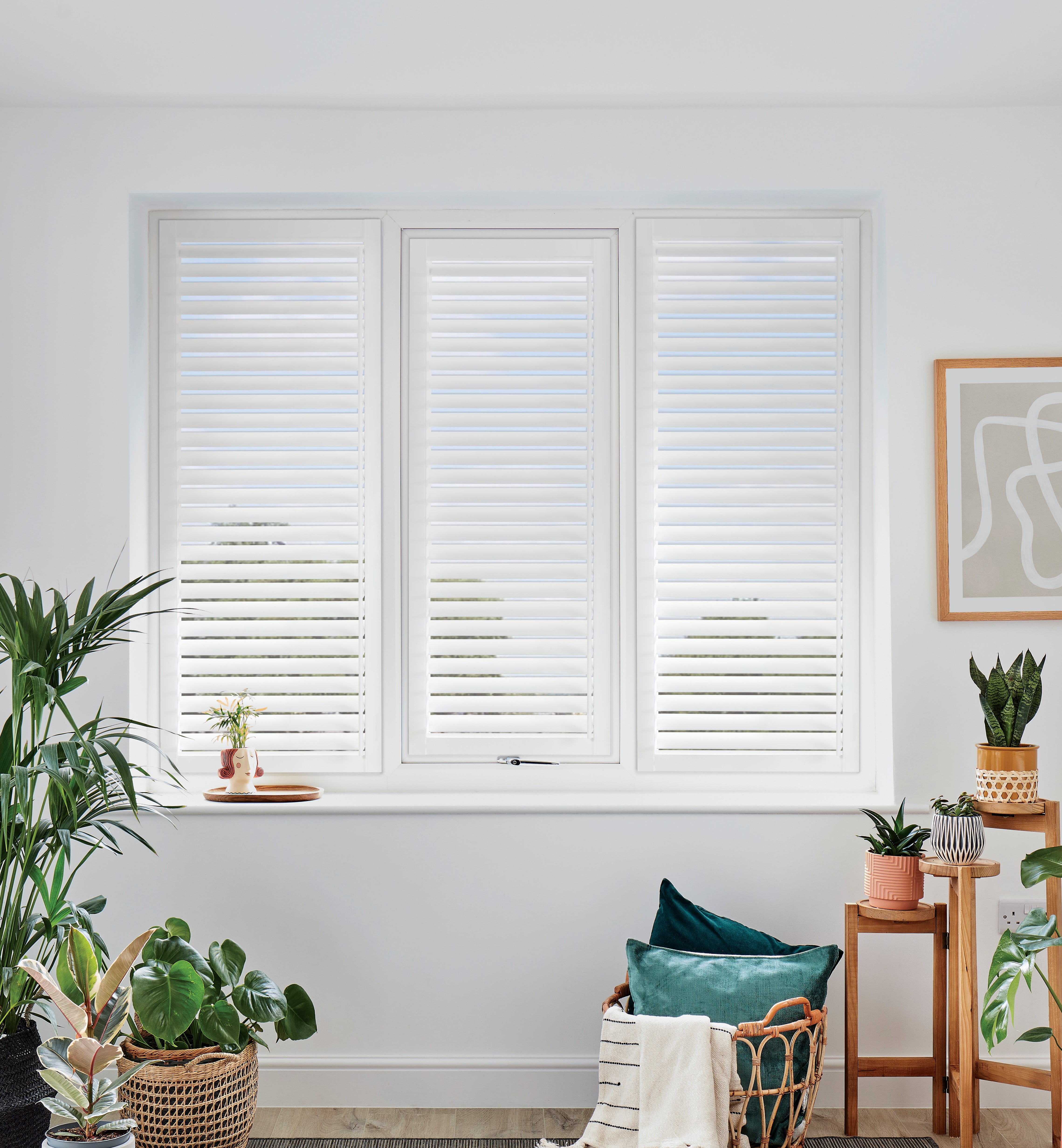
Full-height louvred panels spanning the complete sash opening suit these windows well. In a Hampstead Georgian or early Victorian house, a shuttered window in the correct proportion reads as architecturally continuous with the building's original fabric: the panel size, louvre width, and frame depth are matched to the opening and to the reveal depth recorded at survey. For large house-width installations across a reception floor with three or four sash windows on the front elevation, 89mm louvres are often specified — the wider blade is better proportioned to the greater window height and produces a more open view when the louvres are turned. For narrower sashes and rooms where a finer texture is preferred, 64mm louvres are the standard specification.
Bay windows in Belsize Park Victorian and Edwardian terraces
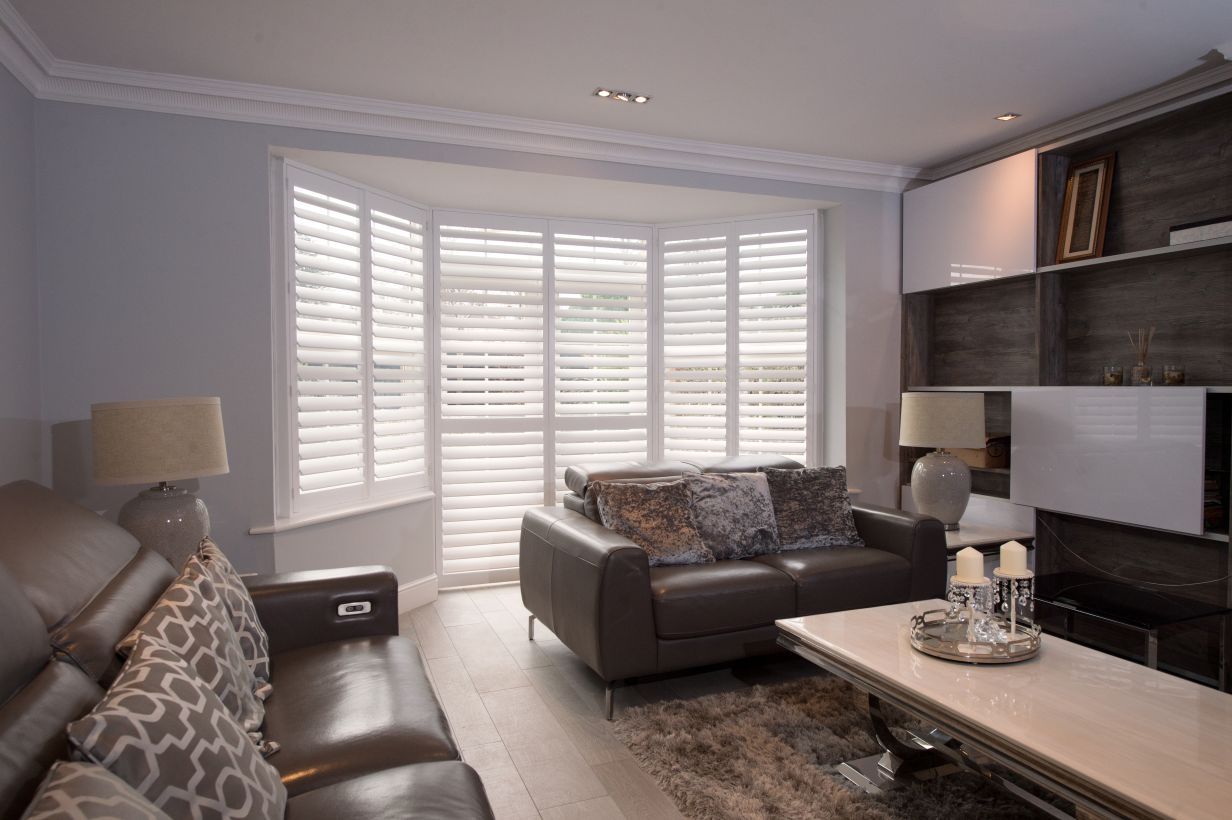
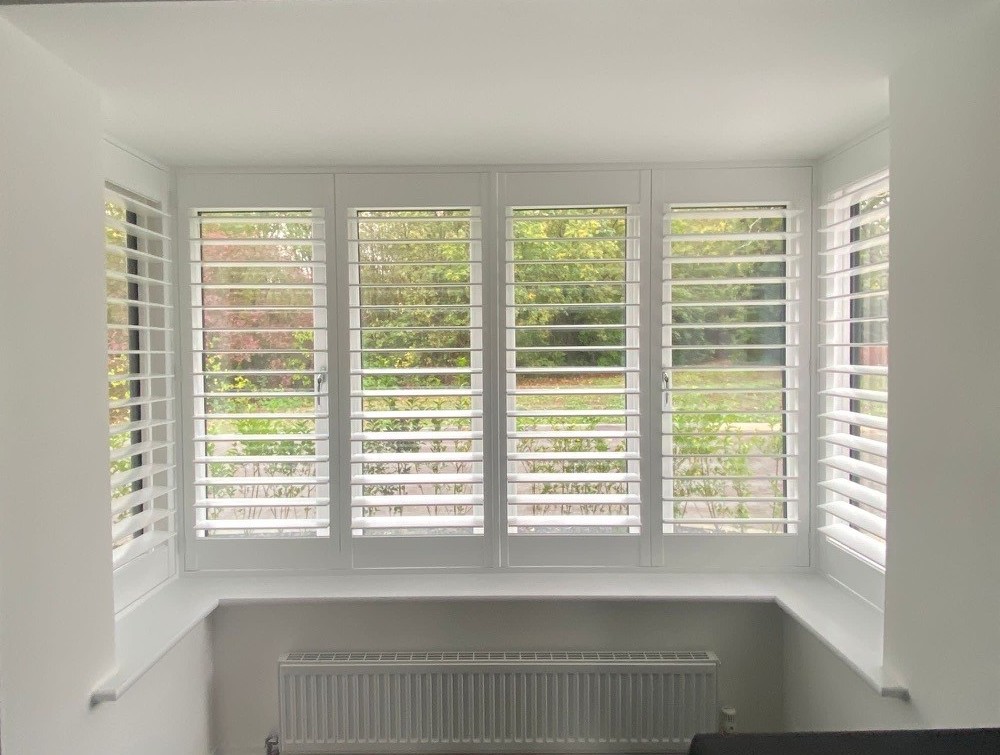
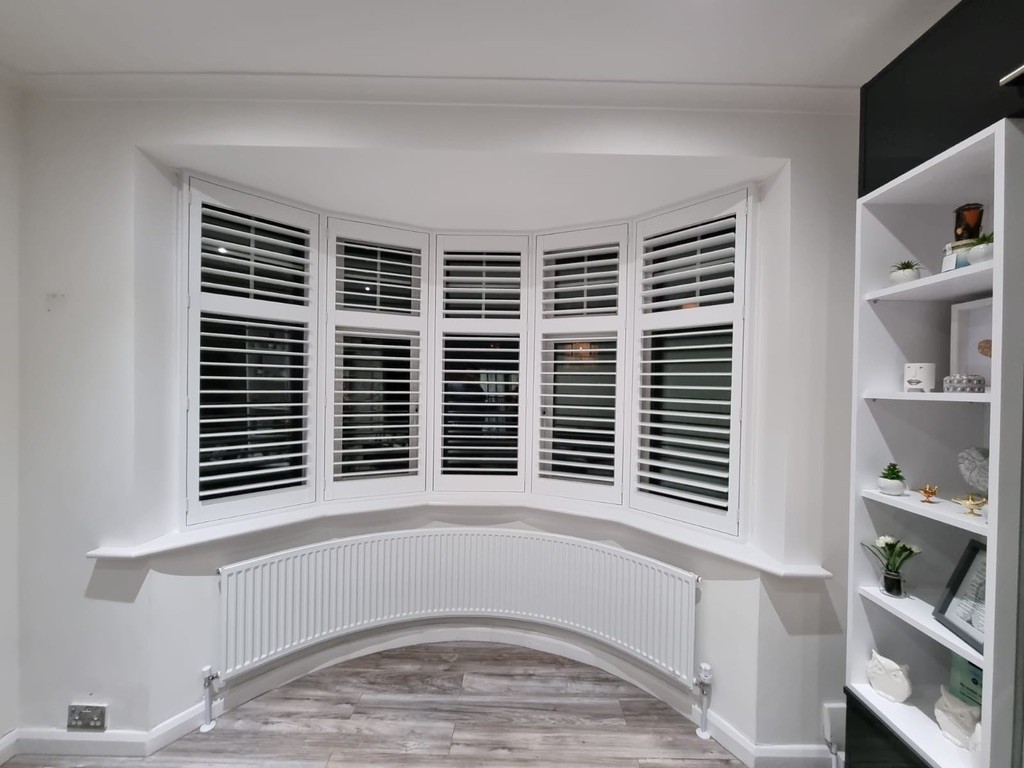
Belsize Park's residential streets between Haverstock Hill and Fitzjohn's Avenue — Belsize Square, Belsize Crescent, Belsize Avenue, Buckland Crescent, and the streets off England's Lane — are predominantly Victorian and Edwardian bay-fronted terraces. The ground-floor front room carries a three-light projecting bay: a central face and two angled returns. Every bay in this stock has a specific angle at each return corner, set by the builder and varying slightly from house to house.
Made-to-measure bay shutter panels with mitred corner frames are the correct specification for these bays. The survey records the angle at each corner precisely — typically 112 or 135 degrees in Belsize Park terraces — and the frame is manufactured with mitre-cut joints at those exact angles. The louvre width is matched across all three sections so the bay reads as a single architectural feature rather than three separate units. Off-the-shelf rectangular panels placed across a projecting bay without mitred corners leave visible gaps at the returns and lack the architectural integration that period joinery demands. Our earlier article on shutters for neighbouring Muswell Hill and Highgate homes describes the same bay-window challenge across comparable North London terrace stock.
Lower-ground and basement flats: privacy at pavement level
Belsize Park has a high proportion of its Victorian terrace housing divided into flats, and the lower-ground or basement conversion presents the most acute privacy challenge in the neighbourhood. These flats — on Belsize Avenue, Antrim Road, Lancaster Grove, Thurlow Road, and the back streets between Belsize Park and Swiss Cottage — have front rooms directly at or below pavement level. The standard domestic requirement is maximum privacy from the street without making a room that already receives less direct sun feel darker or more enclosed.
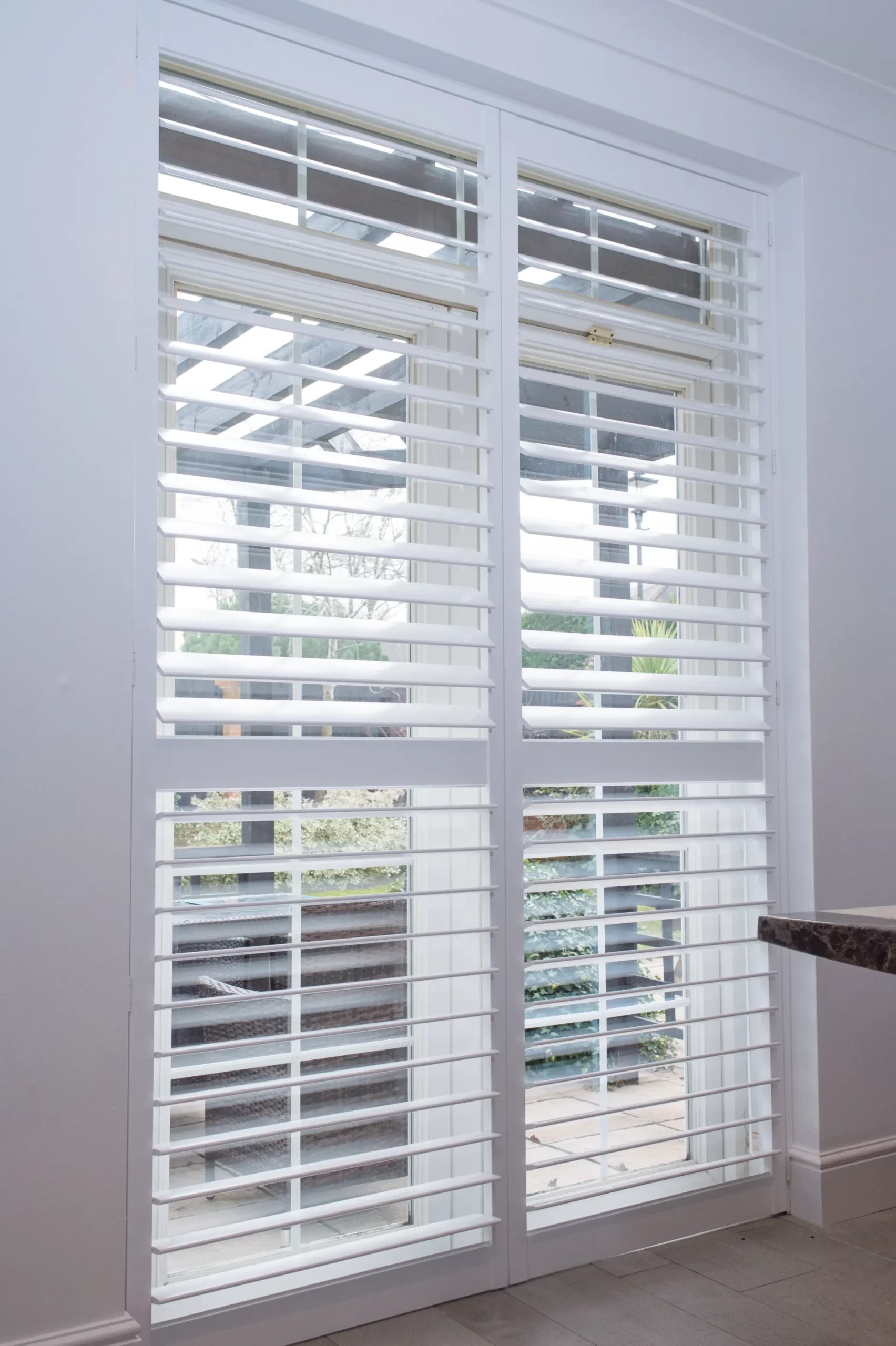
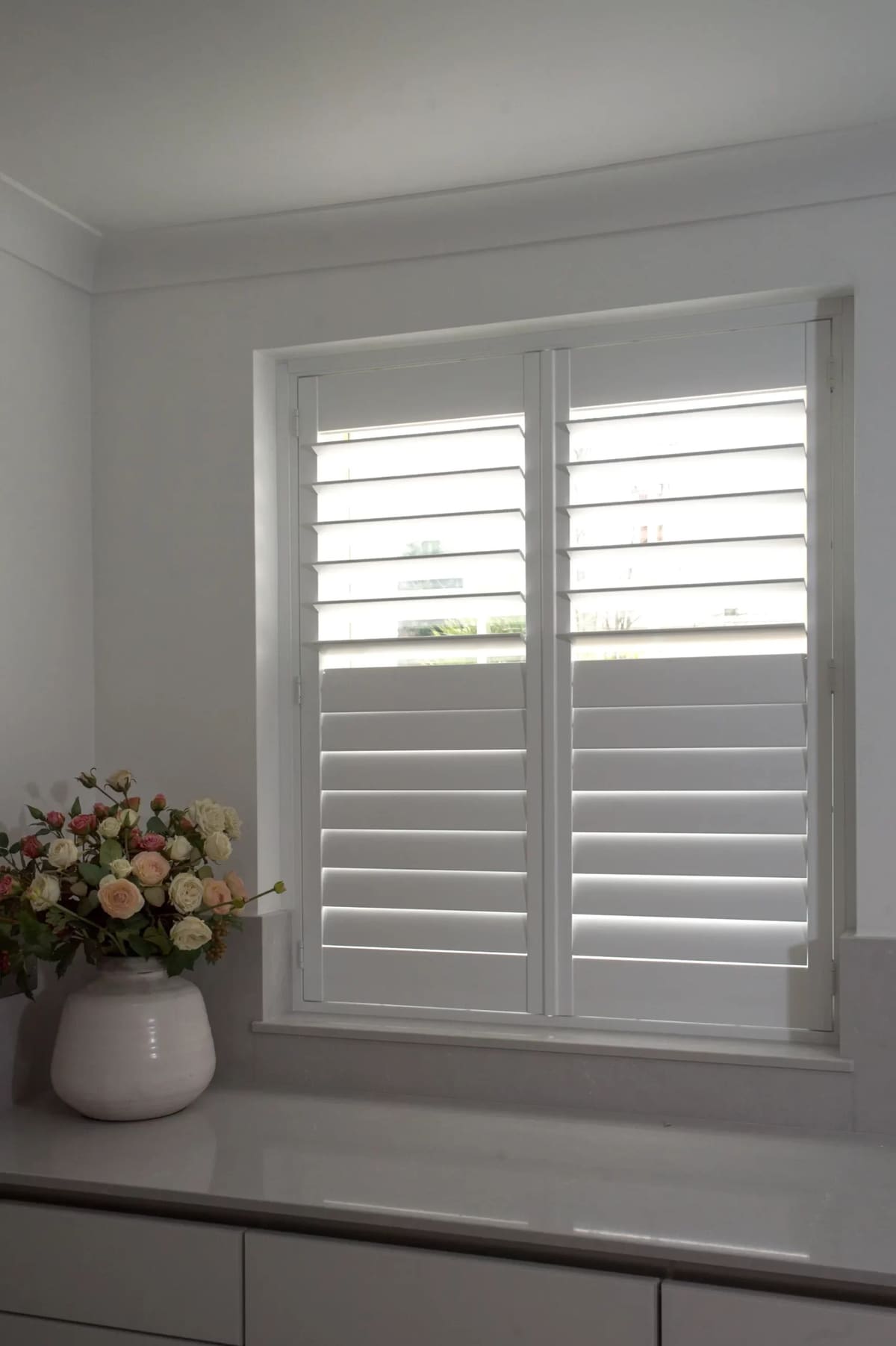
Plantation shutters address this directly. The louvres can be angled to block horizontal sightlines from the pavement while admitting light from angles above the line of sight. Two-section shutters divided at a mid-rail — the upper panel hinged independently from the lower — give the most flexible solution for a lower-ground front window: the lower panel is kept at or near closed during the day for uninterrupted pavement privacy, while the upper panel is angled to admit oblique sky light from above. For rear-facing basement windows where the overlooking comes from an elevated garden or neighbouring property, the same logic applies: the upper panel is closed to block the downward view while the lower section can be opened when privacy conditions allow. See shutters fitted in comparable North London period homes in our installation gallery to understand what each configuration looks like in a lower-ground room. Our article on shutters for Islington and north-central London properties covers the same basement and lower-ground-flat privacy challenge in the adjacent NW1 and N1 stock.
Choosing shutter material for Hampstead and Belsize Park properties
NW3 properties are not coastal and do not face salt-air or elevated humidity conditions that would make aluminium the automatic specification. For the Victorian, Edwardian, and Georgian residential stock that forms the majority of the area's housing, the material choice is primarily between composite and hardwood, based on durability, visual finish, and price.
Mimeo composite shutters are the most commonly specified material across Belsize Park terrace conversions and Hampstead flat conversions. Composite shutters do not absorb moisture from central-heating cycles, do not cup or swell seasonally, and hold a painted finish reliably over the installation's service life. For whole-flat or whole-house installations across the multiple window types typical of an NW3 Victorian property, composite at £380–£580 per window supply-and-fit makes the total cost manageable without reducing the quality of the finished result. For the large period houses around Hampstead village, Branch Hill, and Fitzjohn's Avenue — where original joinery, decorative plasterwork, and timber floors are intact — Endura hardwood shutters carry a material weight and visual warmth that composite does not replicate. The 64mm or 89mm louvre formats suited to the tall NW3 Georgian sash sit within the material vocabulary of period architecture in a way that makes the installation feel designed into the house. The price premium over composite — typically £550–£750 per window supply-and-fit — is most clearly justified in spaces where the existing interior detail rewards matching a natural wood finish. Our full guide to shutters in Victorian and Edwardian homes covers the material and proportion considerations for period properties in more depth.
2026 prices and lead times for Hampstead and NW3
Supply-and-fit prices in Hampstead and Belsize Park in 2026 run from approximately £380–£580 per window for composite and £550–£750 per window for hardwood. These figures include the free home survey, made-to-measure manufacture, delivery, and professional installation. Bay windows with three lights and mitred corner frames cost more per unit than single windows of the same total width — the additional frame joinery and independent panel sizing add to the production cost, confirmed at survey. Large Georgian sash windows above the standard 1,200mm height carry a height supplement; deep masonry reveals above 130mm require a non-standard frame depth specification, also priced at the survey visit.
Lead times from confirmed order to fitting are four to six weeks for composite shutters and six to eight weeks for hardwood. These are production-schedule estimates for made-to-measure manufacture. The survey is the single property visit before the installation appointment; the fitting team arrives with the completed shutters and installs them in one appointment — half a day for a single-room scope and a full day for a whole-house order.
Arranging a shutter survey in Hampstead and Belsize Park
To arrange a shutter survey for a Hampstead, Belsize Park, South Hampstead, or West Hampstead property, book a free home survey online. The survey takes approximately sixty to ninety minutes for a full-house scope or thirty minutes for a single room. Our surveyor measures every window in scope, records reveal depths and any non-standard conditions, brings material and colour samples to view in the actual light of your home, and leaves a written quotation with no obligation to proceed.
Hampstead, Belsize Park, and the surrounding NW3 postcodes are within our standard North London service area. Explore our portfolio of completed shutter installations across comparable London period properties before your survey appointment to identify the configurations and finishes that suit your home.