Checking your lease and building permissions
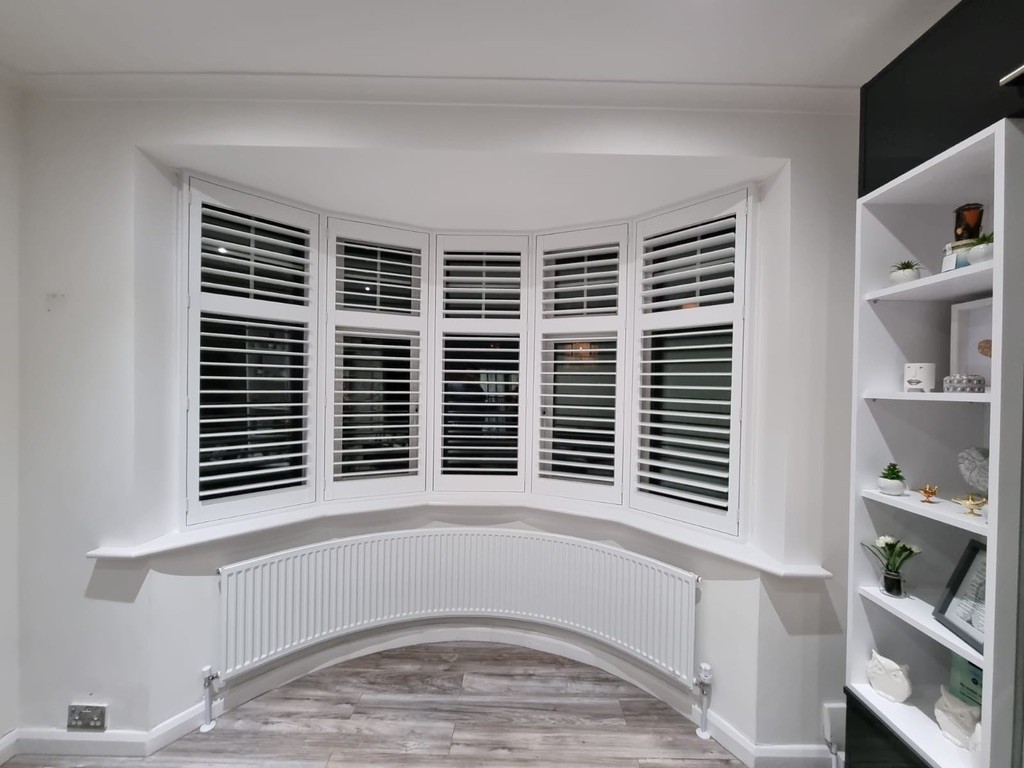
Most leasehold agreements in England permit internal window treatments including plantation shutters, because shutters are installed inside the window reveal and do not alter the external fabric of the building. The practical distinction most leases draw is between internal decoration — generally permitted without consent — and works affecting the structure or external appearance, which typically require landlord or freeholder approval. A well-fitted shutter sits entirely within the reveal: no part of the frame or panel is visible from the street, and the exterior glazing is unchanged.
Some leasehold agreements, particularly in purpose-built mansion blocks and new-build apartment schemes managed by estate agents or resident management companies, include clauses requiring that window treatments present a uniform appearance from outside. White or off-white shutters satisfy virtually all such specifications, as they read as a neutral, built-in appearance from the pavement — considerably more consistent-looking than a mix of curtains, roller blinds, and draped fabric across the same elevation. If your lease or management company agreement includes a window treatment clause, it is worth sending a brief description and a photograph of the proposed installation before ordering, to obtain written confirmation. In our experience, this is rarely refused for shutters in a neutral colour. Our landlord and tenancy guide to shutters covers the most common leasehold and tenancy scenarios in detail, including what to include in a written permission request.
Privacy in flats: managing overlooking and street-level visibility
Privacy is the most consistent reason flat-dwellers specify shutters over other window treatments. A ground-floor flat on a London terrace has pedestrian traffic at window level throughout the day; a mid-rise flat in a purpose-built development may have four or five storeys of neighbouring apartments with direct sight lines into the living room. Standard net curtains manage this passively but remove daylight and any connection to the outside. Roller blinds resolve the problem only by blocking the view completely — and with it, the light. Plantation shutters allow the louvres to be angled upward, directing daylight toward the ceiling and allowing the room to remain bright while the direct sightline from the street is interrupted.
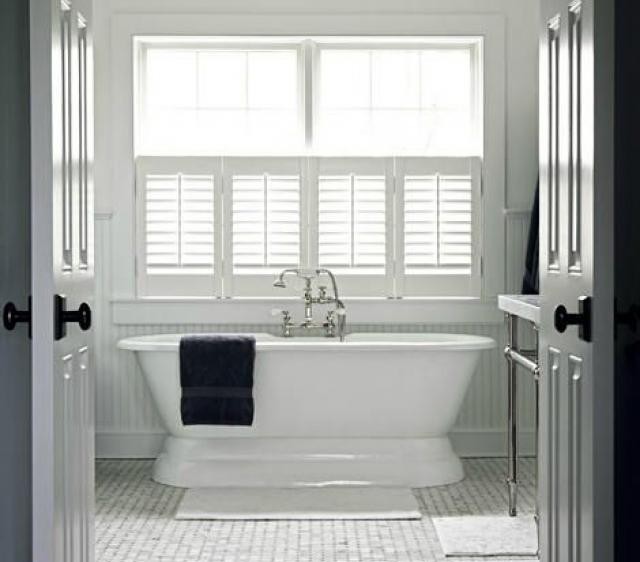
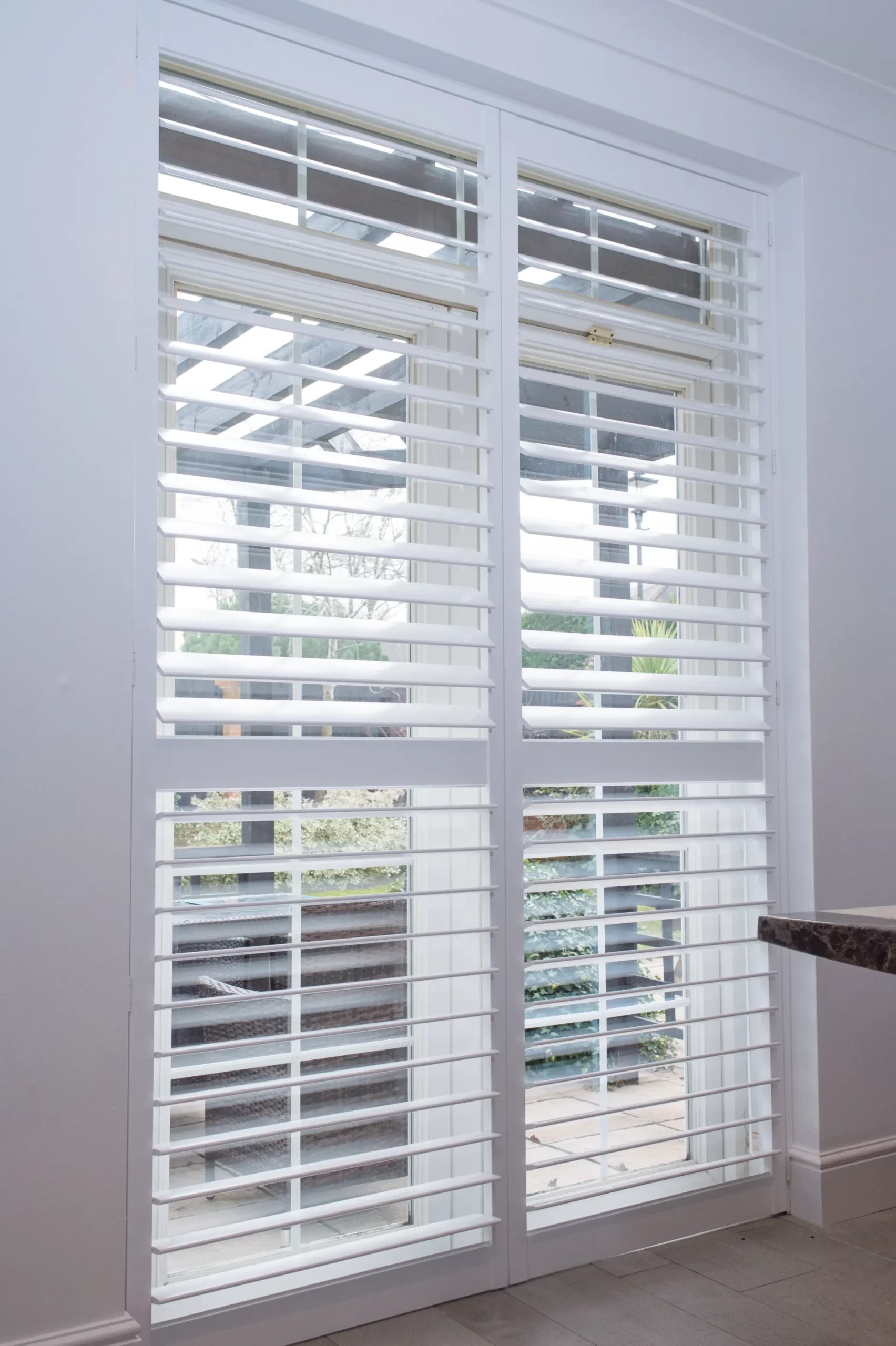
Shutters that cover only the lower two-thirds of each window panel are a well-established flat configuration for precisely this reason. The lower shutter provides uninterrupted privacy at standing eye level from the pavement; the upper portion of the window, left unshuttered, admits sky light freely and maintains the sense of openness that makes smaller rooms feel less enclosed. This configuration works particularly well in Victorian and Edwardian conversion flats, where the original sash windows are tall enough — typically 1.4–1.6 metres — for the division between shuttered and unshuttered portions to fall naturally at approximately chest height. For flats where the entire window is overlooked — a rear-facing window at first or second floor in a terraced conversion, for instance, where a neighbouring garden wall leaves no privacy margin — louvred panels running from sill to window head in a single uninterrupted tier are the complete solution: louvres angled to admit light while blocking the downward view from above. See real examples of how this works in our portfolio of shutters fitted in London flats and apartments.
Light management in north-facing and deep-plan flats
North-facing flats present a specific light challenge that most other window treatments handle poorly. A north-facing living room in a first-floor conversion flat receives no direct sunlight — it depends entirely on diffused sky light and reflected light from neighbouring buildings. Heavy curtains, Roman blinds, and opaque roller blinds reduce that available light further and make small north-facing rooms feel both dark and smaller than they are. Plantation shutters in a north-facing flat are operated differently: for much of the day the panels are folded fully back against the wall, leaving the window entirely unobstructed. When some privacy is needed — a neighbour whose first-floor window is directly aligned with yours, or an evening in which passers-by can see in — the louvres are adjusted rather than the panels closed, maintaining brightness whilst interrupting the sightline.
Studio and open-plan one-bedroom flats face a related challenge: the sleeping area and living area occupy the same space, and a single window must serve both functions. Shutters where the upper and lower panels are hinged independently at mid-rail handle this well. In a studio, the lower panels can be closed for bedtime privacy while the upper panels remain angled to admit morning sky light. In a bedroom area within an open-plan flat, the lower section can be dropped to obscure the view from outside without closing the room entirely. For guidance on how different configurations perform across the full range of flat room types, our guide to the best shutter configurations for privacy covers louvre angles, panel configurations, and the privacy performance of each style in a residential urban context.
Tracked shutters for Juliet balconies and floor-to-ceiling glazing
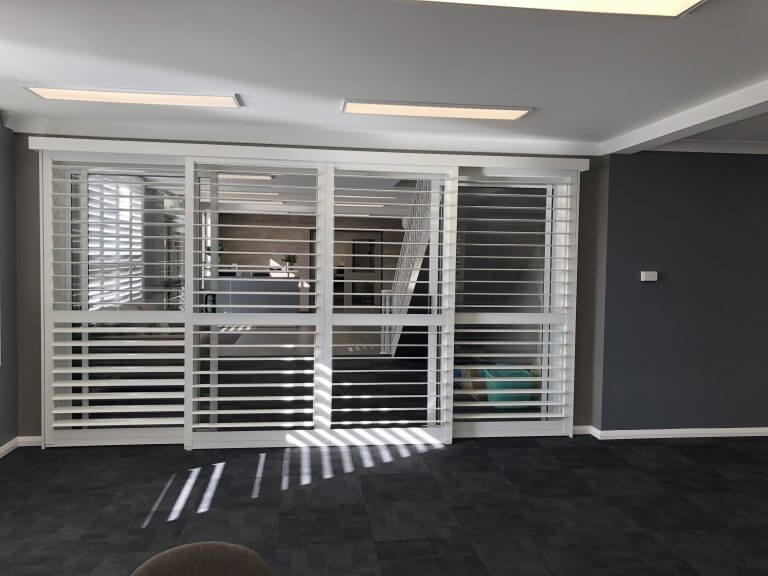
New-build flats across London — particularly in Docklands and the Canary Wharf area, Battersea, Nine Elms, and riverside developments throughout Zone 2 — are disproportionately fitted with floor-to-ceiling glazing and Juliet balconies. Standard hinged shutters cannot serve a Juliet balcony opening: the inward-swinging panels have no room to open within the reveal, and the aperture — typically the full width of the room at 2.4 metres or wider — cannot be served by a pair of standard hinged panels. The solution is a shutter system where the panels slide on a wall-mounted overhead rail rather than hinging into the room. Panels stack behind each other or to one side when the glazing is fully open, leaving the aperture completely clear.
Tracked systems are also the correct solution for wide floor-to-ceiling windows in modern flats where the glazing spans more than approximately 1.2 metres across. A single louvred panel in this width becomes both heavy and visually dominant when open; dividing the opening across two or three panels on a track allows the load to be distributed and the panels to be arranged symmetrically or stacked. The same hardware handles bi-fold door openings where a hinged shutter would obstruct the door mechanism entirely. Our guide to shutters in Docklands and Canary Wharf apartments covers the most common glazing configurations in new-build developments and which tracked specifications suit each.
Renters: drill-free easy-fit shutters
Most assured shorthold tenancy agreements prohibit drilling into window reveals, wall plaster, or window frames without written landlord consent. Standard plantation shutters require a timber or composite frame to be screwed into the window reveal — a permanent fixing that most private landlords will not approve without a conversation, and some will refuse outright. This leaves renters with a choice between requesting permission (which requires landlord engagement and may delay the project), accepting conventional window treatments, or specifying a system that requires no structural fixing.
Luma easy-fit shutters, which require no drilling and leave no marks on the reveal, are designed specifically for this scenario. The frame is held in place by an adjustable top-tension mechanism that wedges into the window opening without screws, wall anchors, or any permanent contact with the reveal surface. The system can be removed cleanly when the tenancy ends, with no trace of the installation remaining. Luma is not suitable for very large or unusually heavy configurations, but it covers the standard bedroom and living room windows found in the majority of one- and two-bedroom rented flats. Our dedicated Luma guide for renters and quick-install projects explains the fitting process and the configurations available in full.
Why composite is the right material for most flat windows
A flat presents environmental conditions that hardwood shutters can struggle with in a way that a detached house does not. Ground-floor conversion flats frequently have elevated ambient humidity, particularly in basements and lower-ground-floor units. Purpose-built apartment buildings with well-sealed envelopes accumulate moisture from cooking and showering, and the glass on south- and west-facing windows can experience significant temperature differentials between day and night. In all of these conditions, a hardwood shutter will undergo seasonal movement — the louvres and panels expand and contract with humidity changes, causing tightening and loosening of the tilt mechanism over time.
Mimeo composite shutters are manufactured from a moisture-resistant polymer core that does not expand or contract with humidity variation. The panel surfaces are smooth-finished throughout — not just at the surface coating — which means the dimensional stability is structural rather than cosmetic. For bathrooms and en-suite bedrooms in particular, composite is the only reasonable specification: hardwood panels in a bathroom will discolour and deform without extraordinary maintenance. For a flat where the same product is being installed across multiple rooms in different moisture environments, composite gives consistent performance across all of them. Browse all shutter products and materials available for flat and apartment installations to compare the full range of specifications.
Prices and lead times for flat window shutters in 2026
Composite shutters for a typical flat bedroom window — approximately 900mm wide by 1,100mm tall — cost approximately £400–£550 supply and fit in 2026. A one-bedroom flat with two bedroom windows and a single living room window would typically come to £1,200–£1,800 for a complete installation. A larger two-bedroom conversion flat with four or five windows in different configurations runs to approximately £2,000–£3,000 depending on window sizes and specifications. Lead times from confirmed order to fitting are four to six weeks for composite and six to eight weeks for hardwood. Tracked systems for floor-to-ceiling glazing carry a modest premium for the additional rail hardware, typically running from £550–£700 per linear metre of aperture.
Easy-fit Luma shutters, available to renters without drilling, are supplied and fitted from approximately £350–£430 per standard window. All prices are supply and fit inclusive of surveying, framing, panels, and installation; the only variable excluded from a standard quote is any structural making-good required by unusually damaged reveals, which is confirmed at survey. Book a free home survey to receive confirmed pricing for your specific windows — the surveyor measures every opening, discusses your privacy and light requirements, and brings physical colour samples and louvre widths to compare in the actual room. There is no obligation to proceed at the survey stage.