Why conservatories are the harshest window environment in a UK home
A glazed conservatory is, in thermal terms, a greenhouse attached to your living space. South- and west-facing conservatories routinely reach 35–42°C on summer afternoons — temperatures at which most fabric window treatments begin to fade, discolour, and release trapped moisture as visible steam when cooled in the evening. North-facing conservatories face the opposite problem: cold, relatively dark, and prone to condensation on cold mornings when warmer indoor air meets chilled glass. East-facing structures cycle between both extremes within a single day.
What these conditions share is their hostility to fabric. Standard roller blinds in a south-facing conservatory show UV fade within 18–24 months — synthetic dyes are not designed for 1,000-plus hours of annual direct sun exposure at glass-surface intensity. Pleated fabric blinds trap moisture and provide a surface for mould growth on north-facing structures. Timber venetian blinds warp when the temperature differential between a closed conservatory and an opened one exceeds 15°C — which it does on most summer days in the UK. Our guide to how shutters improve thermal comfort across different UK window types covers the broader insulation argument; this article focuses specifically on the conservatory, where the case for non-fabric window treatments is most clear-cut.
Managing summer heat: how louvre angles reduce solar gain
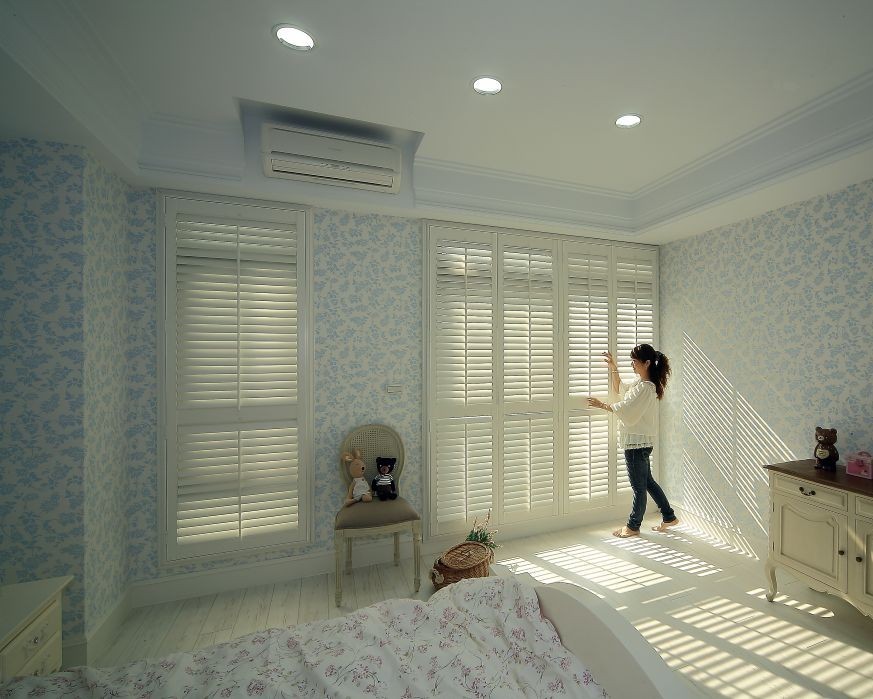
The mechanism by which louvred shutters reduce conservatory temperatures is straightforward. A glazed panel in direct sunlight transmits solar radiation into the room behind it: short-wave radiation passes through the glass, heats surfaces inside, and the resulting long-wave radiation cannot escape back out — the greenhouse effect in miniature. A partially angled louvre intercepts this radiation at the inner glass surface, reflecting or absorbing it before it fully enters the room. Panels angled at approximately 30–45° from vertical deflect the majority of direct summer sun while maintaining some light diffusion and air circulation through the slat gaps.
In a well-specified south-facing conservatory, louvres closed during peak afternoon sun — roughly 1pm to 5pm in a British summer — can reduce peak indoor temperatures by 8–12°C compared to unshielded glazing. This converts an unusable 40°C space into a tolerable 28–30°C room. For east-facing conservatories, morning louvre management is the priority; for west-facing structures, lower sun angles in the afternoon mean vertical shutters work most effectively when supplemented by a roof covering for overhead glazing. Our conservatory shutters overview covers the full range of orientations and how each responds to louvre adjustment.
Winter warmth: the insulating air gap effect
Closed shutter panels create a physical layer between the glass surface and the room interior. This trapped air — which has low thermal conductivity — slows the rate of heat loss through the glazing. The effect is most useful in conservatories with standard double-glazed units rather than triple-glazing, where the U-value of the glass itself is higher and cold-side radiation more significant.
For a heated conservatory used as a dining room or sitting room through the winter, the difference is perceptible: a closed shutter on a cold evening reduces the draught effect caused by cold glass radiating into the room, making the space feel warmer at a given thermostat setting. The energy improvement is not dramatic enough to substitute for insulated glazing, but the comfort gain is real and consistent. In a fully uninsulated single-glazed lean-to — common in older UK properties — the insulating effect of closed composite shutters is particularly noticeable.
Privacy in overlooked conservatories
The majority of rear-facing conservatories in UK terraced and semi-detached properties sit in overlooked gardens — neighbouring upper-storey windows, rear access lanes, and adjacent properties often have a direct sightline into the conservatory interior. A standard 1.8m fence provides ground-level screening but does nothing for first-floor sightlines. A conservatory used as a dining room, playroom, or sitting room benefits from adjustable privacy that does not require closing the whole structure to natural light.
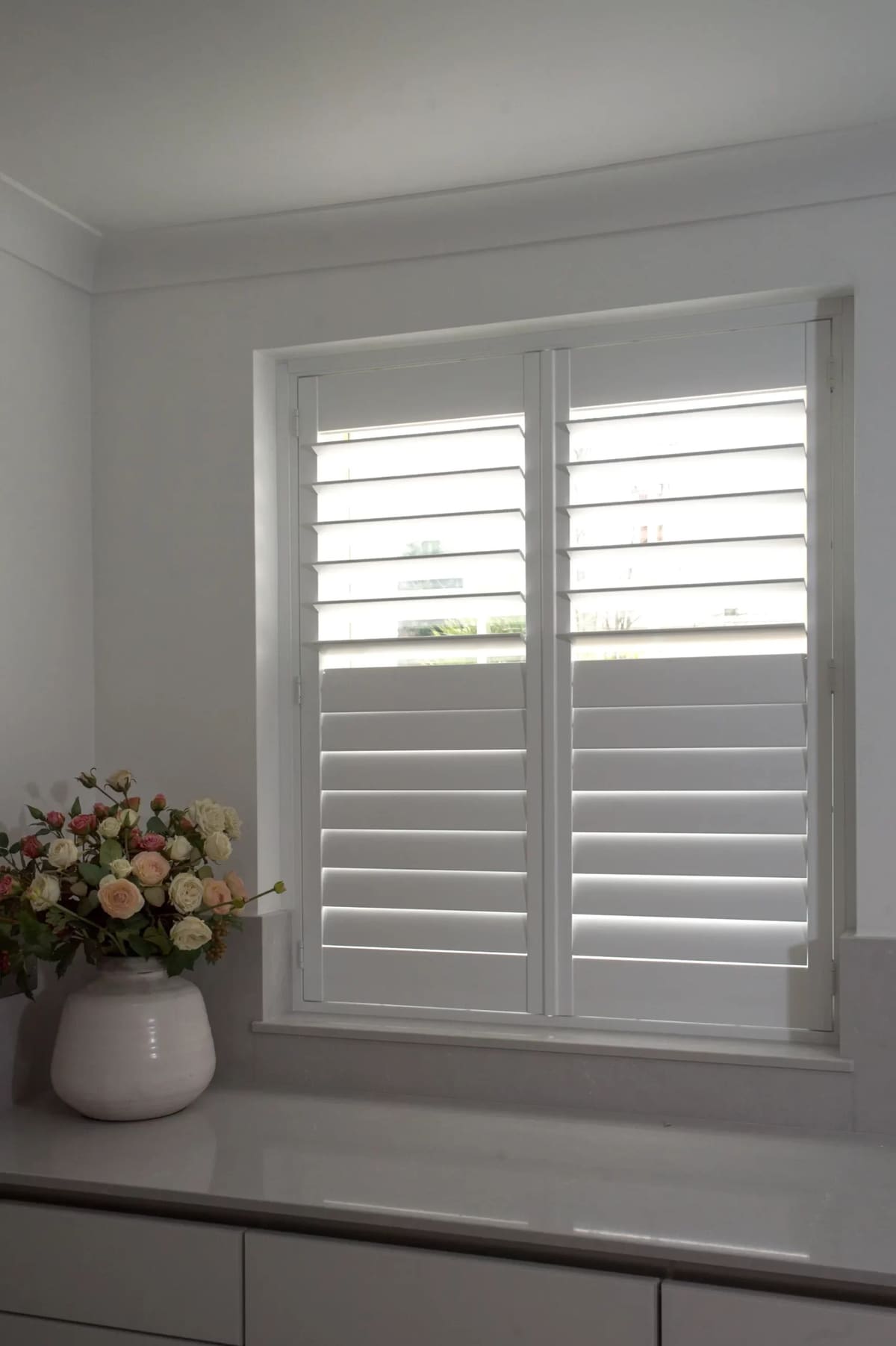
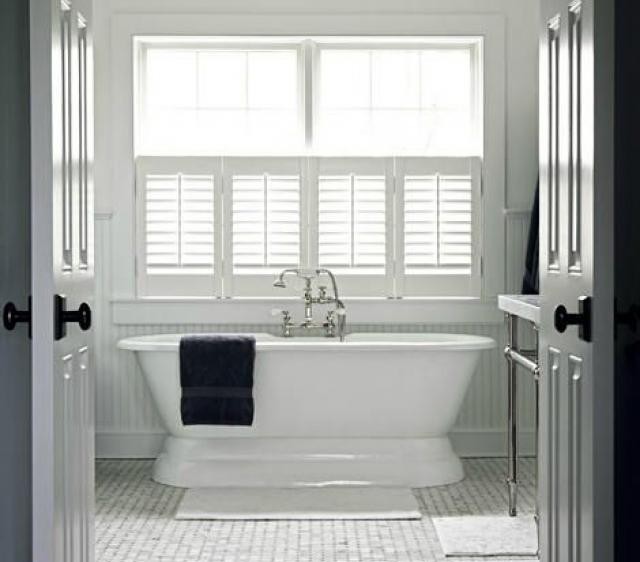
Lower-half louvred panels fitted to the bottom 60–70% of each glazing unit provide privacy at seated height while leaving the upper portion of each window open to sky views and diffused daylight. This works especially well in conservatories with tall glazing sections of 1,500mm and above, where the proportions support a clear visual division between covered and uncovered zones. For structures where the privacy requirement extends to the full window height — ground-floor conservatories directly adjacent to a shared path, or those at road level — individual louvred panels sized to each window opening from sill to head are the complete solution: closed louvres block sightlines entirely, angled louvres filter light without admitting a direct view, and open louvres give full access to the garden.
Materials for conservatories: why composite and aluminium are the right specification
A south-facing conservatory can swing from 5°C on a January night to 38°C on a July afternoon — a 33°C differential that expands and contracts solid timber repeatedly through its annual cycle. Factory-painted hardwood shutters, the standard product for interior rooms, are not the appropriate specification for a space with this thermal profile. The louvre-to-panel joints and end-grain surfaces are the most moisture-permeable points in any timber shutter, and repeated thermal cycling accelerates moisture uptake and checking far beyond what occurs in interior-only conditions.
Moisture-resistant composite shutters with a solid polymer core do not absorb moisture or expand and contract significantly with temperature change. The factory-applied surface finish bonds to the polymer substrate rather than porous timber, and will not crack, peel, or check in conservatory conditions. Composite shutters are the standard material recommendation for all conservatory vertical window installations. For wide conservatory door openings — bi-fold or sliding walls of 2.5m and above — aluminium tracked panels spanning the full opening width are the strongest available specification: the aluminium core is dimensionally stable across the full temperature range of any domestic conservatory, the powder-coat finish is UV-resistant and will not fade in sustained direct sunlight, and the tracked mechanism is engineered for the weight and use frequency that a conservatory main entrance demands.
Shutter styles for different conservatory configurations
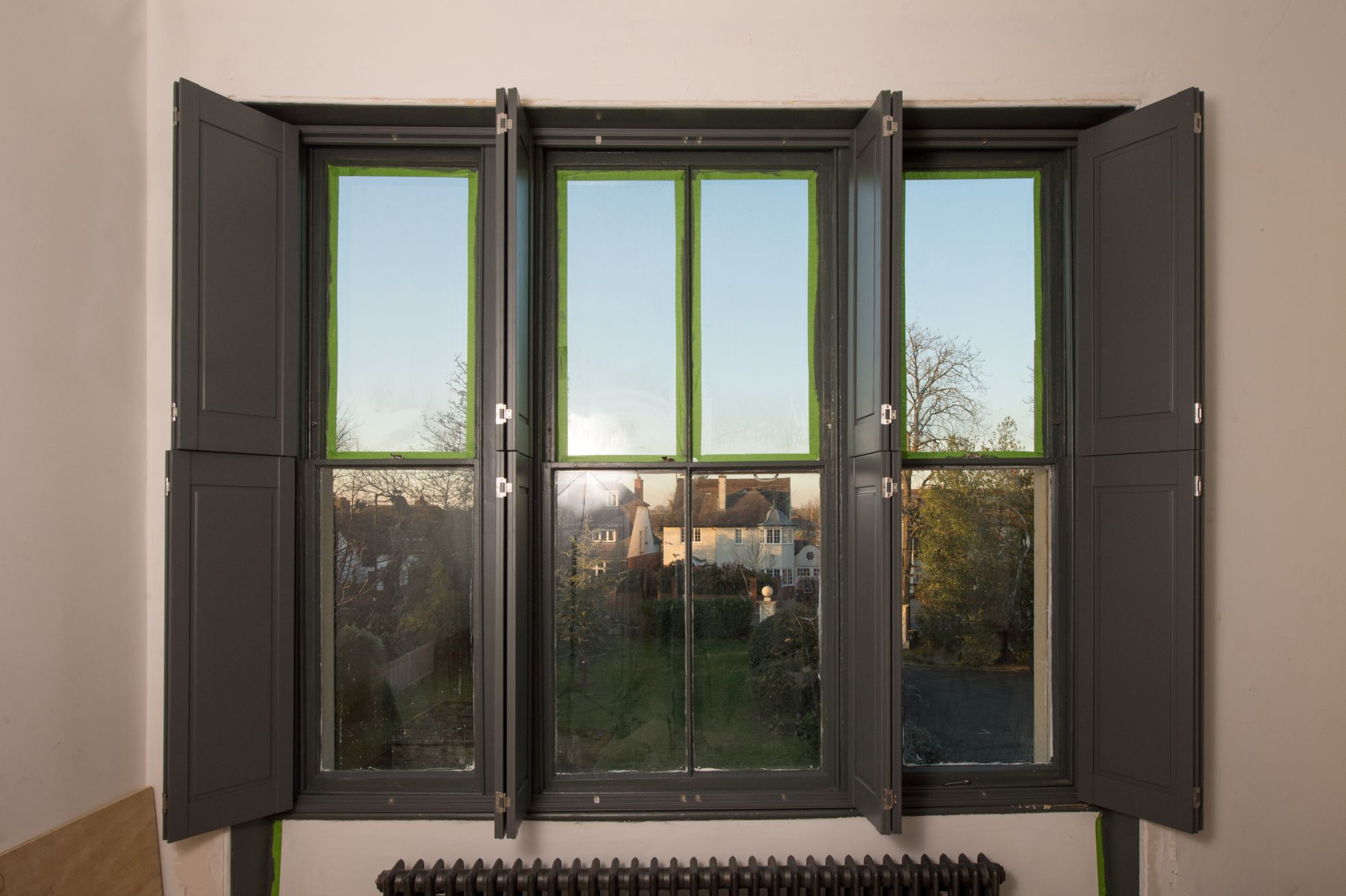
Victorian lean-to conservatories — shallow, single-slope, one or two bays wide — typically feature standard casement windows on the side returns and a door in the centre or end. Individual composite panels hinged to each casement provide complete vertical coverage; the total glazed area is usually modest, 3–6m², and a whole installation fits within a single day.
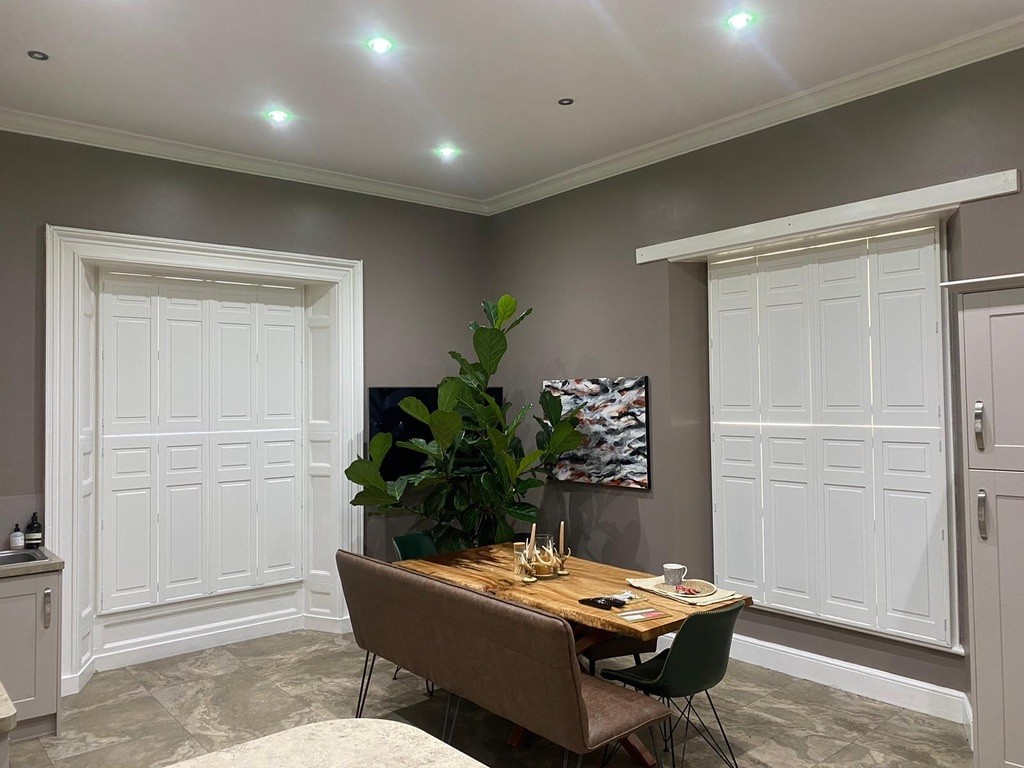
Edwardian conservatories with dwarf walls and taller glazing sections of 1,500mm and above have more complex window runs. The wider front elevation may span 3–5m across two or three glazing units. Sliding panel systems that run on a ceiling-mounted or top-fixed track across the front elevation give complete coverage without the structural requirements of wide hinged panels; side casements are handled with individual hinged composite shutters. Modern glass-sided extensions with bi-fold door walls are the most straightforward application: a single tracked system across the full bi-fold opening, with hinged panels on any fixed side windows, controls the entire rear aspect in one clean configuration. Browse our portfolio of finished conservatory and extension shutter installations to see all three configurations before committing to a specification.
2026 UK pricing for conservatory shutters
Conservatory shutter pricing follows the same per-square-metre logic as interior room installations. Mimeo composite shutters — the standard conservatory specification — start from approximately £350–£400 per m² supply and fit for vertical side windows in hinged panel format. Dura aluminium tracked systems for wide bi-fold or sliding door openings start from approximately £650–£800 per m², reflecting the track hardware and panel engineering required for large spans.
A modest lean-to conservatory with 4m² of vertical glazing fitted in composite runs from approximately £1,400–£1,800 for a complete installation. A larger Edwardian conservatory with 8–10m² of glazing — side windows plus a tracked front elevation — runs from approximately £4,000–£6,500. Lead times from confirmed order to installation are four to six weeks across all standard products. The long-term financial case for shutters over fabric blinds — which typically need replacing every four to six years in a conservatory environment — is covered in our full cost and value analysis for plantation shutters. Book a free home survey to receive a written quote for your conservatory with physical product samples and a confirmed lead time on the day — no obligation to proceed.