What conservation area and listed building restrictions actually cover
Conservation area designation protects the overall character and appearance of a defined area through controls on external alterations. Under the Town and Country Planning Act 1990 and associated regulations, works that would affect the external appearance of a building in a conservation area may require a formal planning application — particularly in areas where an Article 4 direction has removed permitted development rights. The focus throughout is on what is visible from the public realm: extensions, outbuildings, cladding, satellite dishes, window replacements, and external door changes. Interior works are categorically outside this framework.
Listed building consent under the Planning (Listed Buildings and Conservation Areas) Act 1990 extends the control further. Grade II listing is the most common designation, covering approximately 91% of all listed buildings in England; Grades II* and I are reserved for particularly significant or exceptional interest. Listed building consent is required for any works that would affect the character of a listed building as a building of special architectural or historic interest. This phrase carries legal weight: it covers structural alterations, external works, and internal changes that affect the specific features that made the building worth listing — original panelling, staircases, fireplace surrounds, or the window fabric itself. Purely decorative interior additions — blinds, curtains, or plantation shutters — are in an entirely different category.
Why internal shutters sit outside the planning framework
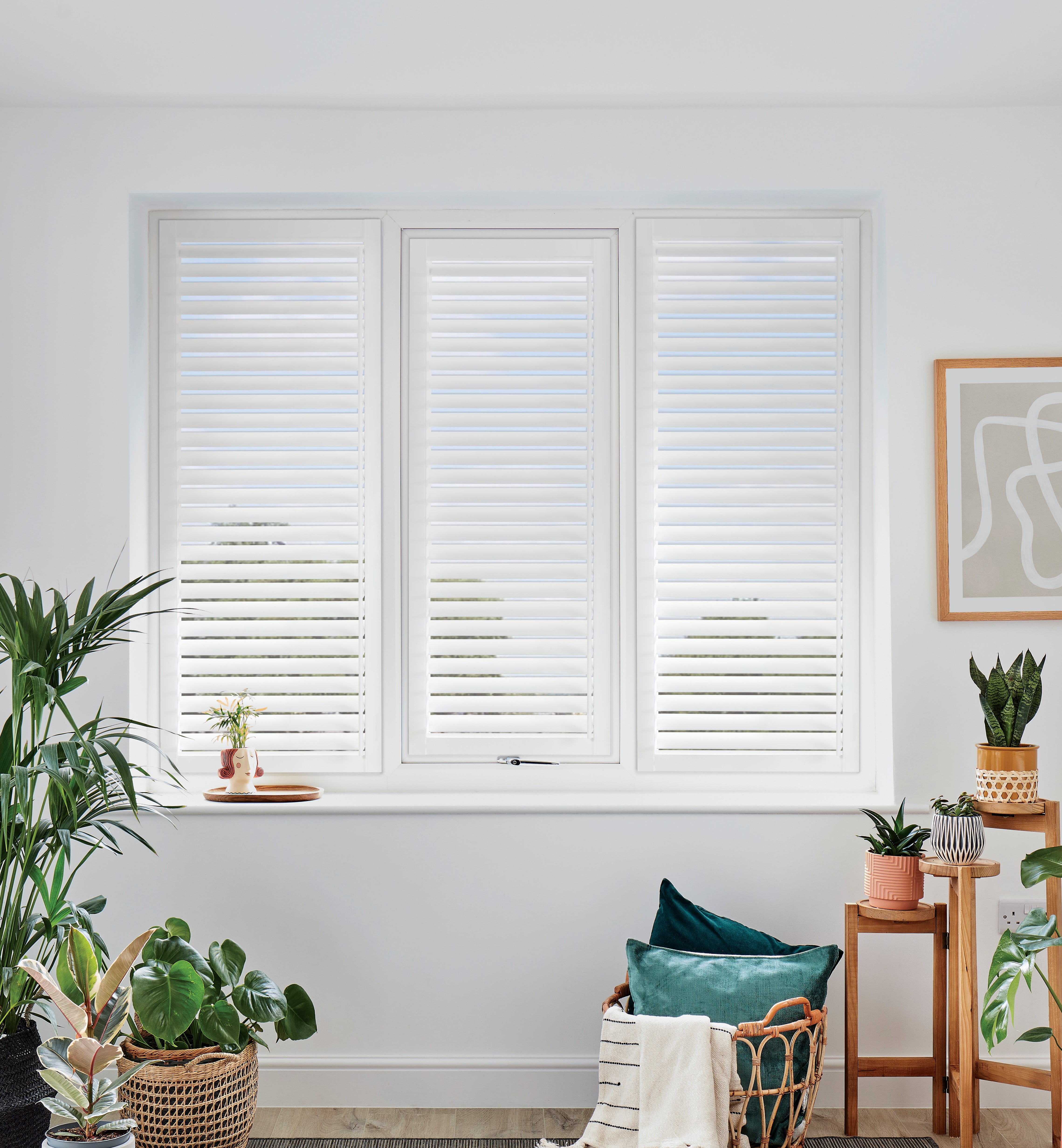
Plantation shutters fitted internally to an existing window opening leave the building's external fabric entirely untouched. The shutter frame is fixed to the internal face of the reveal — typically to a timber sub-frame or window board — and the installation makes no alteration to the external appearance of the window, the glazing bars, the sash mechanism, or any external feature visible from the street. For properties in a conservation area, this means no planning application is required: the external character of the area remains unchanged, and permitted development rights do not extend to interior treatments in any case. Our earlier article on whether shutters require planning permission in the UK covers the full planning framework in detail, including the conservation area and Article 4 position.
The same logic applies within a listed building. A plantation shutter is a reversible interior fixture — it can be removed by unscrewing the frame from the reveal lining without touching the original masonry, timber sash, or glazed lights. Historic England guidance on listed building works distinguishes reversible interior fixtures from alterations that affect the special interest of the building. A set of shutters fitted to a window that had no original surviving shutters does not diminish any heritage feature; it adds a window treatment that sits entirely within the reveal and can be removed without trace. Conservation officers across English local authorities have confirmed this position in practice, and no recorded listed building consent application has been required for an internally fitted plantation shutter to a standard residential listed building.
Choosing the right specification for a conservation-area property
Although no planning consent is required for internal shutters in a conservation area, the visual quality of the installation matters — both for the character of the room and for the exterior appearance seen through the glass. The frame material and colour will be visible from the street in daylight hours, and a specification that reads as sympathetically as possible with the building's architecture is the right approach for any period property. The most common error in conservation-area settings is over-specifying the louvre width: wide 89mm louvres can dominate the proportions of a Victorian sash window with fine glazing bars, whereas 47mm or 64mm louvres complement the vertical rhythm of the opening without visual weight that conflicts with the original details.
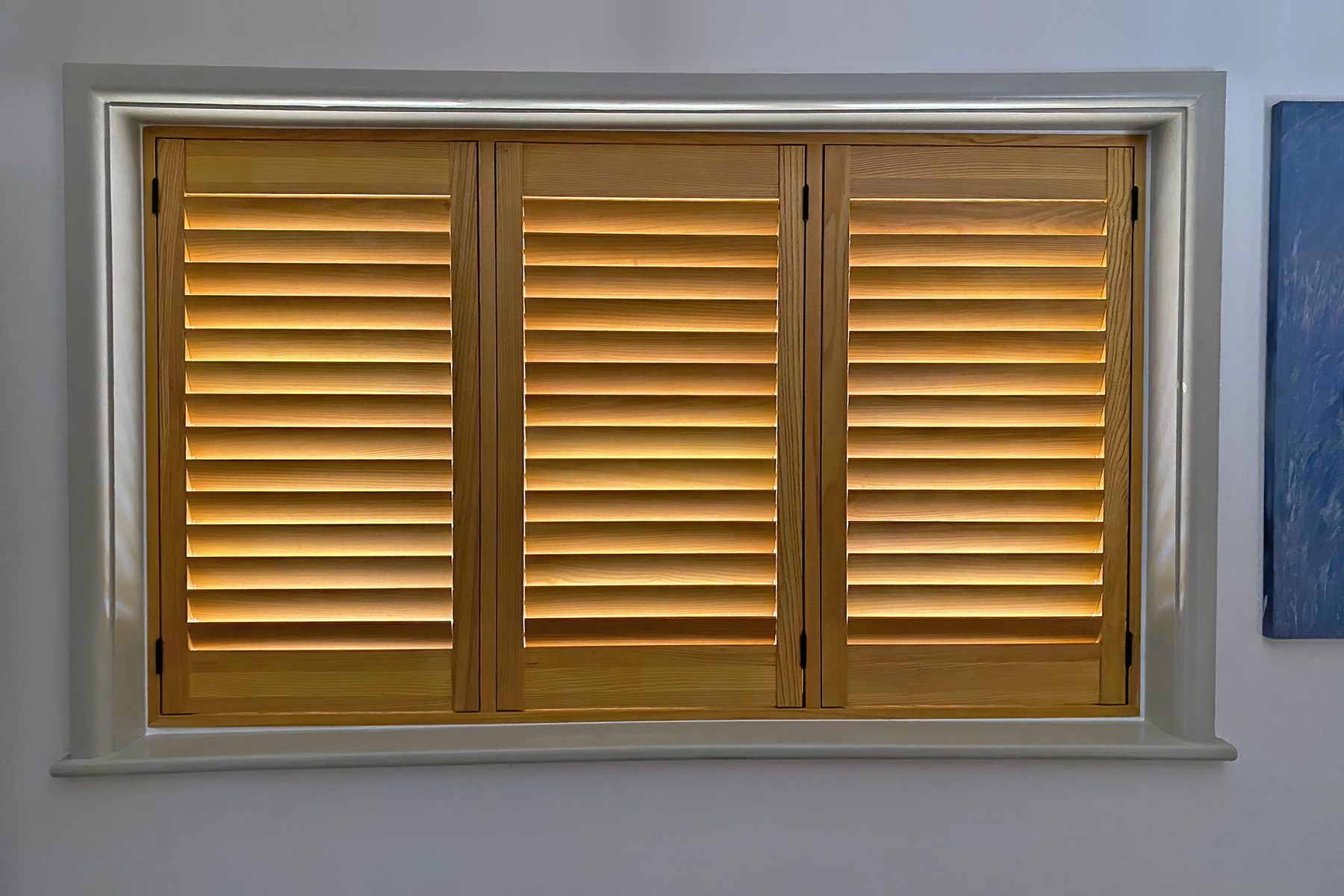
Endura hardwood shutters are the specification of choice for principal reception rooms in Georgian, Victorian, and Edwardian conservation-area properties. Hardwood accepts a factory-applied paint finish in any colour, and the depth of a painted solid-wood surface is closer to original period joinery than a composite alternative. In a sash-windowed Victorian terrace, a hardwood shutter factory-painted to match the existing skirting boards and door architraves reads as if it belongs to the building rather than having been applied to it. For service rooms and upper-floor rooms where a more practical specification is appropriate, Mimeo composite shutters are dimensionally stable, moisture-resistant, and available in the same colour range — a sensible choice for kitchens, bathrooms, and upper bedrooms where a high-specification interior finish is not the priority.
Listed buildings — where the permission question genuinely arises
For Grade II listed residential properties — which cover the vast majority of historic homes in England — internal plantation shutters require no consent. A reversible interior fixture that makes no structural alteration and does not affect the features that created the listing falls outside the listed building consent framework. This position is consistent with Historic England guidance and the advice given by most local authority conservation officers.
The question becomes more complicated in two specific scenarios. The first is where a building's original interior shutters survive as part of the listed fabric. Many pre-Victorian houses had fitted folding-panel shutters as a structural feature of the window reveal; if these survive in any condition, removing or replacing them would require listed building consent. Installing new plantation shutters in a window that has never had fitted shutters is an entirely different scenario. If original interior shutters are present — even in a deteriorated state — record them and consult the conservation officer before specifying any alteration. The second scenario is a Grade I or Grade II* listing with an unusually broad description that specifically identifies interior features throughout the building; this applies almost exclusively to non-residential buildings — country houses, churches, institutional premises — and is rarely encountered in a standard domestic setting. For a broader guide to shutters across the full range of period property types, our period-home shutter guide for Victorian and Georgian properties covers window types and specification approaches in detail.
Matching shutters to period architecture in conservation areas
The window types found in conservation-area properties are the window types that plantation shutters were designed around. Tall double-hung sash windows with deep reveals are the dominant form across Victorian, Edwardian, and Georgian residential conservation areas in England. The reveal depth — typically 100–150mm in Victorian construction — gives a shutter frame a proper mounting depth without any need for face-fixing outside the reveal. The vertical proportions of a tall sash opening — with a width-to-height ratio of roughly 1:2 to 1:2.5 — suit louvred panels running in a single continuous tier from sill to window head particularly well; the unbroken vertical line reinforces rather than interrupts the architectural proportion of the opening. Our auto-blog period style guide for Victorian home shutters covers how different configurations interact with this building type across a range of window proportions.
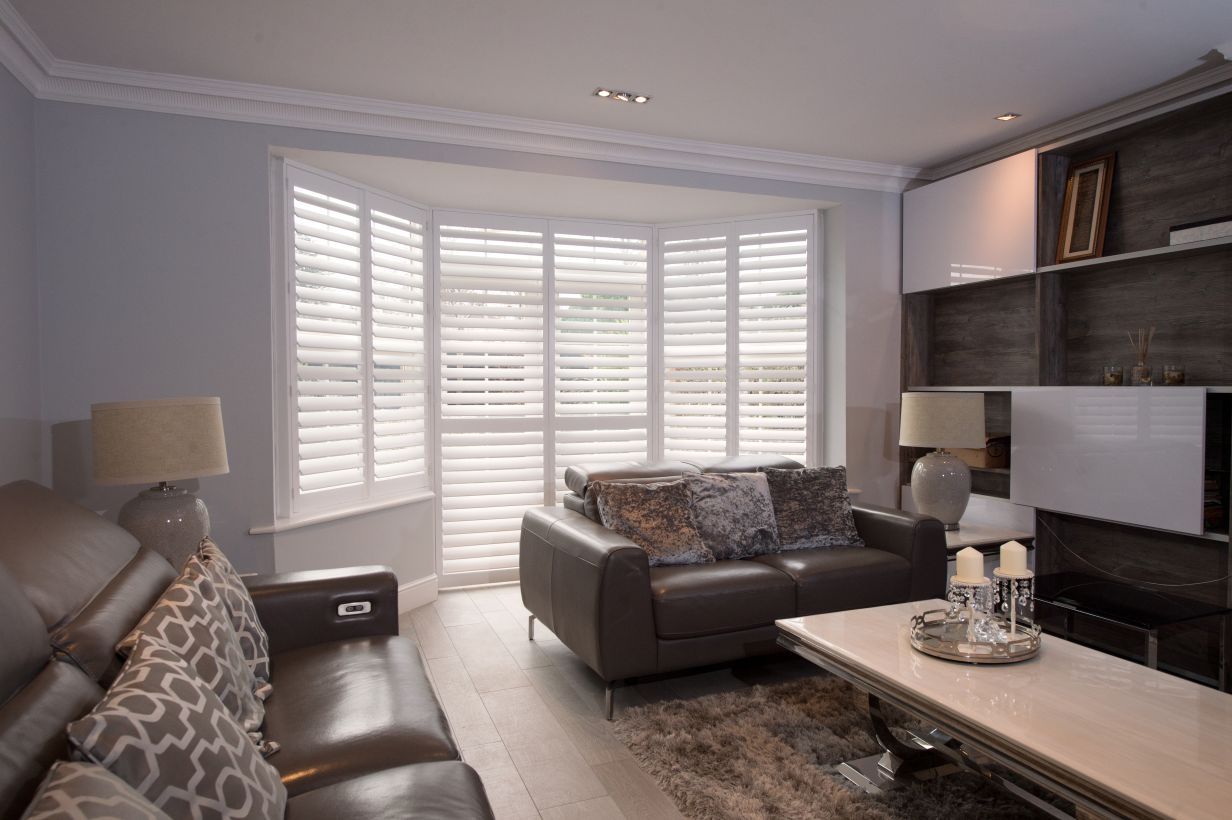
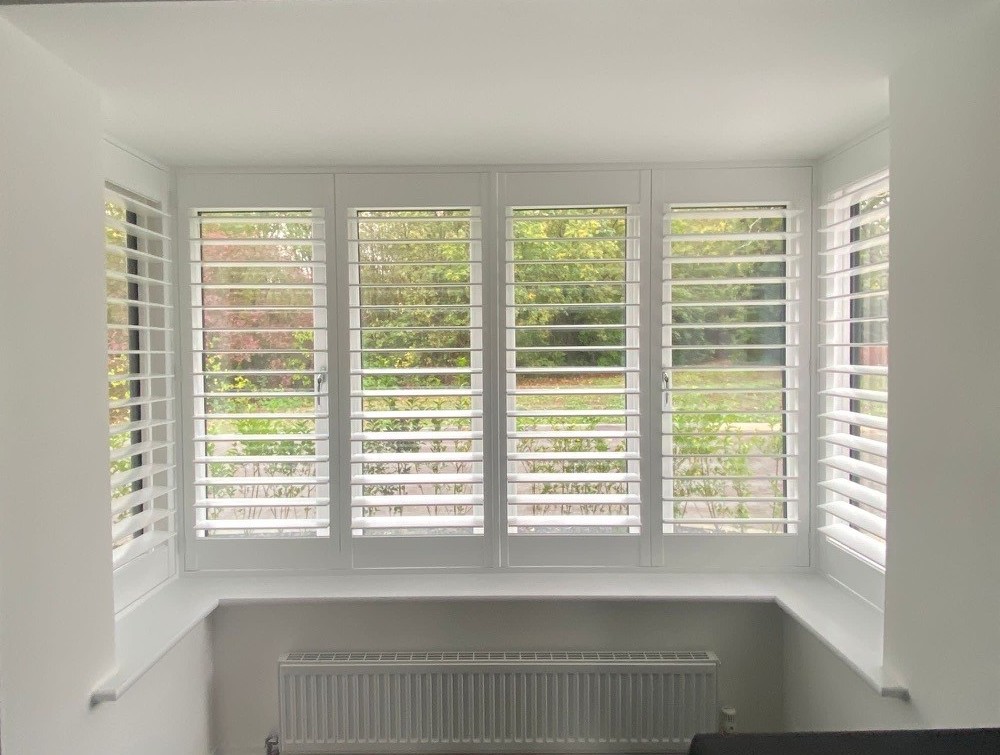
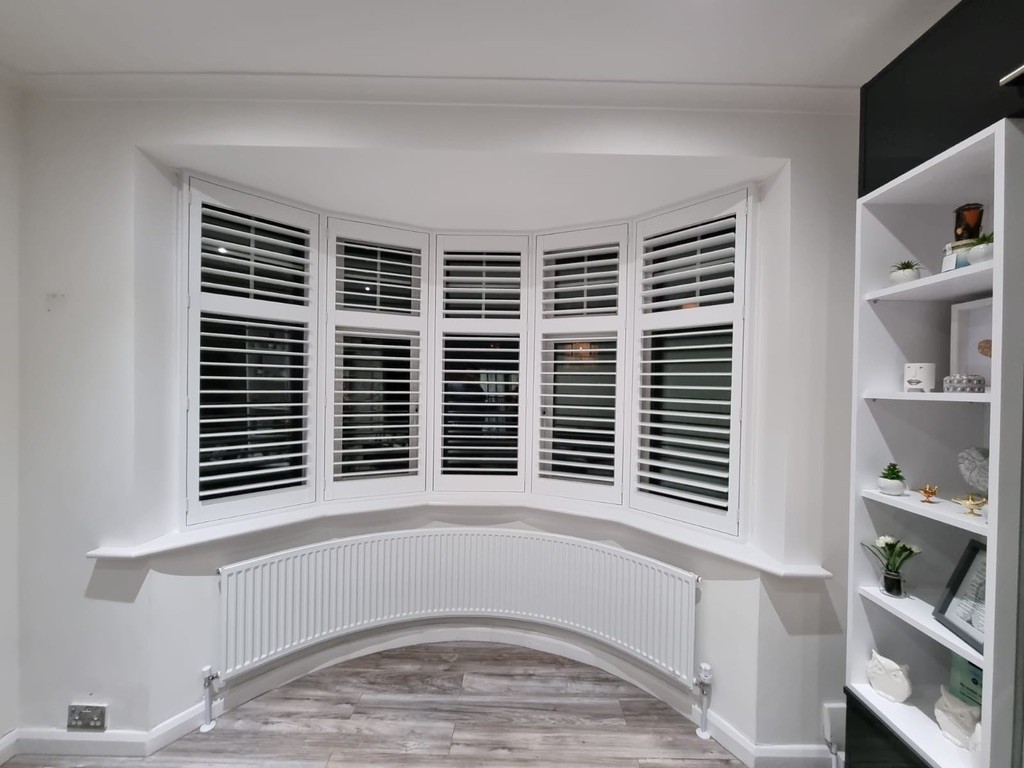
Where the ground-floor principal room features a projecting bay — almost universal in Victorian terraces built between 1870 and 1910 — the shutter installation must account for the bay geometry precisely. Shutters designed for the angled fronts and corner returns of a projecting bay are manufactured with mitred frames at each return corner, so adjacent panels meet cleanly and the installation reads as architecturally integrated rather than applied. Off-the-shelf panels placed across the bay face without corner joints leave visible gaps at the returns — an appearance that is particularly conspicuous in a conservation area where the quality of the built environment is a protected characteristic. Upper-floor sash windows in conservation-area Victorian terraces are well served by shutters with independently operated upper and lower panels, allowing the lower section to be held at or near closed for privacy while the upper section admits daylight from above. Our detailed guide to shutters for Victorian and Edwardian period homes covers the full range of window configurations common to the conservation-area housing stock and how each is best specified.
The survey and specification process for conservation-area homes
The right way to approach a shutter specification for a conservation-area or listed property is with a professional survey. A surveyor experienced in period properties will identify non-standard conditions — irregular reveal depths, unusual sill profiles, surviving original architraves that require careful fixing to avoid damage, sash windows with ovolo mouldings that affect the frame's seating — before the order is placed. These conditions are common in pre-1920 construction and are impossible to assess accurately without a physical visit. Attempting to order from approximate measurements in a period property is the single most common cause of a refitting visit, and it is entirely avoidable.
Book a free home survey with Shutters Factory — your surveyor brings material and colour samples, measures every window to the millimetre, and provides a fixed supply-and-fit quotation with no obligation to proceed. The survey is free and carries no pressure to commit. Before your appointment, browse our portfolio of shutters installed in period and conservation-area properties across London and the Home Counties to understand how each material and configuration looks in rooms comparable to your own — seeing a similar specification in a comparable setting gives the clearest reference point for deciding on louvre size, material, and colour before samples arrive at your door. Explore the full range of shutter materials and styles to understand every option before the surveyor confirms the optimal specification for your windows.