What causes condensation on windows?
Condensation forms when warm, moist air contacts a surface cold enough to cool the air below its dew point — the temperature at which water vapour turns back into liquid. Windows are typically the coldest surface in any room because glazing transfers heat quickly between indoors and out. In a living room at 20°C with typical winter humidity, a single-glazed window running at 3–5°C will condense moisture readily; modern double-glazed units reduce this significantly by raising the inner glass surface temperature to around 12–15°C, but condensation remains possible on cold mornings or in rooms with high humidity from cooking, showering, or drying clothes. UK homes — particularly the Victorian and Edwardian housing stock where older glazing remains common — are especially susceptible.
The practical effect of persistent condensation on windows extends well beyond water marks on the glass. Repeated moisture at the sill breeds mould, accelerates timber rot in wooden window frames, and — in properties with older single-glazed sashes — contributes to structural damp if left unaddressed. Repeated freeze-thaw cycles in the sill area can crack paint and masonry. Any window treatment that reduces the temperature differential at the glass surface, or that reduces the humidity of the air reaching the cold glass, will reduce condensation. Plantation shutters do both — but only under the right conditions.
How a shutter panel acts as a thermal buffer
A closed plantation shutter panel creates an insulating air gap between the cold glass surface and the warmer room interior. This gap acts as a thermal buffer in the same way as a cavity wall or a double-glazed unit: still air is an effective insulator, and even a 50mm gap between panel and glass meaningfully raises the temperature of the glass-side microclimate. A window that runs at 8°C without any covering will typically reach 12–14°C with a closed shutter panel in front of it — a shift that materially raises the dew point margin and reduces the likelihood of condensation forming. Our overview of how shutters improve window insulation and reduce heat loss covers the full thermal physics, including comparisons with alternative window treatments.
Solid panel shutters deliver the strongest thermal barrier of any shutter type because the panel is a continuous surface with no gaps — unlike a louvred panel, where the louvres allow a small degree of air movement even when tilted shut. For north-facing bedrooms with persistent cold-glass condensation, a solid panel combined with double glazing provides a very effective combined barrier. Louvred shutters with the louvres fully closed still create a significant air gap and deliver meaningful insulation improvement over an unshuttered window. The insulation benefit is an indirect condensation management tool: reducing heat loss through the window makes the room easier to heat to a temperature where the relative humidity falls and condensation becomes less likely.
The ventilation caveat — why airflow still matters
The thermal buffer benefit of shutters assumes that the space between the shutter and the glass does not itself become a trap for humid air. In a well-ventilated room this is not a concern: the air behind a closed shutter slowly exchanges with the room air through the louvre gaps and around the frame, maintaining broadly the same low humidity as the rest of the room. In a room where moisture output is high and ventilation is insufficient — a bathroom without a working extractor, or a kitchen where condensation from cooking is not drawn away — the air behind a closed shutter can become trapped and more humid than the room average, causing condensation on the glass surface without the occupant being aware until the shutter is opened.
The practical rule is straightforward: shutters reduce condensation risk in well-ventilated rooms, and can worsen it in poorly ventilated ones. Before fitting plantation shutters in any room where condensation is already a problem, address the ventilation first. In bathrooms, a functioning extractor fan running during and for at least ten minutes after a shower prevents moisture build-up regardless of the window treatment. In kitchens, a cooker hood exhausted externally — not a recirculating type — and an openable window between cooking episodes are the fundamental requirements. Once ventilation is adequate, shutters in a bathroom provide privacy, thermal comfort, and a stable moisture-resistant finish without any ventilation trade-off.
Kitchens and bathrooms: matching shutters to wet rooms
Kitchens and bathrooms are the rooms where high moisture output and cold window surfaces create the most persistent condensation problems — and also the rooms where shutter material choice matters most. Wooden shutters, even when painted and sealed, will absorb moisture through the end grain over time in a bathroom environment; a shutter repeatedly saturated with shower steam will eventually cup, crack at the joints, or cause the paint finish to peel from the louvre edges within a few years. In kitchens, grease-laden air accelerates the same deterioration. The correct specification for both rooms is a moisture-resistant material. Moisture-resistant composite panels are dimensionally stable in high-humidity environments and carry a factory-applied painted finish that is not susceptible to moisture penetration — the core material does not swell or warp regardless of steam or condensation exposure.
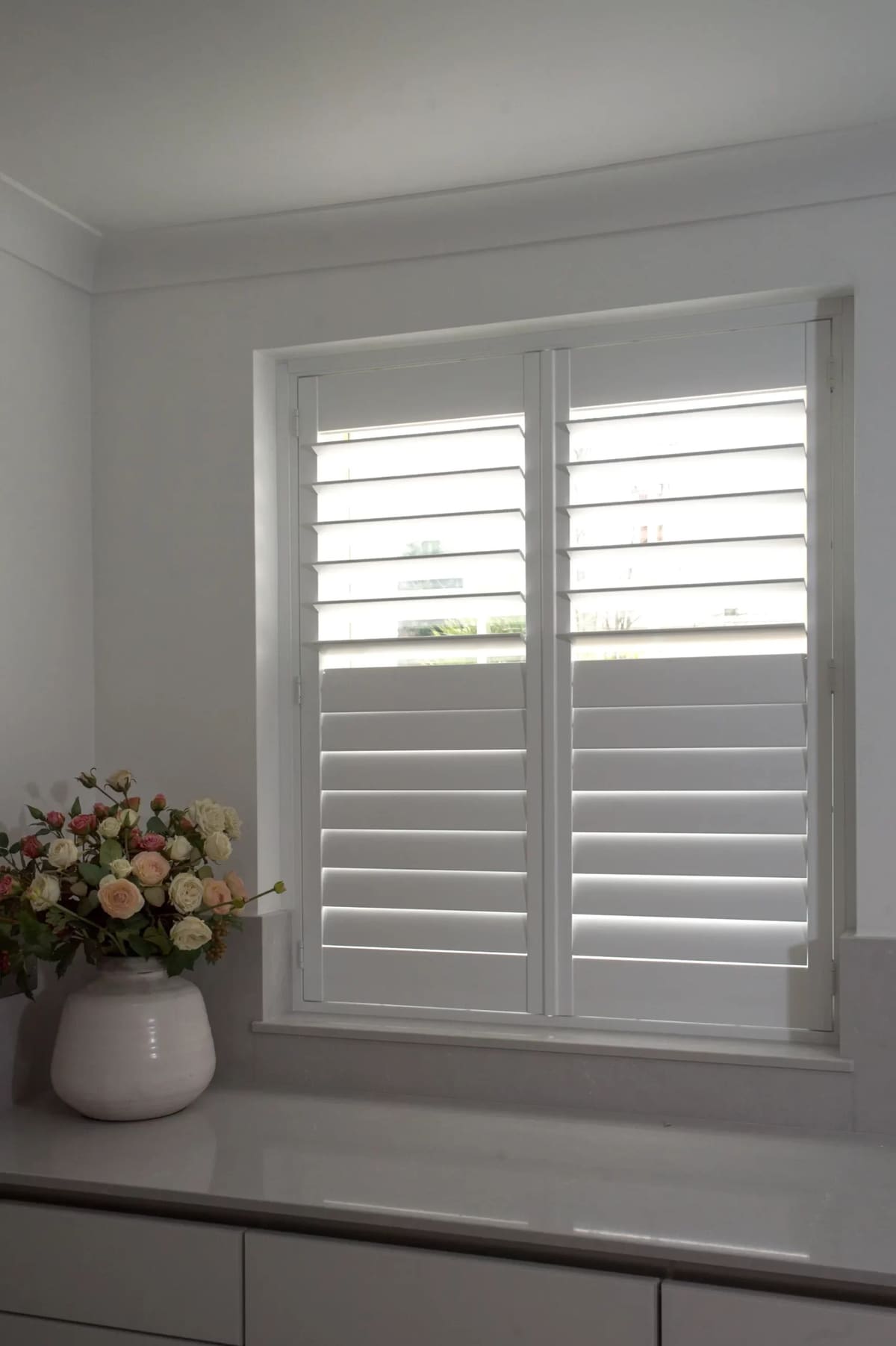
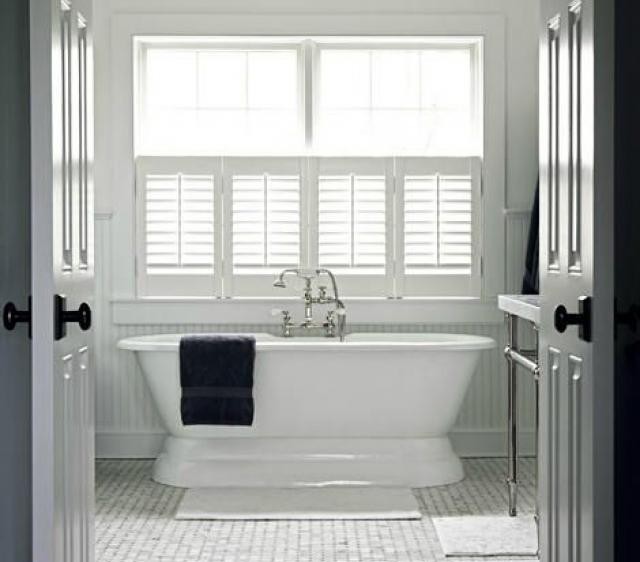
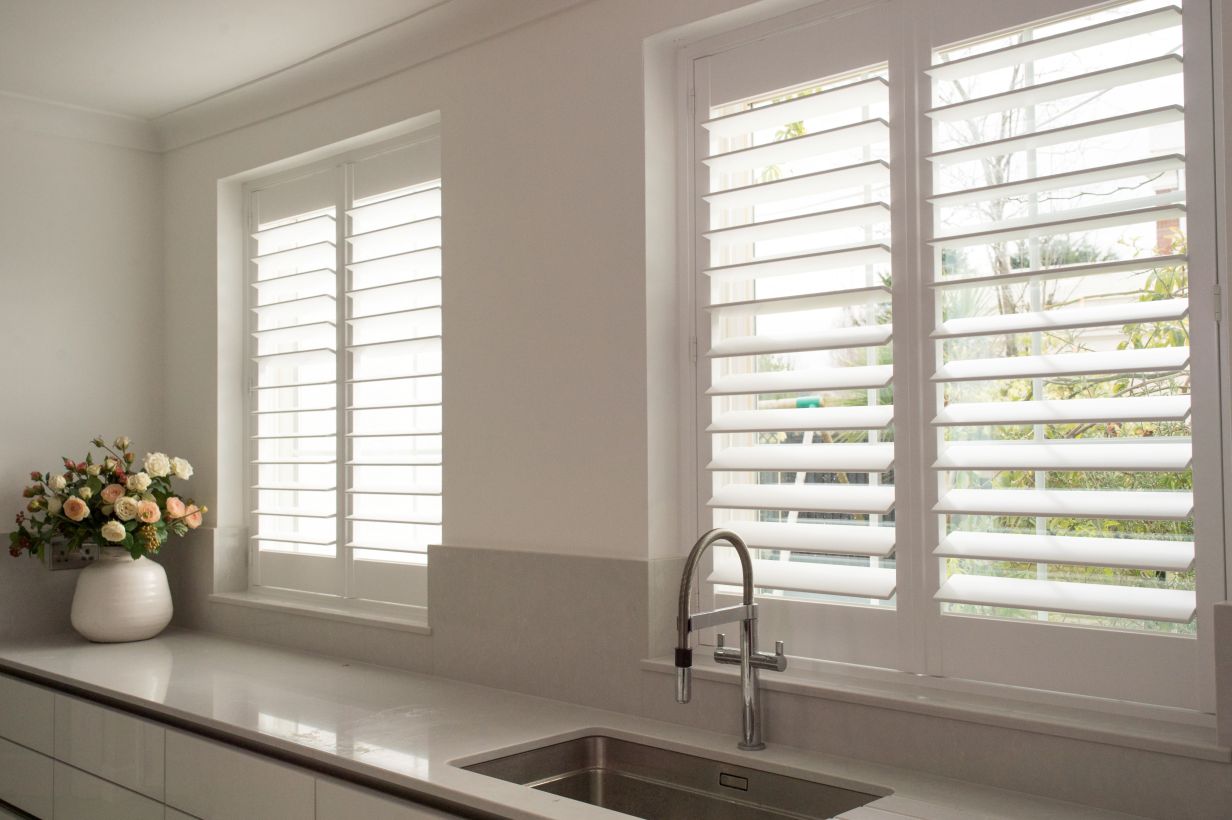
In kitchens, lower-panel shutters that cover only the bottom half of the window are a practical configuration: the lower portion provides working-height privacy at the sink, while the upper portion of the window remains unobstructed and allows natural ventilation and airflow during cooking. This reduces the area of cold glass in contact with cooking steam at the height where most moisture is generated, while avoiding the ventilation trap of a fully closed shutter panel. In bathrooms, a full-height shutter with composite or aluminium louvres provides complete privacy while the material choice ensures the shutter itself does not become a moisture damage problem over its lifetime. Our auto-blog post on moisture-proof shutter solutions for bathrooms covers the full specification in more detail.
Which shutter materials work best in damp-prone rooms
Wood shutters are the traditional choice for principal rooms in dry environments — hallways, sitting rooms, and bedrooms — but are not recommended for rooms with persistent moisture. Even with a factory-applied paint finish, timber absorbs moisture through the end grain over time; the effect accelerates in a bathroom or utility room where the humidity cycles daily between high and low. For rooms where condensation and moisture are a standing concern, a composite or aluminium specification is the correct starting point. Our guide to comparing wood, composite, and aluminium shutter materials covers durability, maintenance, and cost across all three material types in detail.
Fully waterproof aluminium shutters are the correct specification for wet rooms, shower rooms, and conservatories — which have the most demanding thermal and moisture conditions of any domestic space. The extruded aluminium frame and louvres will not corrode, warp, or absorb moisture under any humidity condition likely in a domestic bathroom or kitchen. Composite shutters occupy a practical middle ground: moisture-resistant and suitable for all but the wettest installations, they are the most common specification for standard bathrooms and kitchens where the fully waterproof properties of aluminium are not strictly required but wood would not be appropriate. In either material, the shutter remains in good condition indefinitely — a relevant consideration given the ten to twenty year lifespans typical of well-specified plantation shutters.
Addressing condensation beyond the shutter
Plantation shutters are an effective component of a condensation management approach, but they are not a substitute for addressing root causes. A property with inadequately insulated external walls, single glazing, and no background ventilation will experience condensation regardless of the window treatment. The effective hierarchy is: first, improve the thermal envelope — secondary glazing, draught-sealing, double-glazing upgrades where single-glazed units remain. Second, control moisture at source — functioning extractors in kitchens and bathrooms, avoiding indoor clothes drying where condensation is already a problem, maintaining consistent background heating rather than allowing rooms to cycle between cold and warm. Third, fit window treatments that reduce the thermal differential at the glass, of which plantation shutters — fitted with the correct material for the room — are among the most effective available.
Conservatories are a specific scenario where all three layers of this approach combine: poor thermal performance of the glazed roof and walls creates extreme temperature differentials, and moisture from plants, hot drinks, and adjacent rooms makes condensation on the glazing almost inevitable in winter. Shutters in conservatories address the thermal differential at the vertical glazing panels very effectively; the roof condensation requires separate treatment. For the insulation properties of the most thermally effective shutter type, our article on the insulation benefits of solid panel shutters covers the energy-efficiency and condensation angles in depth — a useful read for north-facing rooms and ground-floor extensions where thermal performance is the primary driver.
Survey, specification, and next steps
A free home survey is the most reliable way to match the shutter specification to your condensation situation. The surveyor assesses each window in context — the orientation, the glazing type, the room function, visible evidence of existing condensation, and the ventilation in place — and specifies the frame material, panel type, and louvre size that fits the combination. In rooms where condensation is an active concern, the survey identifies whether the problem is a material choice issue (wood shutter in a damp room), a ventilation shortfall that should be addressed before the shutters are fitted, or a combination of both. Book your free home survey with Shutters Factory and a surveyor will assess every window and provide a fixed supply-and-fit quotation with no obligation.
Before your appointment, browse our portfolio of completed shutter installations to see how composite and aluminium shutters look in kitchens, bathrooms, and other demanding environments across a range of UK home types. Whichever room you are considering, the combination of correct material specification, adequate ventilation, and a well-fitted frame will produce a shutter installation that manages condensation effectively while providing the light control, privacy, and lasting durability that make plantation shutters the most practical window treatment in UK homes.