Clapham's architectural mix: what you are working with
Clapham and Clapham Common cover a wider architectural range than the postcode suggests. The streets immediately adjacent to the Common — The Avenue, Nightingale Lane, Clapham Common West Side and South Side — are dominated by large Georgian and early Victorian detached and semi-detached properties with generous window openings, tall ceilings, and deep sash reveals typical of the 1820–1870 building period. Moving south and east towards Clapham Old Town, Abbeville Village (the residential triangle between Clapham South and Clapham Common stations), and Clapham Manor, the stock shifts to Victorian and Edwardian bay-fronted terraces — the most prevalent type in the neighbourhood. West of the Common towards the SW11 border with Battersea, the housing diversifies into 1930s and 1950s semi-detacheds, converted Victorian houses along Larkhall Rise and the backstreets off Clapham High Street, and a growing number of new-build blocks from the 2000s and 2010s.
The consequence for window treatment decisions is that there is no single Clapham specification. A bay-fronted Victorian terrace on Elspeth Road requires mitre-jointed frames built to the specific angle of that bay's projection; a lower-ground flat on Rectory Grove needs maximum privacy at pavement level without losing daylight; a tall first-floor reception room in a Georgian townhouse on The Avenue requires louvred panels proportionally suited to a window with a 300mm-deep masonry reveal and 2.8-metre ceilings. All of these require made-to-measure manufacture confirmed at a professional survey. For the wider context of what we install across South and Central London, our London plantation shutter service covers area coverage, lead times, and the full property-type range.
Bay windows in Victorian Clapham terraces
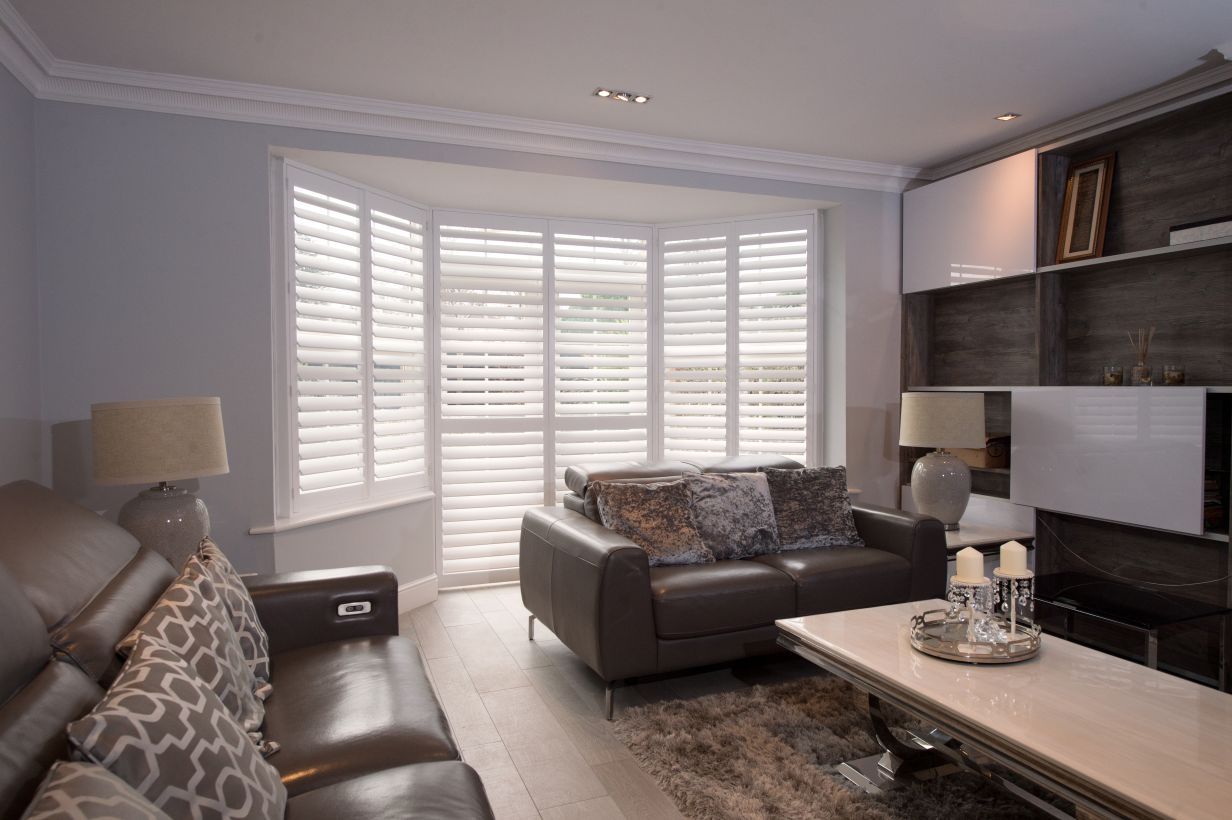
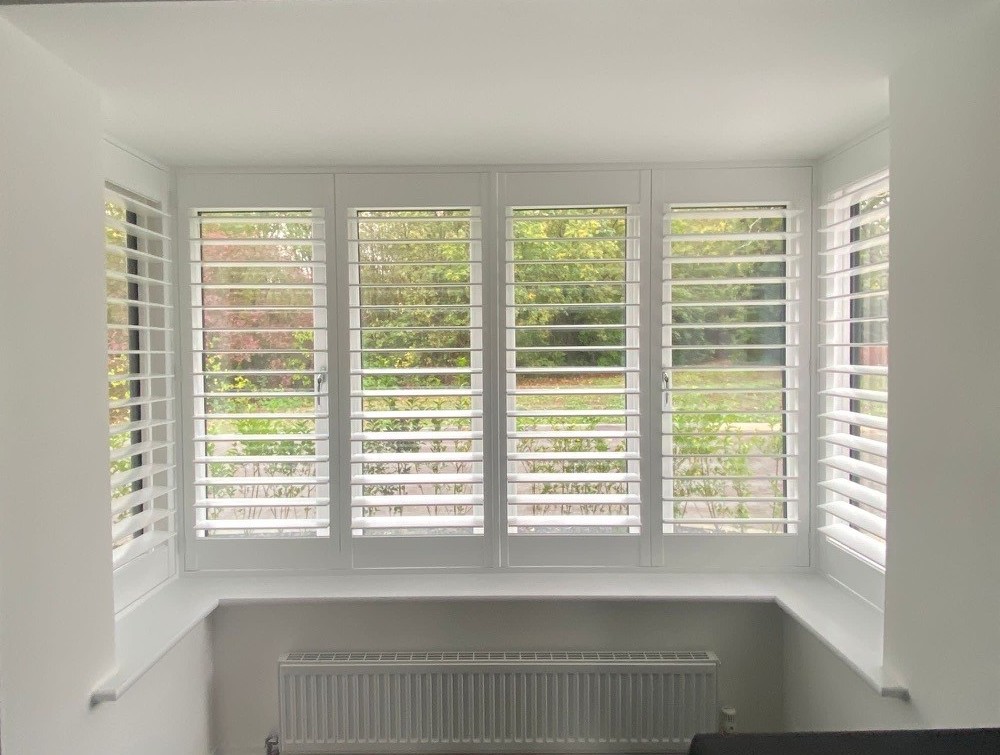
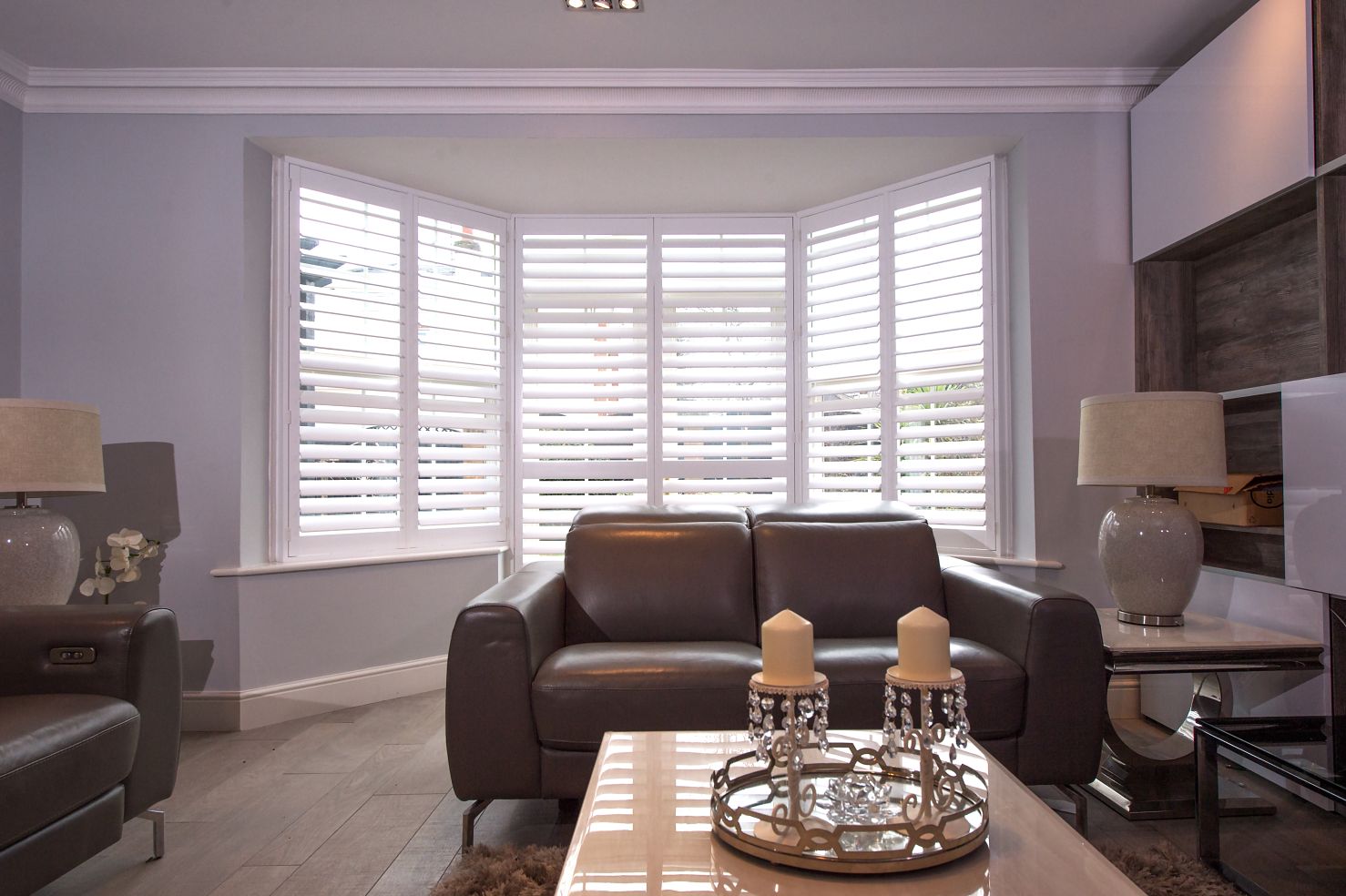
The most common window challenge in Clapham is the ground-floor bay. Victorian terraces built across the neighbourhood between roughly 1870 and 1910 carry a projecting three-section bay at ground level — a central face and two angled returns — set above a tiled or paved front path at close range to the street. The angle at each return corner varies from house to house, which matters significantly for the quality of the finished shutter installation. Bay shutters with mitred corner frames built to each individual bay's precise projection geometry produce a result that appears to have been built into the room's joinery; off-the-shelf rectangular panels placed across the face without corner joints leave visible gaps at the returns and lack the architectural integration that makes a period bay window look considered rather than improvised.
Shutters Factory's survey for a bay-window installation records each light's width and height separately, the overall projection depth, the floor-to-sill and floor-to-head dimensions, and the exact angle at each corner. These measurements go directly to our manufacturing facility, where frames are cut with mitred joints at the recorded angles. The louvres are matched in width across all three panels so the bay reads as a single continuous feature rather than three separate units. For a detailed reference on fitting considerations across different bay configurations — square-fronted, angled, and curved — our guide on bay window shutter styles and fitting tips covers the full range of variations found in London period properties.
Lower-ground and garden flats: privacy without sacrificing light
A substantial proportion of Clapham's Victorian terrace stock has been divided into flats, and the lower-ground or ground-floor conversion presents the most acute privacy challenge in the neighbourhood. These flats — on Abbeville Road, Clapham Manor Street, Clapham Park Road, and the residential streets between the Common and Clapham High Street — sit at or just below pavement level, with front-room windows directly overlooking the footpath and rear windows at eye-level with garden neighbours above. The occupant needs effective privacy on multiple facades throughout the day without reducing available daylight in rooms that already receive less direct sun than upper-floor equivalents.
Plantation shutters address this specific requirement because the louvres can be angled to block horizontal sightlines — the direction from which street-level overlooking comes — while admitting light from angles above and below. For lower-ground flats where the rear garden window also poses a privacy concern, split-level shutters with independently operated upper and lower panels allow the upper section to be angled for oblique sky light while the lower section stays closed. For maximum privacy on a front window directly overlooking a pavement, louvred panels that close the full window from sill to head in a closed-louvre position transmit diffused light without permitting a direct view from outside — a considerably more liveable arrangement than a roller blind or privacy film in the same position. Our separate article on shutters for Fulham Victorian terraces covers the same lower-ground privacy challenge in comparable converted SW6 properties.
Upper-floor sash windows: tier-on-tier versus full-height
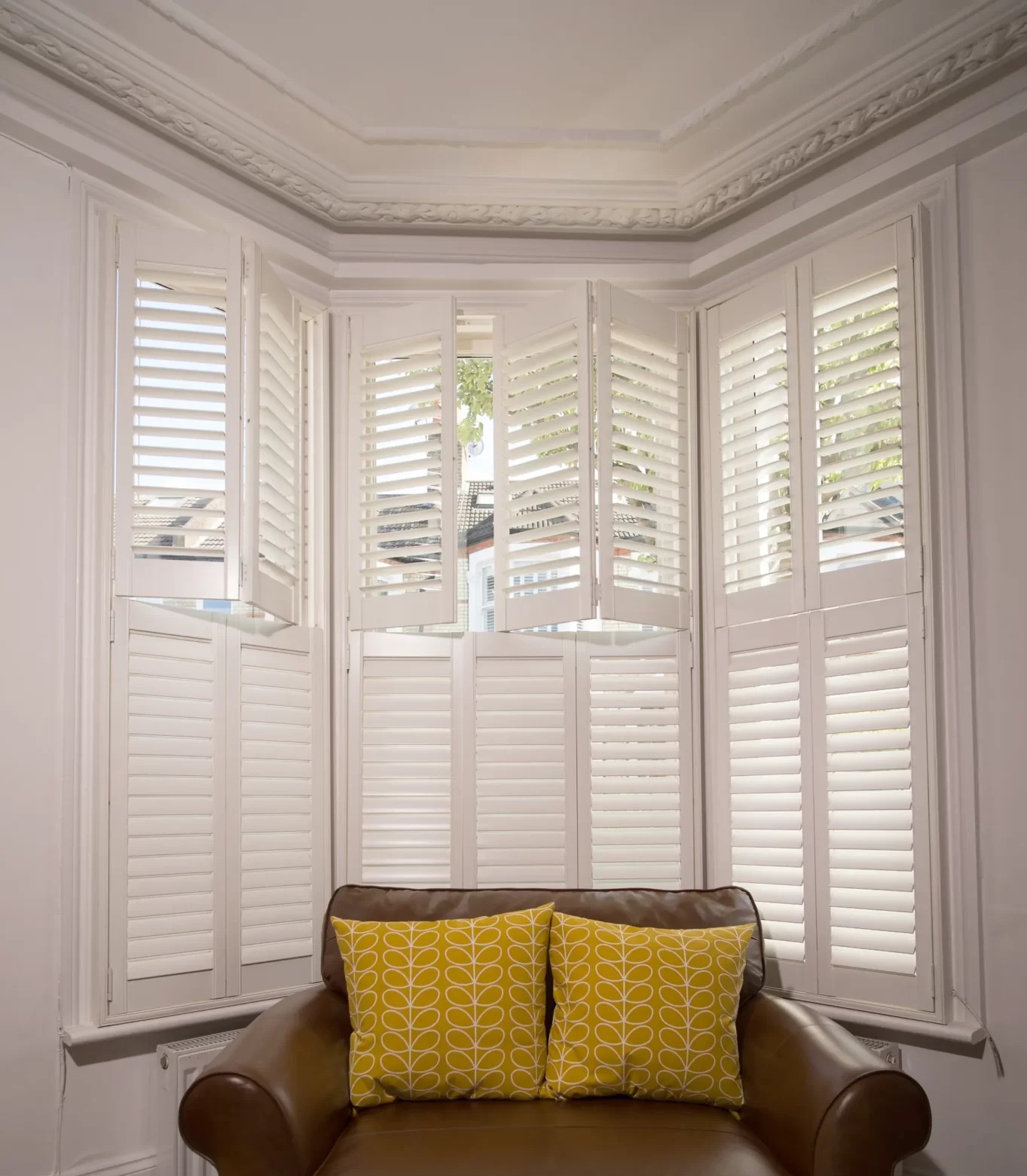
Above the ground-floor bay, Clapham Victorian and Edwardian terraces carry flat-faced double-hung sash windows — typically narrower than the bay below, set in flush brickwork with a simple boxed frame, and carrying the characteristic divided-light configuration of the period. The practical configuration question for these windows is almost always about balancing privacy against daylight in rooms that face the street at first or second-floor level.
Where the window directly faces the rooms of the property opposite — typical in the tightly packed streets off Clapham High Street and in the denser parts of Clapham North — shutters with independently operated upper and lower sections give the most flexible response to the privacy challenge. The lower panel is kept at or near closed during the day to block horizontal sightlines, while the upper section is opened or angled to admit sky light. This differs structurally from a blind: closed louvres still transmit diffused light rather than blocking the window entirely. For rear-facing sash windows and upper floors with less direct overlooking pressure, single-tier louvred panels that run the full height of the window opening are simpler to operate and marginally less expensive to fit. Our gallery of completed London installations shows how both configurations look in comparable period sash windows across a range of room contexts.
Choosing shutter material for Clapham properties
Most Clapham properties — Victorian and Edwardian terraces, Georgian townhouses, converted flats, and 1930s semi-detacheds — are centrally heated throughout the year and do not face the elevated humidity or salt-air conditions that would make aluminium the automatic material choice. For these properties, the choice of shutter material is primarily about durability, visual finish, and price rather than environmental resilience.
Mimeo composite shutters, built on a moisture-resistant polymer core, are the most commonly fitted material in Clapham conversions and Victorian terraces. Composite shutters do not absorb moisture from seasonal central-heating cycles, do not cup or swell in response to humidity changes, and hold a painted finish reliably over the installation life. The price range — approximately £380–£580 per window supply-and-fit — makes composite the practical choice for whole-flat or whole-house installation without the per-window cost becoming prohibitive. For the period properties around the Common perimeter with original joinery, plasterwork, and wood floors, hardwood shutters carry a visual warmth and material weight that composite does not replicate. The specification question is whether the installation should feel continuous with the building's original fabric or sit as a distinct modern addition; for traditionally decorated rooms, hardwood shutters in a period-appropriate paint colour are often the answer. Our guide on why full-height shutters remain the most popular style choice in UK period homes addresses the material and proportion considerations for period properties in more depth.
2026 prices and lead times for Clapham SW4
Supply-and-fit shutter prices in Clapham in 2026 run from approximately £380–£580 per window for composite and £550–£750 per window for hardwood, inclusive of the free home survey, made-to-measure manufacture, delivery, and installation. These are per-window figures for a standard Victorian sash or a single bay light; a three-light bay window spanning 1.8 to 2.4 metres costs more per unit than a single window of the same total width because the mitred corner frames, independent panel sizing, and additional fitting time all add to the price — the exact figure is confirmed at the home survey. Non-standard shapes — an arched head over a Clapham Common townhouse entrance, an obtuse-angled bay in an Edwardian semi-detached — are produced to the exact templated geometry and carry a premium over standard rectangular equivalents.
Lead times from confirmed order to fitting run four to six weeks for composite shutters and six to eight weeks for hardwood. These timelines are production-schedule estimates for made-to-measure manufacture, not off-the-shelf delivery estimates. The full process requires a single property visit: the fitting team arrives with the completed shutters and installs them in one appointment, typically half a day for a full-room scope and a full day for a whole-house order. To understand the full cost picture before your survey, our detailed breakdown of whether plantation shutters are worth the investment covers supply-and-fit pricing, longevity, and resale value in context.
Next steps: arranging a shutter survey in Clapham
To arrange a shutter survey for a Clapham or SW4 property, book a free home survey online. The survey takes approximately sixty to ninety minutes for a full-house scope or thirty minutes for a single room; our surveyor measures every window in scope, records reveal depths and any non-standard conditions, brings material and colour samples to view in the actual light of your home, and leaves a written quotation with no obligation to proceed.
Clapham, Clapham Common, and the surrounding postcodes — SW4, SW8 along the Stockwell border, SW12 along the Balham boundary — are fully within our standard South London service area. For a wider view of the area we cover and recent installations nearby, our London shutter installation and survey service includes the full coverage map and area guide. Before your survey appointment, browse completed shutter installations across similar London period properties to identify styles and configurations you want to discuss, and explore the full product range to understand the material options before samples arrive at your door.