What hardware is included in a plantation shutter installation
Every made-to-measure plantation shutter installation includes four main categories of hardware: hinges (which attach the panels to the hinge posts within the frame), tilt-rod fittings (the clips and top handle connecting the louvre rod to the panel stile), catches or magnetic closures (which hold panels in their open or closed position without rattling), and frame fixings (screws, anchor bolts, and seating shims that secure the outer frame to the reveal). All of these components are included in the standard installation price — there is no separate hardware line item for the standard specification.
The number of hinges per panel is calculated at the factory based on panel height and material weight. As a working guide: panels up to 1,200 mm tall carry two hinges; panels between 1,200 mm and 1,800 mm carry three; taller or heavier panels carry four or more. This calculation is part of the manufacturing specification and is confirmed at survey — the homeowner does not need to specify hinge count independently. Understanding how hinges sit within the wider frame system is covered in detail in the guide to L-frames and Z-frames, which explains how the hinge post is positioned relative to the reveal type and frame profile.
Hinge types: face-mounted, full-surface, and concealed
The most common hinge in UK plantation shutter installations is a face-mounted butt hinge: two rectangular leaves joined by a barrel, with one leaf fixed to the panel stile and the other to the frame's hinge post. Face-mounted hinges are visible on the finished installation — a deliberate feature, since the barrel and leaf present a clean hardware detail at the panel edge. On white shutters with white hardware, the hinge reads as a fine line accent; on shutters with a brushed nickel or antique brass finish, the hinge becomes a more prominent decorative element that contributes to the overall aesthetic of the room.
Full-surface hinges are a variant where both leaves lay flat on the surface of the panel stile and hinge post rather than being recessed into a mortise cut. They carry slightly more weight per hinge, making them the preferred specification for heavy hardwood panels or tall commissions where panel weight is significant. Our kiln-dried hardwood Endura range is typically specified with full-surface hinges on panels above 1,500 mm, both for load capacity and for the satisfying visual weight the heavier hardware adds to a premium installation.
Concealed hinges — cup hinges or pivot points recessed into the panel stile thickness — are available on selected ranges where a completely flat panel face is the priority. These suit contemporary interiors where the shutter is intended to read as cabinetry rather than a window treatment, and where surface-mounted hardware is considered a visual distraction. Concealed hinges add a few millimetres to the panel depth, which is worth flagging at survey on a shallow window reveal where depth tolerance is tight.
Tilt-rod hardware: hidden vs visible
The tilt rod is the vertical bar that links every louvre blade in a panel and moves them in unison when operated. Its hardware consists of a clip or staple fixing at each louvre tenon running the length of the rod, and a handle fitting at the top of the rod visible from the front of the panel. The two main options — visible tilt rod and hidden tilt rod — differ in how and where the rod is positioned relative to the panel face.
On a visible-tilt-rod panel, the rod runs down the centre of the panel face in front of the louvre blades and is operated by pushing it left or right. On a hidden-tilt-rod panel, the rod sits behind the blades and the top louvre acts as the actuator — pushing it tilts all blades simultaneously via an internal mechanism. The hidden arrangement gives a cleaner, more contemporary panel face; the visible rod is the traditional specification and is generally considered more intuitive for everyday use on taller panels. Both options are available across all materials and finishes, and the top handle fitting is colour-matched to the selected hardware finish.
The practical and aesthetic differences between the two systems — including which performs better in different room types and window heights — are covered in our guide to hidden vs visible tilt-rod shutters, which compares both options across a range of window configurations and interior styles.
Magnetic catches, panel latches, and security fittings
When a shutter panel is in the closed position, it must be held firmly without rattling — particularly on windows with an open casement creating airflow behind the shutter. Magnetic catches — small rare-earth magnets embedded in the meeting stile of the panel and the corresponding position on the adjacent panel stile or frame upright — are the standard solution for most UK plantation shutters. When the panel is pushed closed, the magnets snap together and hold the panel with no visible hardware on the face.
For installations where a more positive hold is required — a conservatory window exposed to significant wind pressure, a commercial frontage, or a porch opening where pressure differentials are high — a traditional bar latch or lever catch is specified instead. The latch fitting is visible on the panel face and must be selected in a finish consistent with the rest of the hardware. Magnetic catches are functionally invisible; a mechanical latch is a decorative hardware item and should be chosen with the same care as the hinges.
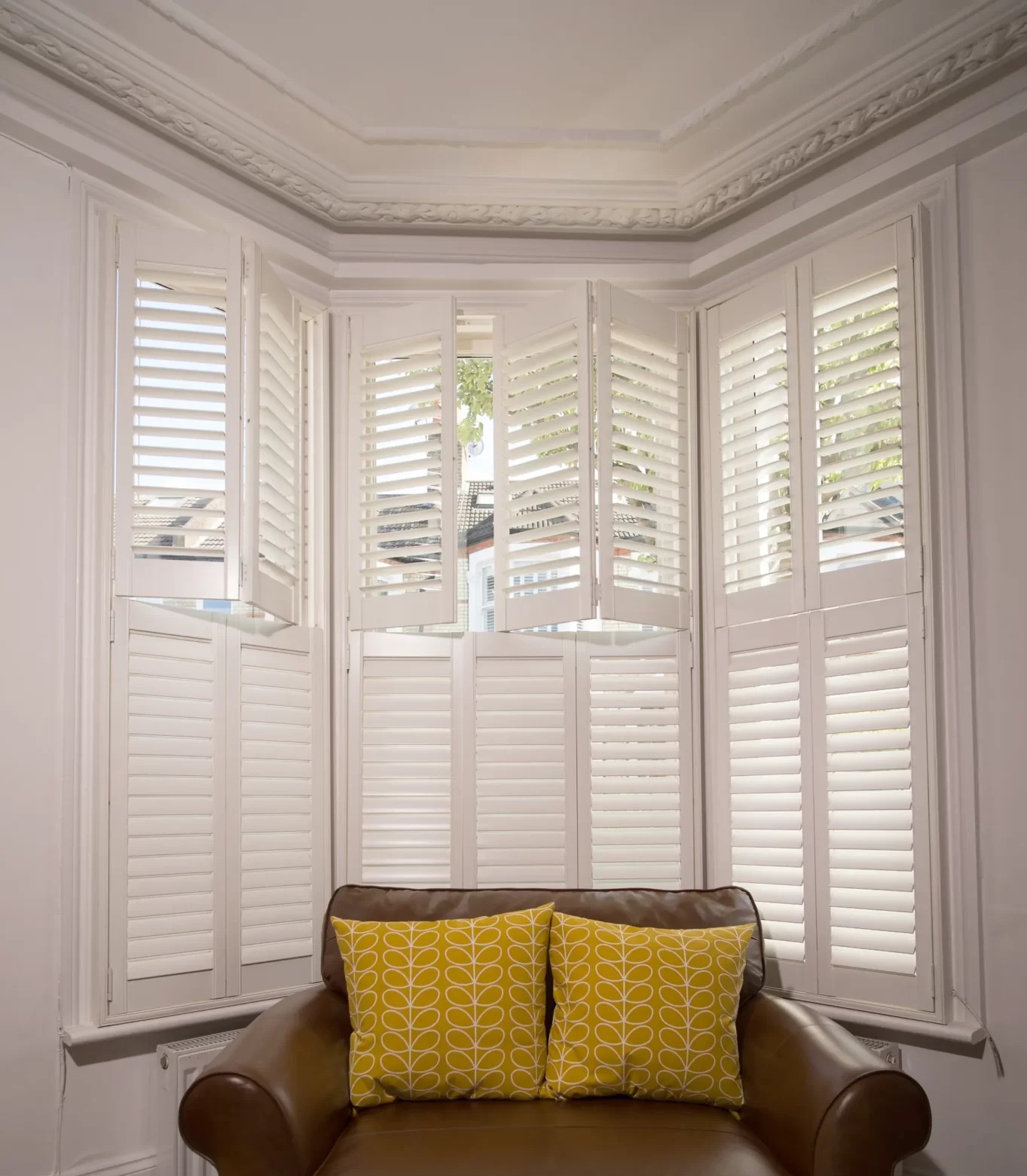
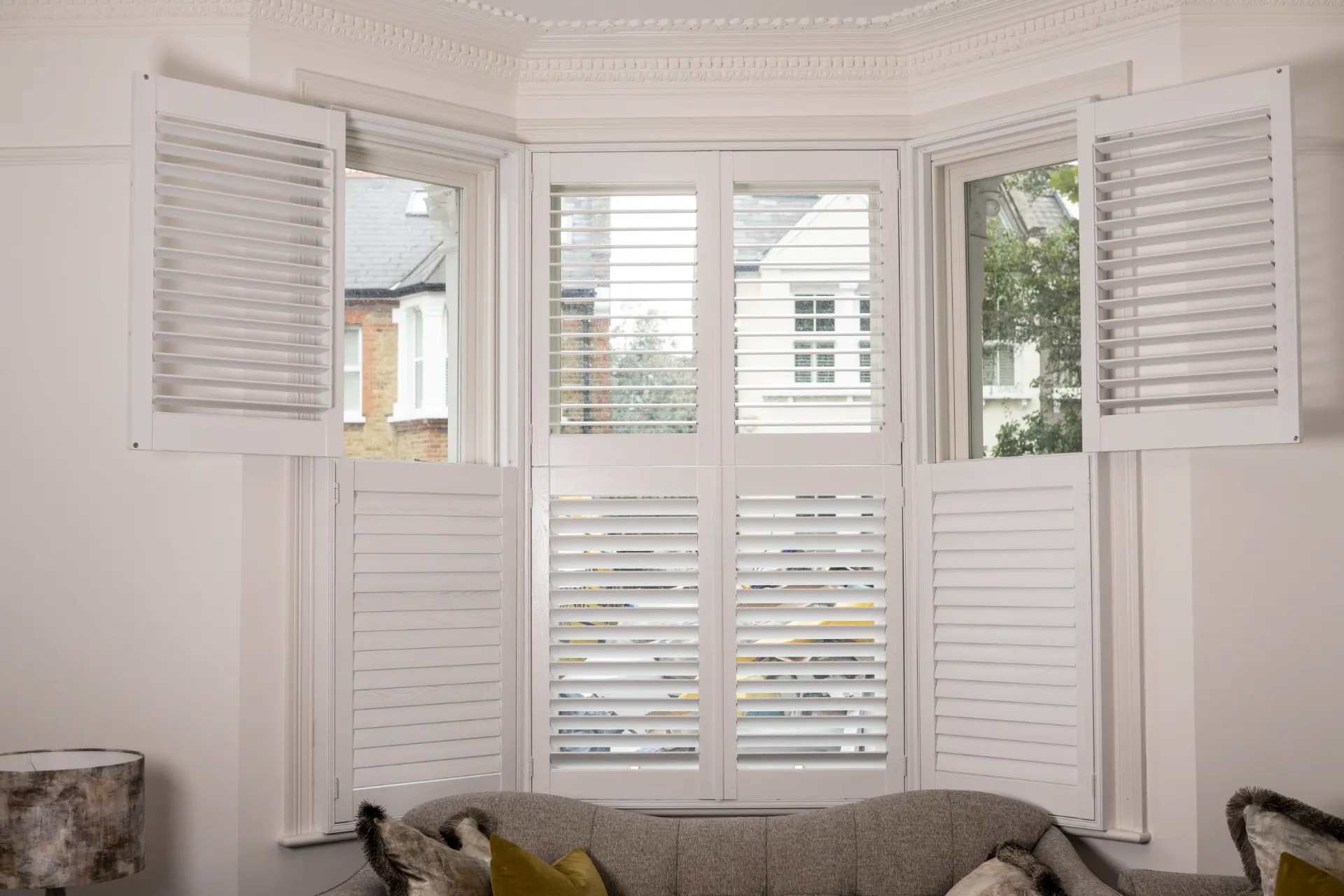
Tier-on-tier shutters, which have independently operated upper and lower panel sections, carry their own catch arrangement on each tier. The upper and lower sections are specified identically in most cases, though on windows where the upper tier is above comfortable arm reach, a catch with a longer pull handle may be appropriate to make daily adjustment easier.
Hardware finishes: white, brushed nickel, antique brass, and beyond
The standard hardware finish for white and off-white shutters is a matching white powder-coated or painted metal — hinges, tilt-rod fittings, and catches all matched to the frame and panel tone. This creates a seamless result: the hardware dissolves into the installation and the louvres and frame geometry become the visual subject. For the majority of UK homes, where shutters are specified in White, Chalk, Cotswold, or similar near-white tones, white hardware is the correct default and the right starting point for any specification.
Accent hardware finishes — brushed nickel, satin chrome, polished chrome, antique brass, satin gold — are available for installations where visible metalwork is a deliberate design choice. Brushed nickel is the most popular accent finish in contemporary UK interiors, reading as warm without the formality of polished brass; it suits grey, navy, and off-white shutters equally well. Antique brass is a natural companion to period hardwood shutters in Victorian or Georgian rooms, where the metal warmth echoes existing ironmongery. Polished chrome reads as cooler and suits industrial-style kitchens and wet-room installations. For guidance on coordinating hardware finish with shutter colour and room scheme, our shutter colour options guide explains how tone and finish interact across different material specifications.
For shutters specified in a custom RAL colour — charcoal, deep navy, forest green — the hardware is typically powder-coated in the same RAL so the installation reads as a single continuous surface rather than a colour-on-metal contrast. This colour-matching is carried out in the same production run as the panels at the Shutters Factory manufacturing facility, where hardware components pass through the same finishing process as the frame profiles, ensuring a consistent tone across every element of the installation.
Aluminium shutter hardware: a different specification
Aluminium shutters use a distinct hardware specification compared with timber and composite installations. The extruded frame system used for Dura aluminium shutters incorporates precision-machined pivot points rather than surface-mounted butt hinges, and the louvre blades are actuated by a concealed tilt mechanism within the panel frame rather than an external rod. This gives aluminium shutters a completely clean face — no visible rod, no surface-mounted hinges, no catch magnets interrupting the panel.
Hardware finish on aluminium shutters follows the powder-coat colour of the extrusion: a white aluminium installation has white hardware throughout; a dark grey or black installation is finished uniformly in the same colour, including all pivot points and closure mechanisms. The advantage is a fully colour-integrated system with no separate hardware selection required — the finish is integral to the extrusion process and applied in one production step. The difference in hardware philosophy between aluminium and timber installations, and why factory control over the finishing process matters for long-term quality, is explored in our article on why the manufacturing process matters for hardware quality.
How hardware is confirmed at survey and what to expect
Hardware choices are confirmed during the free home survey, when the surveyor has physical samples of hinges, catches, and tilt-rod fittings in every available finish. This is the most practical way to assess how a brushed nickel hinge reads against your chosen shutter colour and in your room's natural light — online swatches and product photographs are rarely sufficient for a decision that remains fixed for the life of the installation.
Once the survey specification is confirmed and the order placed, hardware is prepared alongside the panels at the factory. Because the finish is integral to the manufactured component — not applied on site at fitting — it cannot be changed after manufacture without remaking the relevant parts. This makes the survey the right moment to try the samples: the surveyor will hold hardware examples against your existing joinery, your wall colour, and any ironmongery nearby to help you choose. Spending a few minutes on this during the survey is always worthwhile.
To see how different hardware finishes read in real completed rooms, browse the completed project gallery for examples across white, brushed nickel, and antique brass specifications in a range of shutter styles and room types. When you are ready to begin the process, arrange a free home survey at a time that suits you — note any hardware preference in the appointment request so the surveyor arrives with the right samples.