Why louvre size matters more than most buyers expect
Plantation shutters are made up of a frame, panels, and louvres — the horizontal slats that rotate to control light. Of these three components, louvre width is the specification most first-time buyers overlook, yet it has the greatest impact on how the finished shutters look in a room and how useful they are in daily life.
The reason louvre width matters aesthetically is proportion. A louvre width well-matched to the window's dimensions creates a balanced, architectural appearance; one that is too narrow makes the shutter look fussy and cluttered; one that is too wide looks disproportionate on a small opening. The same window with different louvre sizes does not simply look different — it reads as a fundamentally different kind of window treatment. Functionally, a wider louvre presents more surface area to incoming light and intercepts more light per degree of rotation, giving slightly more light control at a given tilt angle. This also means a wider louvre moves between open and closed in fewer degrees of rotation, which makes fine-tuning the angle less precise. For rooms where gradual light adjustment matters — home offices, living rooms used at different times of day — the 64mm louvre hits the practical sweet spot between the two extremes.
The 47mm louvre: traditional character for smaller windows
The 47mm louvre is the narrowest option in most made-to-measure shutter ranges and is the closest in character to the original plantation shutters found in period homes. It is the right specification for smaller windows — typically those below 600mm wide — where a wider louvre would create panels with only two or three slats, looking sparse and unbalanced. With more slats at 47mm width, the panel has an intricate horizontal rhythm that reads as intentional rather than simply small.
Victorian and Edwardian sash windows — particularly the narrower lights common in upstairs bedrooms — suit the 47mm louvre well. The finer lines complement the delicate glazing bars typical of period glazing and tend to look more in keeping with the building's architectural character. Our guide to shutters for Victorian homes explores how louvre size and panel configuration interact with period architecture in detail.
There is also a practical advantage: the 47mm louvre creates a shallower panel stack when the shutters are folded open, because narrower slats require less reveal depth. If your reveal depth is between 63mm and 80mm — common in older properties with shallower window recesses — the 47mm specification is worth discussing with the surveyor at the home visit.
The 64mm louvre: the versatile standard for most UK homes
The 64mm louvre is the most commonly specified option in the UK residential market, and for good reason: it works well across the widest range of window sizes, balances traditional and contemporary aesthetics without committing firmly to either, and gives the most precise control over light direction of the three standard sizes.
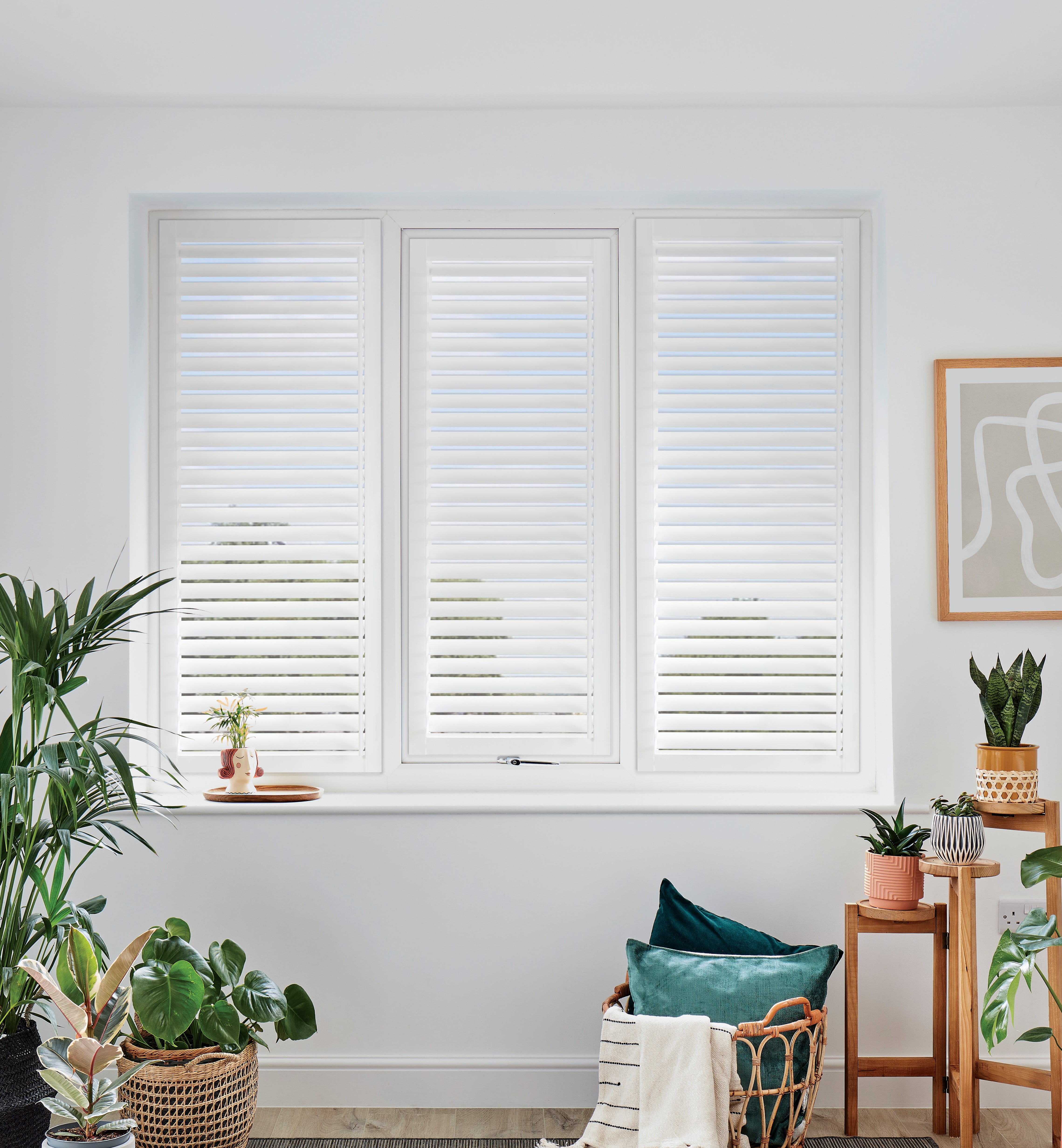
For windows between roughly 600mm and 1,200mm wide — which covers the majority of standard domestic windows in UK homes, from Victorian terraced-house sashes to modern casements — the 64mm louvre creates panels with a proportionate number of slats. The rhythm is neither too dense nor too sparse, and the individual slats are wide enough to be clearly visible as a design element without dominating the window.
The 64mm louvre is available across the full product range, including Mimeo composite shutters, Endura hardwood shutters, and Dura aluminium shutters, making it the safest specification to quote when asking for an initial estimate. In home offices and living rooms — where louvre angle is adjusted frequently to manage glare and privacy — 64mm gives enough angular travel to move gradually from upward tilt (directing light toward the ceiling) to downward tilt (blocking a low evening sun). Our guide to plantation shutters for home offices covers louvre angle and light management in practice.
The 89mm louvre: contemporary scale for large openings
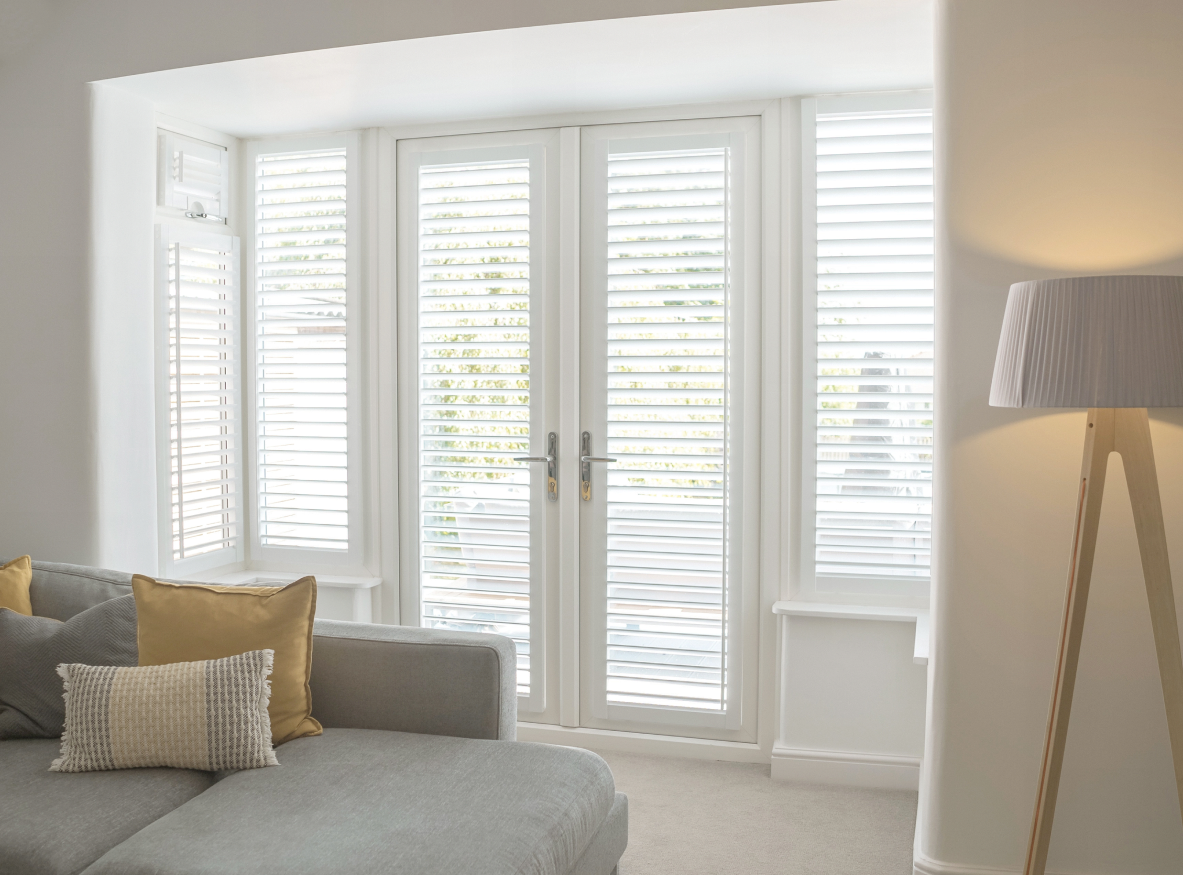
The 89mm louvre is the widest standard option and creates a distinctly contemporary appearance. Each slat is almost as wide as a hand's span, which means the number of slats per panel is lower and each individual louvre becomes a visible design statement rather than part of a recurring pattern. The aesthetic is clean, bold, and well suited to large modern windows, bi-fold door openings, and open-plan spaces where the shutters form a major visual element of the room.
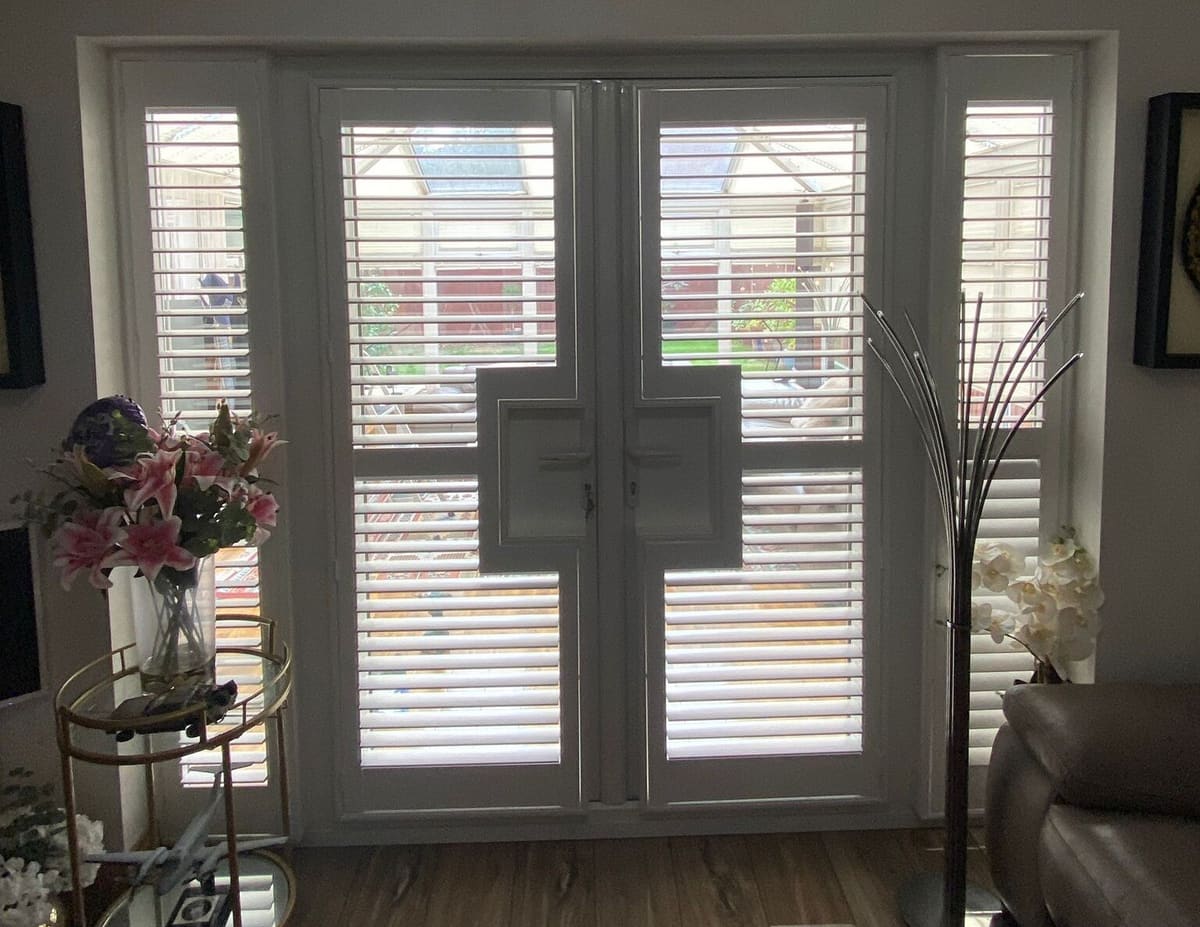
Tracked shutters across bi-fold or sliding door openings are a natural application for the 89mm louvre — the scale of the opening calls for a louvre width that maintains proportion across a wide panel, and the bolder appearance reads well where shutters serve as room dividers as much as window dressings. Bay window shutters in modern extensions and contemporary homes can also use the 89mm specification effectively, particularly in corner bays where the window area is large and the room benefits from an expansive, hotel-like aesthetic. In period properties, the 89mm louvre is generally less appropriate — the scale reads as anachronistic against fine Victorian glazing bars and smaller window openings.
One practical note: the 89mm louvre creates a deeper panel stack when folded open, because the larger slats require more reveal depth to accommodate. Ensure your reveal depth is at least 90mm before specifying the 89mm option; the surveyor will confirm this at the home visit.
How louvre size affects light control, privacy, and view-through
All three louvre sizes provide complete privacy when the louvres are fully closed — no light passes through and no sightline exists from outside. The meaningful differences emerge when the louvres are partially open.
With louvres at 45° tilt, the 47mm louvre leaves the smallest gap between adjacent slats; the 64mm a moderate gap; and the 89mm the largest gap. This means the 89mm specification allows slightly more ambient light through at a given tilt angle, but also creates a slightly wider sightline from outside at that same angle. For ground-floor windows facing the street — where privacy is a primary concern — the 47mm or 64mm specifications are preferable. For first-floor windows or rooms where privacy pressure is lower, the 89mm louvre is entirely suitable.
View-through from inside to outside follows the same geometry. With 89mm louvres at 45° tilt, the view out is notably broader than with 47mm louvres at the same angle — an advantage in rooms with a strong garden or riverside outlook. Our guide to the best shutter options for privacy explores in detail how louvre size, fitting style, and tilt angle combine to manage sightlines in different room and street situations.
Matching louvre size to window type and room
Small sash windows and narrow casements (under 600mm wide) suit the 47mm louvre best — the proportions are better and the traditional character complements period windows. Standard domestic windows between 600mm and 1,200mm wide are best served by the 64mm louvre, which is the industry default and almost always the right choice without a specific reason to deviate. Large modern windows, bi-fold openings, and patio doors over 1,200mm wide benefit from the 89mm louvre, which maintains proportion across a larger panel and suits the contemporary character of those openings.
In bedrooms and ground-floor privacy windows, 47mm or 64mm gives the most precise fine-tuning of light and privacy. Tier-on-tier shutters — which allow the upper and lower halves to be set independently — fitted with 64mm louvres are a particularly effective configuration for bedroom sash windows, where you want the lower panel closed for privacy at street level while the upper panel admits daylight. For living rooms, the 64mm louvre on full-height shutters is the most common and practical choice for daytime light management. Our article on why full-height shutters are the most popular style explains how the panel and louvre specification work together across different room situations. In home offices, 64mm at upward tilt is the standard working position.
Prices, products, and getting the specification right
Louvre size does not add a significant premium to most shutter ranges — the difference in price between 47mm and 64mm on the same product is typically modest or nil. The 89mm louvre occasionally attracts a small uplift on certain composite ranges, though this varies by supplier and product line. What matters most for accurate pricing is the total window area, the product selected, and the panel configuration.
For an indicative guide: Mimeo composite shutters start from around £380 per m² supply and fit; Endura hardwood shutters from around £550 per m²; and Dura aluminium shutters are priced individually based on span and panel count. Lead times are 4–6 weeks for composite and 6–8 weeks for hardwood and aluminium. Our dedicated UK shutter pricing guide covers the full cost breakdown across all product categories and configurations.
The best way to confirm the right louvre size for your windows is to view physical samples in your own space — the same width looks different under your light conditions and against your wall colour than it does in a photograph. Browse finished examples across different window types and rooms in the shutters gallery, and when you are ready to see physical samples and confirm your specification, book a free home survey. The surveyor will bring samples of all three louvre sizes so you can compare them directly at your windows before committing.