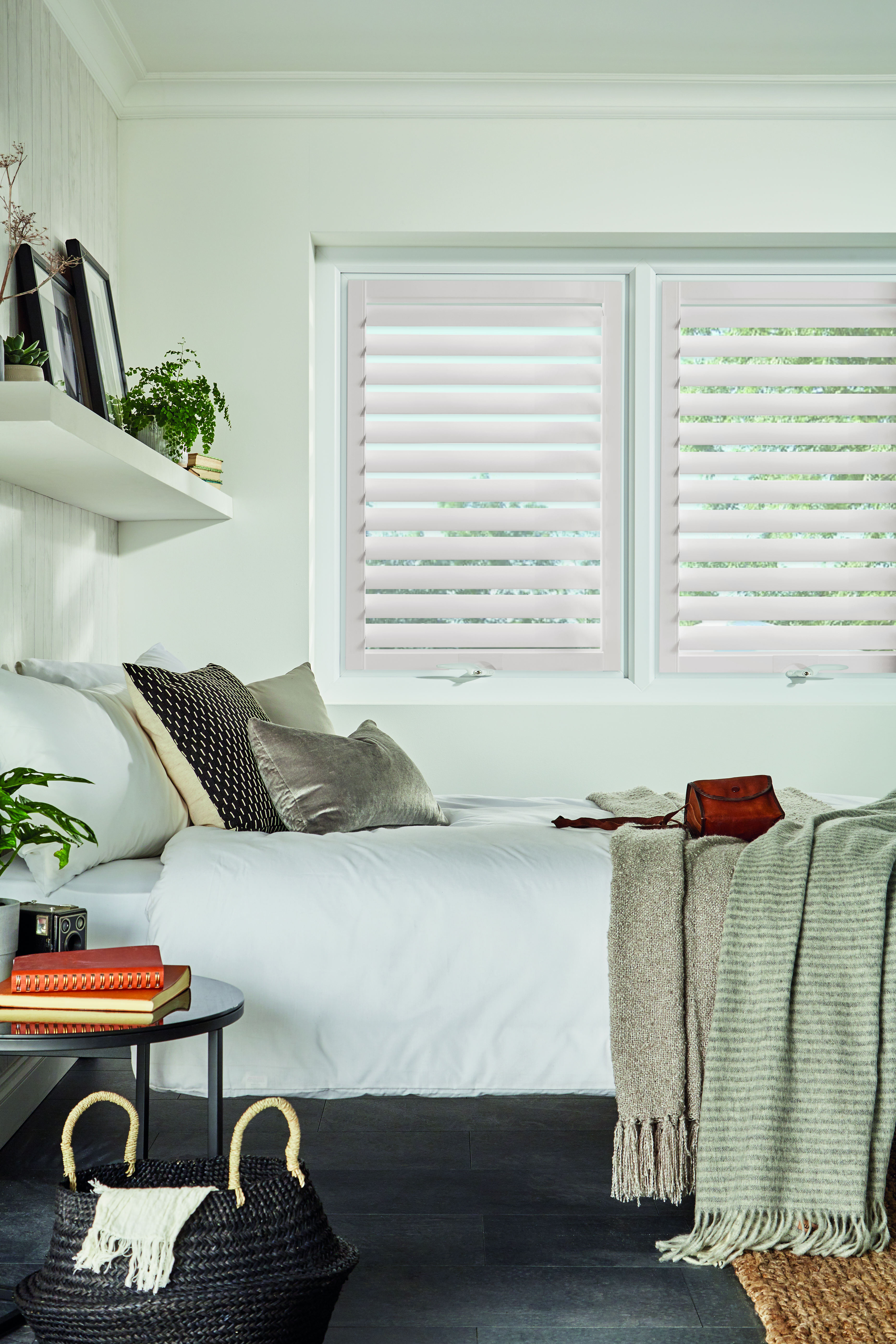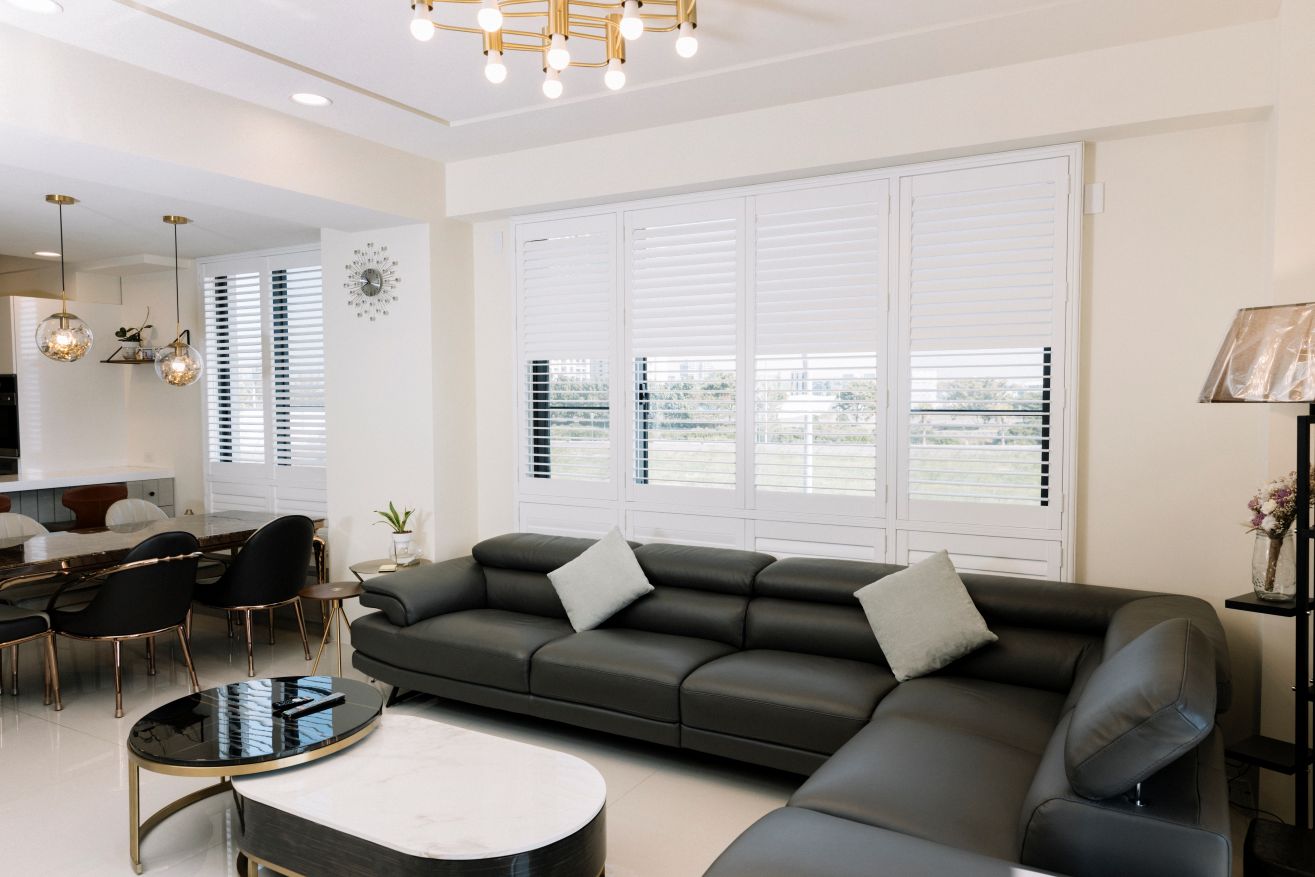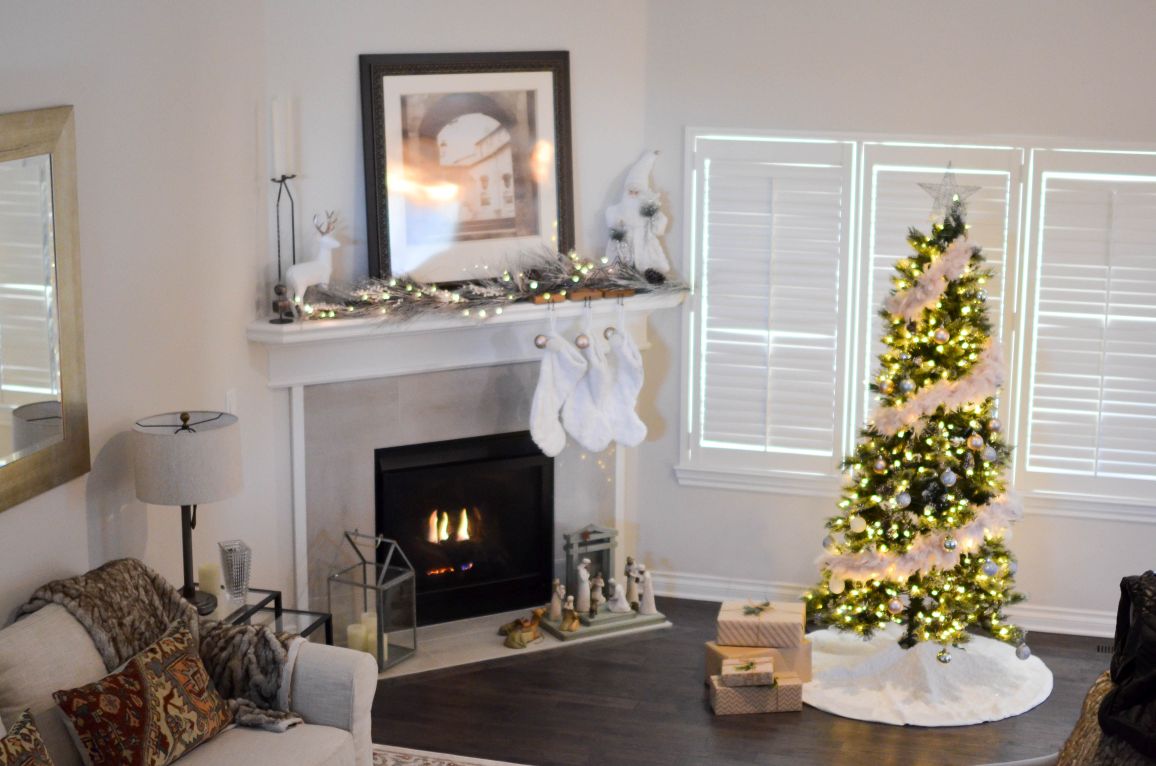
Why combining shutters and curtains makes sense
The logic behind the combination is that the two elements serve genuinely different functions rather than simply doubling up on the same job. A plantation shutter fitted inside the window reveal handles precision light control — the louvre blades tilt to any angle from fully open to tightly closed, directing light toward the ceiling in a bright south-facing room while keeping the lower sash private from the street. Curtains bring a different set of qualities: softness, acoustic absorption, draught reduction, and the visual weight that fabric delivers at a window. In a high-ceilinged Victorian drawing room or a period bedroom, a fabric element is almost always desirable on aesthetic grounds alone, and a shutter alone cannot provide it.
There is also historical precedent for this approach in UK homes. Victorian and Edwardian properties originally had both internal wooden shutters and heavy curtains or drapes at the same window — the shutters folding into the reveal during the day, the curtains drawn at night for warmth and privacy. Contemporary versions of this arrangement tend to be considerably lighter in touch: a linen or cotton curtain over full-height louvred panels fitted across the whole window rather than velvet and chenille, but the underlying logic is unchanged. For a detailed breakdown of where shutters outperform curtains as a standalone choice — and vice versa — the room-by-room comparison of shutters and curtains covers the functional trade-offs in full before you decide to combine them.
The geometry: where each element sits
Getting the spatial relationship right is the single most important practical decision in this combination. A plantation shutter is fitted inside the window reveal on a frame that sits either flush with the wall face or slightly proud of it, depending on the frame profile and the reveal depth. The curtain must sit entirely outside this frame — a curtain that drapes across the shutter face when open serves no purpose and blocks access to the louvre blades. The standard recommendation is to mount the curtain pole 10–15 cm above the top of the window architrave, with the pole extending 30–45 cm beyond the frame width on each side. This means the curtains stack on the wall beside the window when open, leaving both the shutter and the glazing fully visible.
The projection of the shutter frame from the wall face determines how close the curtain fabric hangs to the louvre surface. A shallow-reveal window where the frame sits close to the outer wall face has very little depth between the fabric and the louvre edge, which can cause the curtain to catch on the tilt rod or a louvre blade when drawn. A heading style that holds the fabric away from the frame — a pinch-pleat or goblet heading rather than an eyelet — provides enough stand-off to prevent snagging. For a clear explanation of how L-frame and Z-frame profiles relate to the wall face and reveal depth, which determines this projection dimension, the shutter frames explained guide is worth reading before confirming a pole position.
Which shutter styles suit the layered look
Full-height shutters are the most versatile pairing for curtains because the panel configuration is continuous from sill to head, giving a clean visual backdrop when the curtains are drawn back. The louvred surface behind a drawn-back linen curtain reads as a considered architectural detail. For the combination to look intentional, the shutter frame should be tightly fitted to the reveal with no visible gap between the frame edge and the reveal wall — even a 5 mm gap will read as unfinished once a curtain draws attention to the window zone.
Café-style shutters that cover only the lower half of the window create a particularly interesting effect with floor-length curtains. The curtain hangs across both the glazed upper sash and the café-shuttered lower section, and when drawn back, the two-tier result — full glass above, louvred panel below — frames the window in a way that is distinctive in a bay or large sash opening. Tier-on-tier shutters divided at a mid-rail work equally well: the upper section can be angled open for ventilation while the lower remains closed for privacy, and floor-length curtains drawn back on each side complete the composition without competing with either tier. For very large sliding or bi-fold openings where tracked shutters are specified, the curtain pole must be positioned to clear the track housing — always confirm this with the fitter at the survey stage.
Fabric and colour choices that complement shutters
The combination that appears most frequently in UK living rooms and bedrooms is white or off-white plantation shutters paired with a warm-toned linen curtain in a natural or oatmeal shade. The contrast between the crisp lacquered surface of the shutter and the textural softness of a linen weave is what makes this pairing visually successful — the two materials are clearly different in character, which avoids the flattened appearance that results when matching identical whites. If both the shutter and the curtain are the same tone of brilliant white, the combination tends to read as over-coordinated rather than designed.
The principal risk in the off-white territory is undertone clash. Shutter finishes typically have either a warm (yellow or cream) or cool (pink or blue) undertone. A curtain fabric with a strongly opposing undertone placed beside a painted shutter surface will make both elements look wrong — the shutter will appear yellow next to a cool-white fabric, or pink next to a warm yellow-white curtain. The safest approach is to bring a fabric swatch to the survey and compare it directly against the shutter sample boards. The white and off-white plantation shutters colour guide covers the principal finish families and how their undertones read in different aspects — useful reference before choosing a curtain fabric.
Warmth, draught control and near-blackout performance
One of the under-appreciated advantages of the shutter-and-curtain combination is its thermal performance. A plantation shutter provides an insulating layer at the window — particularly effective in a recess-fitted installation where the panel closes tightly within the frame — but fabric adds a different kind of barrier. An interlined curtain drawn over a louvred shutter creates a double insulating layer at the window plane that is noticeably effective at reducing draughts in older properties with single glazing or period sash windows. In a cold north-facing room exposed to a draughty sash, this two-layer approach is one of the most cost-effective thermal upgrades available without altering the window itself.
For bedrooms where near-total darkness is the priority, combining a solid panel shutter with no louvre gaps with a blackout-lined curtain is the most effective available option short of external shutters. The solid panel eliminates the primary light path, and the blackout curtain deals with the residual light at the frame edge and the gap between the curtain heading and the ceiling. This is the combination used in nurseries, shift-worker bedrooms, and home cinemas where absolute darkness during daylight hours is the requirement. For a broader look at how shutters and soft furnishings combine in living room settings, the living room shutter design ideas guide covers a range of layering approaches across different window types.
The living room: making the combination work at scale
The living room is the most popular setting for layering shutters with curtains, and the bay window is where the pairing appears most often. A bay with shutters on each facet — angled panels on the returns, full-width panels on the centre light — and a continuous curved curtain track or pole running across the full bay opening produces a result that is both functional and architecturally complete. The curtains pool at the floor on each side of the bay when open, framing the shuttered window behind, and draw together across the full bay width for privacy and warmth in the evening. For the specific considerations of bay window shutter fitting — how angled returns are framed and the choice between inline and angled panel configurations — how shutters work across different living room window configurations covers the bay window case in detail.
Outside the bay, a standard rectangular sash or casement uses the same principle at a simpler scale: shutters inside the reveal, a pole above the window with curtain panels stacking either side. The visual key is ensuring the curtain stack is entirely clear of the glazing when open — a stack that covers even 10 cm of glass makes the window feel smaller and the room dimmer. Wide poles, generous fabric allowance per panel (at least 1.5× the stack width in fullness), and a pole extension of at least 35 cm each side are the three measurements that determine whether the combination reads as spacious or cramped. For inspiration across a range of finished rooms — bay windows, standard sashes, and larger format living spaces — our customer installation photo portfolio shows how the shutter-and-curtain combination reads at different scales and in different property types.
Getting the order of installation right
Shutters should always be fitted first. The shutter survey determines the exact frame position and projection from the wall — only once the frame is installed can the curtain pole position be confirmed with precision. The fitter will be able to tell you the exact projection of the frame face from the wall, which determines how far forward the pole bracket must sit to keep the fabric clear. Ordering curtains or poles before the shutter frame is in place risks choosing a bracket depth that is too shallow, meaning the fabric catches on the frame every time it is drawn. For a comparison of how this applies across timber, composite, and aluminium shutter materials — all of which can be combined with curtains on the same pole arrangement — the full shutters and curtains comparison guide sets out the material-specific considerations alongside the styling ones.
Book a free home survey to start the process — the surveyor measures the window, confirms the frame profile and projection, and discusses the pole clearance dimension so that when you visit a curtain supplier you have the exact specification to share. To review the full shutter range across all materials and finishes before the appointment, browsing the full product range helps you arrive with a clear sense of which material and finish best suits the room you are planning.