What makes Graino different: the natural grain finish
Graino paulownia shutters are manufactured from the same timber species as the Strato painted range — paulownia (Paulownia tomentosa), the lightest commercial hardwood used in shutter manufacture — but the finishing process takes an entirely different approach. Where Strato applies an opaque factory paint to produce a smooth, coloured surface, Graino uses a penetrating stain and protective lacquer that enhance the natural grain of each paulownia plank while sealing the surface against dust, UV, and everyday handling. The result is a shutter that shows the longitudinal fibre lines, subtle variation between growth rings, and tactile character that are the hallmarks of real, unmasked timber.
The distinction between the two products is one of finish philosophy rather than structural specification. Both use the same kiln-dried paulownia panels, the same precision-milled louvres, and the same hinge and tilt-rod hardware. The stain treatment is applied to the finished, assembled louvre and rail surfaces before panel assembly, ensuring consistent colour depth across every component. Paulownia's characteristically fine, even grain structure accepts a penetrating stain without the blotching or uneven absorption that affects more open-grained hardwoods — which is part of why the species translates so well to a grain-visible shutter finish. For an overview of paulownia's material properties and why the industry adopted it ahead of traditional timber species, see our guide to lightweight wood shutters and why paulownia wins.
Graino is available with a hidden tilt rod as standard — the clean, contemporary option in which the tilt mechanism is concealed at the back of the panel — or with a traditional central tilt rod for period authenticity. Both operate the louvres identically. The stain finish has no effect on the structural performance of the panel or the smooth operation of the tilt mechanism over years of daily use.
Graino versus Strato and the rest of the range
The range covers four principal shutter materials: Mimeo composite, Strato paulownia, Graino paulownia, and Endura painted hardwood. Understanding where each sits makes the specification decision straightforward.
Composite (Mimeo) is the waterproof, dimensionally stable option for kitchens, bathrooms, and any environment with sustained humidity or condensation. It is not real wood and cannot be stained or refinished, but it is the unambiguous correct specification wherever moisture is the primary concern. Within the natural wood range, the key distinction is between painted and grain-visible finishes. Strato and Graino are both paulownia — the material properties are identical in terms of weight, structural performance, and dimensional stability. Strato delivers a smooth, opaque painted finish in white, off-white, or any colour from the factory range. Graino delivers a stained surface that reveals the timber's natural character. For a detailed treatment of the Strato product and where a painted finish is the right choice, see our Strato paulownia shutters guide.
Endura painted hardwood sits at the premium tier — denser hardwood species with a heavier material weight and a deeper factory paint system. For period properties where the shutters will be examined as precision joinery and the solidity and feel of denser hardwood is valued for its own sake, Endura justifies the additional cost. For interiors where a grain-visible finish is the priority, Graino provides authentic natural timber character at a more accessible price point than premium hardwood.
Where natural grain shutters suit UK homes best
Graino is not the default residential shutter — it is the right choice for specific interior contexts where painted white wood would work against the room's design intent rather than with it. The following are the settings where Graino consistently produces the strongest result.
- Scandinavian and Nordic-influenced interiors — pale ash and natural stain options complement light oak flooring, linen textiles, and the clean, material-honest aesthetic of Nordic design. Full-height Graino shutters in a pale ash finish sit within this palette without the visual interruption that a bright white painted shutter would introduce.
- Farmhouse, cottage, and rural interiors — the visible grain and warm natural tones of Graino make it a natural fit for cottage-style homes, converted barns, and rural properties where the material language is built around organic, unfinished surfaces rather than smooth modern finishes.
- Mid-century modern interiors — mid-century design prioritises authentic material expression. Walnut-stained Graino shutters in 63 mm or 89 mm louvre widths align with mid-century furniture — teak sideboards, walnut dining tables, leather upholstery — in a way that painted shutters simply cannot replicate.
- Rooms with exposed timber features — where original floorboards, exposed beams, hardwood staircases, or substantial timber joinery set the material character of a space, Graino in a matching or complementary stain brings the window treatment into the same material world. Painted shutters in the same room can read as incongruous.
- Tier-on-tier configurations on sash windows — the stacked panel arrangement emphasises the horizontal louvre rhythm of the shutter. A natural grain finish adds texture and depth that reinforces the traditional proportions of a sash window rather than smoothing them into a neutral backdrop.
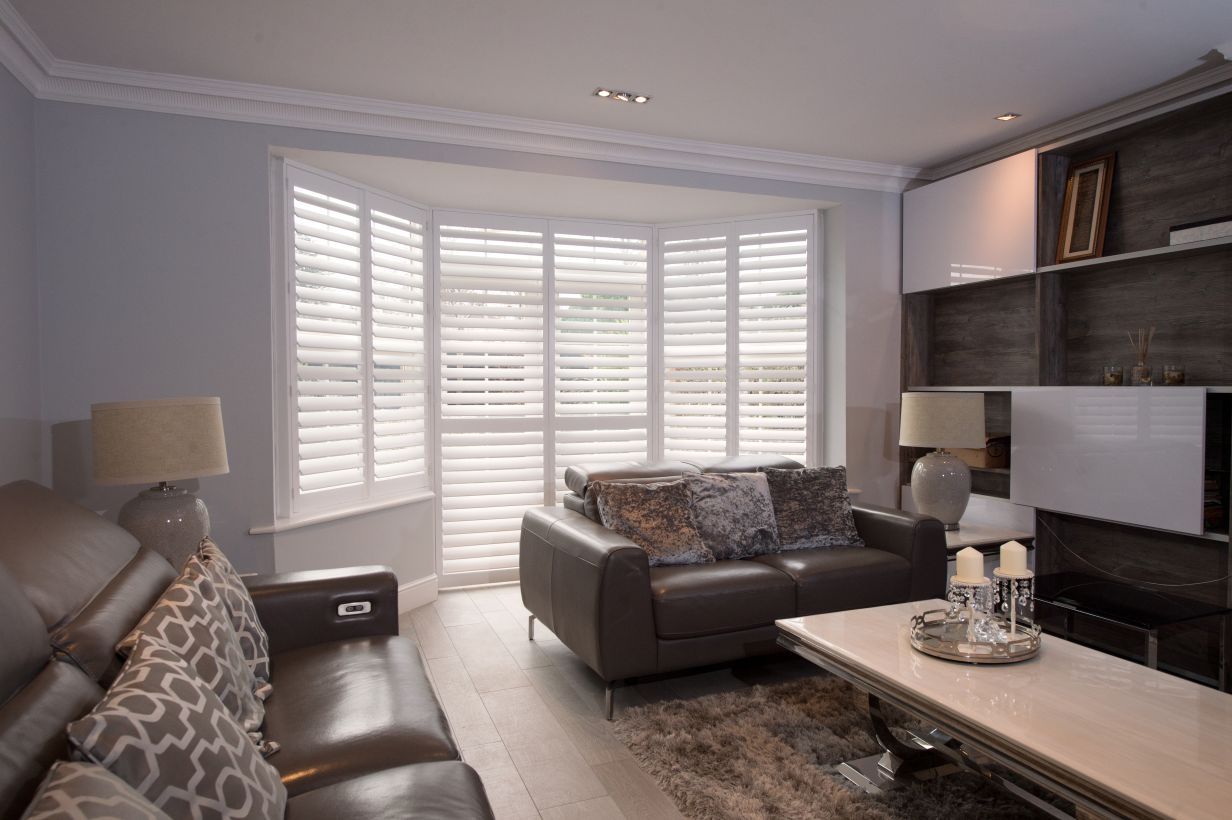
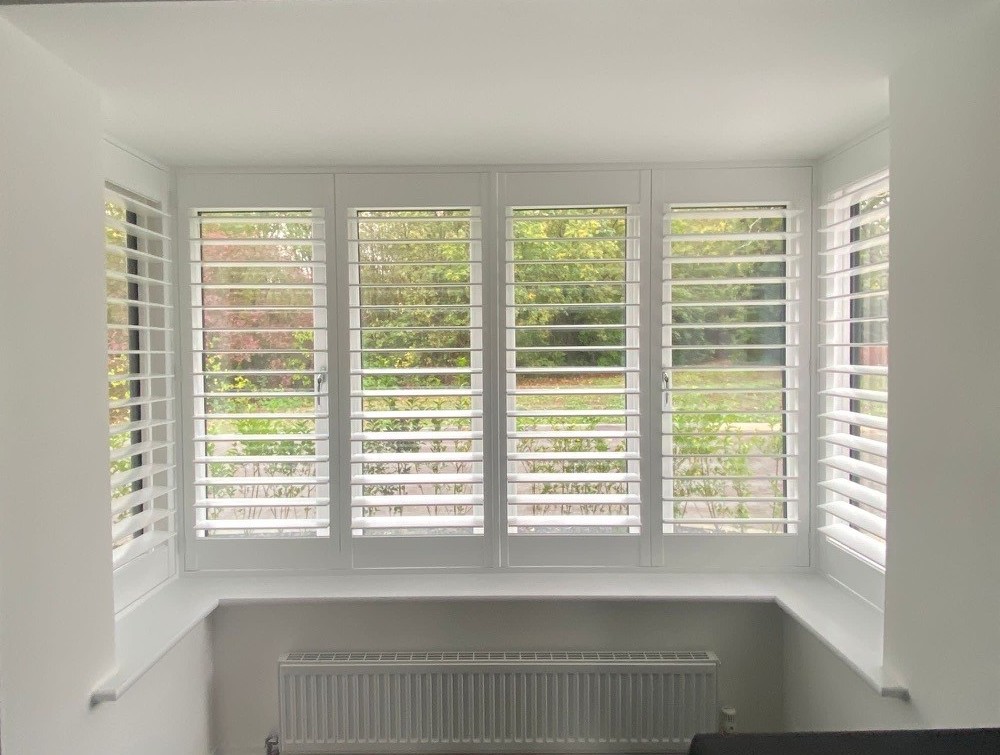
- Bay window shutters — a bay in Graino becomes a positive design statement in the room. Where the bay configuration is a focal architectural feature — as it is in most Victorian and Edwardian reception rooms — the warmth and character of a grain-visible finish amplifies rather than minimises its presence.
Stain colours and louvre options
Graino is available in a range of stain colours covering the principal natural timber tones: pale ash at the lighter end — a near-white, creamy tone that reads almost as light grey in some lighting conditions — through mid-range oak and honey tones, to deeper walnut shades in the warm brown part of the timber palette. All stains are factory-applied before panel assembly, ensuring consistent colour depth and adhesion across every louvre, rail, and frame component.
The range is supplied in three louvre widths: 47 mm, 63 mm, and 89 mm. The 47 mm louvre produces the tightest, most classical-looking panel — suited to smaller windows and period properties where a fine-pitched, densely louvred silhouette matches the historical proportions of the building. The 63 mm louvre is the most versatile specification, working well across the widest variety of window sizes and interior styles; it is the most commonly chosen width across both Graino and Strato installations. The 89 mm louvre creates an open, contemporary feel with fewer visible slats per panel — the right choice for larger, wider windows where an expansive view through the open louvres is the priority.
Because Graino uses a stain rather than an opaque paint, the confirmed colour should be approved on a physical sample rather than from a screen image. The interaction between the stain pigment and the individual grain pattern of each paulownia batch can produce subtle variation that digital representation does not reliably capture. Sample boards are available at the survey stage. For a broader look at how colour and finish choices work across the full shutter range, see our guide to shutter colour options.
Thermal and acoustic performance
Graino shutters are manufactured from the same paulownia material as Strato, and the thermal and acoustic performance of a closed panel is equivalent to any other paulownia shutter of the same geometry. A closed Graino panel creates a still-air layer between the louvres and the glazing surface, reducing conductive heat loss and providing a buffer against cold-air convection at the window. In draughty period properties with original single glazing or early double glazing, this thermal contribution reduces the cold sensation at window walls and lowers heating demand across the colder months. For a detailed treatment of the insulating mechanism and the realistic thermal gains achievable with shutters, see our guide to shutters for insulation and thermal benefits.
The acoustic contribution of a closed Graino panel is also meaningful for properties in noisy urban or suburban locations. The timber panel and enclosed air layer absorb and reflect sound energy, attenuating external noise across the mid-frequency range that accounts for most road traffic, aircraft, and urban ambient sound. Paulownia's fine, dense cellular structure handles this absorption effectively; the stain treatment does not alter the acoustic properties of the material.
Paulownia's dimensional stability — its resistance to warping, cupping, and twisting across seasonal humidity cycles — is unchanged by the stain finish. Graino panels maintain their flat, true surface year-round in normally conditioned living rooms, bedrooms, and hallways. As with all natural timber shutters, Graino is not recommended for bathrooms or kitchens with sustained high humidity or steam. For those environments, Mimeo composite shutters are the correct specification.
Realistic 2026 pricing for Graino paulownia shutters
Graino sits at a comparable price point to Strato, with a modest premium reflecting the additional finishing stages involved in the staining and lacquering process. All figures below are supply-and-fit, covering survey, manufacture, grain-stain finish, hardware, delivery, and installation by trained fitters.
- Graino paulownia, standard window, full-height hinged: from £500 per m² supply and fit
- Typical single sash window (approx. 0.9 m × 1.4 m): from £630–£800 total supply and fit
- Bay window configuration, three panels (approx. 2.8 m × 1.4 m total): from £1,960–£2,700 total supply and fit
- Full-height shutters, floor-to-ceiling (approx. 1.0 m × 2.2 m): from £1,100–£1,460 total supply and fit
- Tier-on-tier configuration, standard sash window: from £750–£980 total supply and fit
- Strato painted paulownia for comparison: from £480 per m² supply and fit; Endura painted hardwood from £550 per m² supply and fit
- Lead time: 5–7 weeks from confirmed order to installation
Survey, lead time, and what to expect
The survey process for Graino follows the standard procedure: a surveyor visits the property, measures every window to be fitted, checks reveal depth and squareness, photographs the windows, and confirms the louvre size and stain colour specification. The stain colour is the most important specification decision for Graino, and it should be confirmed against a physical sample board at the survey rather than from a screen or printed image. The surveyor brings sample boards and can advise on which tone works best alongside the room's flooring, joinery, and soft furnishings.
After the survey, a written fixed quote is provided within 48 hours. Graino shutters are manufactured to the confirmed dimensions and stained to the specified colour before panel assembly. Lead time from confirmed order to delivery and installation is typically 5–7 weeks. Installation is carried out by trained fitters who fix the frames into or onto the reveal, hang the panels, set the louvre tension, and leave the shutters operating correctly. For a full house installation — a three-bedroom period home with bay window, multiple bedrooms, and a hallway — the fitting typically takes one day. For a broader overview of what the full made-to-measure process involves, see our guide to wooden plantation shutters.
To arrange a free survey and receive a detailed all-in quote, book a free home survey — pricing confirmed within 48 hours with no obligation to proceed. Browse the full range of shutter materials and styles at Shutters Factory products, or view installed examples across different room types and interior styles in the shutters gallery.